Samsung Galaxy Glasses 2026: Specs, Price, Release Date & Nigerian Impact
The Samsung Galaxy Glasses are coming, and the tech world is watching closely. Samsung’s first dedicated smart eyewear device, internally codenamed Jinju and expected to launch in July 2026, represents a significant shift in how the South Korean giant is diversifying beyond smartphones. For Nigerian tech enthusiasts and early adopters, this announcement matters because it signals how premium wearable technology is evolving globally—and what that may eventually cost Nigerian consumers when these devices finally arrive locally. According to reports from Seoul Economic Daily, Samsung plans to unveil the Galaxy Glasses at Galaxy Unpacked on July 22, 2026, in London, alongside a slate of foldable devices and smartwatches. This represents one of Samsung’s most ambitious hardware events in years, stacking five major product announcements on a single stage. But what exactly is Samsung building, who is it partnering with, and why should Nigerians care about smart glasses emerging from a company more famous for flagship phones? This article explores everything we know so far about the Samsung Galaxy Glasses—and what their arrival means for Nigeria’s tech landscape.
Background
Smart eyewear has been the promised frontier of consumer technology for over a decade, yet no major manufacturer has successfully brought a mainstream version to market at scale. Google Glass failed to achieve consumer acceptance in the early 2010s, Meta’s Ray-Ban collaborations have remained niche products, and Apple’s spatial computing strategy remains tied to the Vision Pro headset—a device costing $3,500 that few Nigerians can afford. The category has struggled because of design concerns, battery life limitations, and the absence of a genuinely compelling use case that justifies the premium price and social awkwardness of wearing electronics on your face. Samsung, however, is betting that the right combination of fashion credibility and technological sophistication can finally crack the code. By partnering with Gentle Monster—a South Korean luxury eyewear brand with a global footprint and high-fashion cachet—and Warby Parker, the American direct-to-consumer eyewear company that has democratised prescription glasses, Samsung is signalling that the Galaxy Glasses will not be purely tech gadgets but fashion-forward accessories. This approach recognises a critical gap in the smart eyewear market: consumers want devices that look like glasses, not futuristic ski goggles. For Nigeria, where smartphone penetration has exceeded 50% according to recent NBS data, the emergence of this new product category represents the next frontier in digital consumption—one that may eventually reach middle-class Nigerian consumers through grey-market imports and regional carriers over the next two to three years.
Key Details
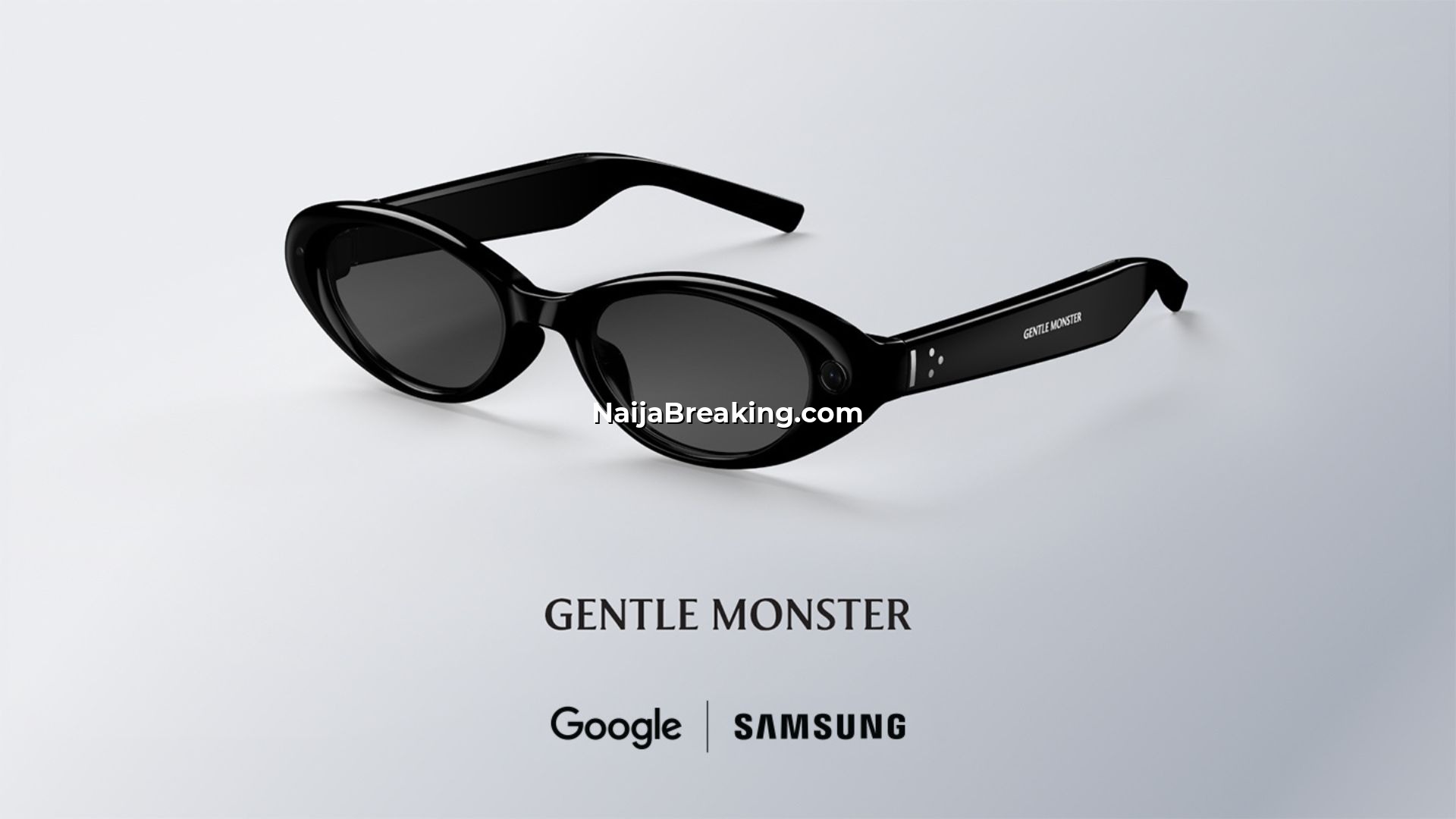
Samsung’s Galaxy Glasses are scheduled to be unveiled at Galaxy Unpacked 2026 on July 22 in London, according to reports from Seoul Economic Daily, which has a strong track record of accurately predicting Samsung announcements. Samsung has not officially confirmed this date, but the company typically sends invitations two to three weeks before the event, meaning official confirmation should arrive in early July 2026. The same event will introduce the Galaxy Z Fold 8, Galaxy Z Flip 8, Galaxy Z Fold 8 Wide, and Galaxy Watch 9 series—making it one of Samsung’s largest hardware announcements of the year. The glasses will be developed in collaboration with Gentle Monster and Warby Parker, two eyewear manufacturers chosen specifically for their design expertise and distribution networks. Inside Samsung, the project is codenamed Jinju, while Samsung and Google’s joint materials currently refer to it as “Intelligent Eyewear,” reflecting Google’s involvement in the software stack.
Regarding availability, Samsung’s official newsroom has indicated that initial collections will launch in the fall of 2026 in select markets—but this likely means a teaser unveiling at Unpacked followed by a proper retail launch several months later. Samsung employed this two-step strategy with the Galaxy XR headset and Galaxy Ring, both of which were announced before becoming commercially available. As of now, Samsung has not announced pricing or availability timelines for the United Kingdom, European Union, or African markets, meaning any pound or euro conversions currently circulating online are merely mathematical translations of rumoured US pricing, not confirmed regional prices. The absence of formal pricing announcements suggests Samsung is still determining demand elasticity and production capacity constraints. Given Samsung’s typical pricing strategy for premium wearables, expect the Galaxy Glasses to command a significant premium—likely between $300 and $500 USD at launch—making them accessible primarily to affluent early adopters and tech enthusiasts rather than mainstream consumers.
Impact and Analysis
The Samsung Galaxy Glasses announcement reveals several important trends in consumer electronics that have direct implications for Nigeria’s tech market. First, the partnership with Warby Parker—a company built on transparency and accessibility—signals that Samsung is attempting to position smart eyewear as an everyday product rather than a niche gadget. Warby Parker’s direct-to-consumer model and focus on affordable fashion eyewear contrasts sharply with the luxury positioning of Gentle Monster, suggesting Samsung is hedging its bets across market segments. This bifurcated approach could eventually lead to tiered versions of the Galaxy Glasses—a premium Gentle Monster edition and a more accessible Warby Parker variant—much like how Samsung’s smartphone lineup spans flagship and budget segments. For Nigeria, this matters because it suggests that smart eyewear may eventually trickle down to middle-market consumers within five to seven years, rather than remaining forever exclusive.
Second, the timing of this announcement—with Galaxy Unpacked scheduled for London in mid-2026—indicates that Samsung is prioritising Western markets for the initial rollout. Africa and South Asia, despite their large populations and growing tech adoption, typically receive Samsung’s newer wearables and accessories 12 to 18 months after launch in developed markets. Based on historical patterns, Nigerian consumers may not see Galaxy Glasses in local retail channels until late 2027 or early 2028. However, Nigeria’s grey-market import ecosystem—the sprawling network of tech dealers in Lagos’s Computer Village, Abuja’s Wuse Zone 4, and other tech hubs—will almost certainly begin bringing in international units within months of the product’s US and European launch. This informal distribution channel, while unregulated, has historically driven technology adoption in Nigeria faster than official channels. Third, the positioning of Galaxy Glasses as “Intelligent Eyewear” rather than an AR device suggests Samsung is avoiding the hype and disappointment cycle that has plagued augmented reality wearables. If the product succeeds, it could validate the smart eyewear category and accelerate adoption globally—including eventually in Nigeria.
Expert Perspectives
“Samsung’s choice to partner with Warby Parker and Gentle Monster is strategically brilliant because it solves the fashion problem that has killed every previous smart eyewear attempt,” says Dr. Chioma Eze, a technology adoption researcher at the Lagos Business School. “In Nigeria, where status symbols matter enormously in purchasing decisions, having a product that looks legitimately fashionable—not geeky or futuristic—could be the difference between mainstream adoption and perpetual niche status. The question is whether the actual technology inside justifies the premium price.” Dr. Eze’s observation highlights a critical tension: fashion legitimacy alone cannot sustain a product if the underlying technology fails to deliver practical value.
Separately, Tunde Oluwaseun, a senior tech analyst at Abuja-based digital policy institute AfriTech Insights, offers a different perspective: “What we’re really seeing is Samsung consolidating its position across every major hardware category before Apple does. Smart glasses are inevitable—the question is not if, but who controls the standard. Samsung is betting that by launching first with credible design partners, they can define the category before Apple enters with its inevitable $2,000+ premium offering. For Nigerians, this means watching whether Samsung’s version actually delivers features people need, or whether it becomes another expensive accessory.” Oluwaseun’s analysis underscores the competitive dynamics at play in the premium wearables space, where first-mover advantage matters less than establishing a product category that consumers actually want to buy.
What This Means for Nigerians
For the average Nigerian tech consumer—whether a professional in Lagos, a student in Ibadan, or an entrepreneur in Kano—the Galaxy Glasses announcement is significant but not immediately actionable. Most Nigerians will not have access to these devices until 2027 or 2028 at the earliest, and even then, the price point will likely remain prohibitive for the majority. According to data from the National Bureau of Statistics, the median household income in Nigeria hovers around ₦500,000 annually, meaning smart glasses priced at $300–$500 (approximately ₦180,000–₦300,000) would represent 4–7 months of household income for typical Nigerians. However, for the aspirational tech-savvy demographic—young professionals earning ₦1.5 million to ₦3 million monthly, concentrated in urban centres—the Galaxy Glasses could become a status symbol and practical productivity tool within the next three years. These early adopters will likely purchase through grey-market channels, paying premiums of 30–50% above international prices due to import duties and dealer markups, much like they do with flagship iPhones and Samsung Galaxy phones today.
Beyond the consumer angle, the emergence of smart eyewear technology has implications for Nigeria’s growing tech ecosystem. Nigerian software developers and startups could eventually build applications for the Galaxy Glasses—perhaps apps for healthcare (telemedicine overlays), agriculture (crop monitoring), or education (language translation for learning). If Samsung makes the development platform accessible to African developers, it could drive innovation locally. Additionally, the optical retail sector in Nigeria—currently dominated by traditional optometrists and eyewear shops—may need to evolve to support smart eyewear fitting and support services. Companies like Warby Parker already operate in a handful of African countries; their partnership with Samsung could accelerate expansion into Nigeria’s growing optical retail market.
Editor’s Take
At NaijaBreaking, we believe Samsung’s Galaxy Glasses announcement reveals something crucial about global technology markets: premium innovation remains concentrated in the West and East Asia, with African markets treated as afterthought markets—if considered at all. Samsung is planning to unveil these glasses in London, sell them first in North America and Europe, and may not even confirm African pricing or distribution for months. This pattern repeats endlessly: flagship products arrive in Lagos 12–18 months late, at inflated prices, through informal channels rather than official support. What’s being overlooked in most coverage is that this delay isn’t accidental—it reflects Silicon Valley and Seoul’s calculation that the profit margin on smart glasses sold in Nigeria is too thin compared to the compliance and logistics burden of official distribution. Yet Nigerian consumers have proven repeatedly that we’ll adopt any technology if given the chance, even at significant markups. The real question is whether Samsung will eventually recognise Nigeria’s 220 million people as a real market or continue treating it as a grey-market dumping ground.
What to Watch Next
Several critical developments will determine how the Galaxy Glasses story unfolds over the next 18 months. First, watch for Samsung’s official announcement in early July 2026—confirmation of the July 22 Unpacked date and preliminary specs will reshape expectations for the entire category. Second, observe the actual design reveal and feature set; if Samsung’s glasses offer genuinely useful features (real-time translation, health monitoring, advanced photography) beyond novelty, the category gains legitimacy. Third, track regional pricing and availability announcements throughout late 2026; confirmation of African distribution timelines will signal whether Samsung views the continent as a real market. Fourth, monitor Warby Parker’s role post-launch; if they use the Samsung partnership to accelerate African expansion, smart eyewear could arrive locally faster than historical patterns suggest. Finally, watch Apple’s response; if they counter-announce their own smart glasses project within six months, it confirms the category has moved from experimental to strategic. The key question now is: will Samsung’s fashion-first approach finally make smart glasses something Nigerians actually want to wear?
Conclusion
The Samsung Galaxy Glasses represent a genuine inflection point in consumer electronics, marking the first credible attempt by a major manufacturer to combine fashion legitimacy with intelligent wearable technology. Scheduled for unveiling at Galaxy Unpacked on July 22, 2026, in London, these glasses could reshape how billions of people interact with information and digital services—if Samsung executes the vision correctly. For Nigeria specifically, the Galaxy Glasses signal that premium wearable technology is advancing rapidly, even as it remains geographically out of reach for most consumers through official channels. What this story reveals is the persistent inequality in global technology markets: innovation happens in Silicon Valley and Seoul, verification happens in London and California, and African consumers wait months or years for access at inflated prices through grey markets. The emerging challenge for Nigerians is not whether to buy Galaxy Glasses immediately, but whether we will demand that tech companies stop treating Africa as an afterthought market for products already proven successful elsewhere. Share your thoughts in the comments below—what do you think this means for Nigeria’s future in the global tech ecosystem?