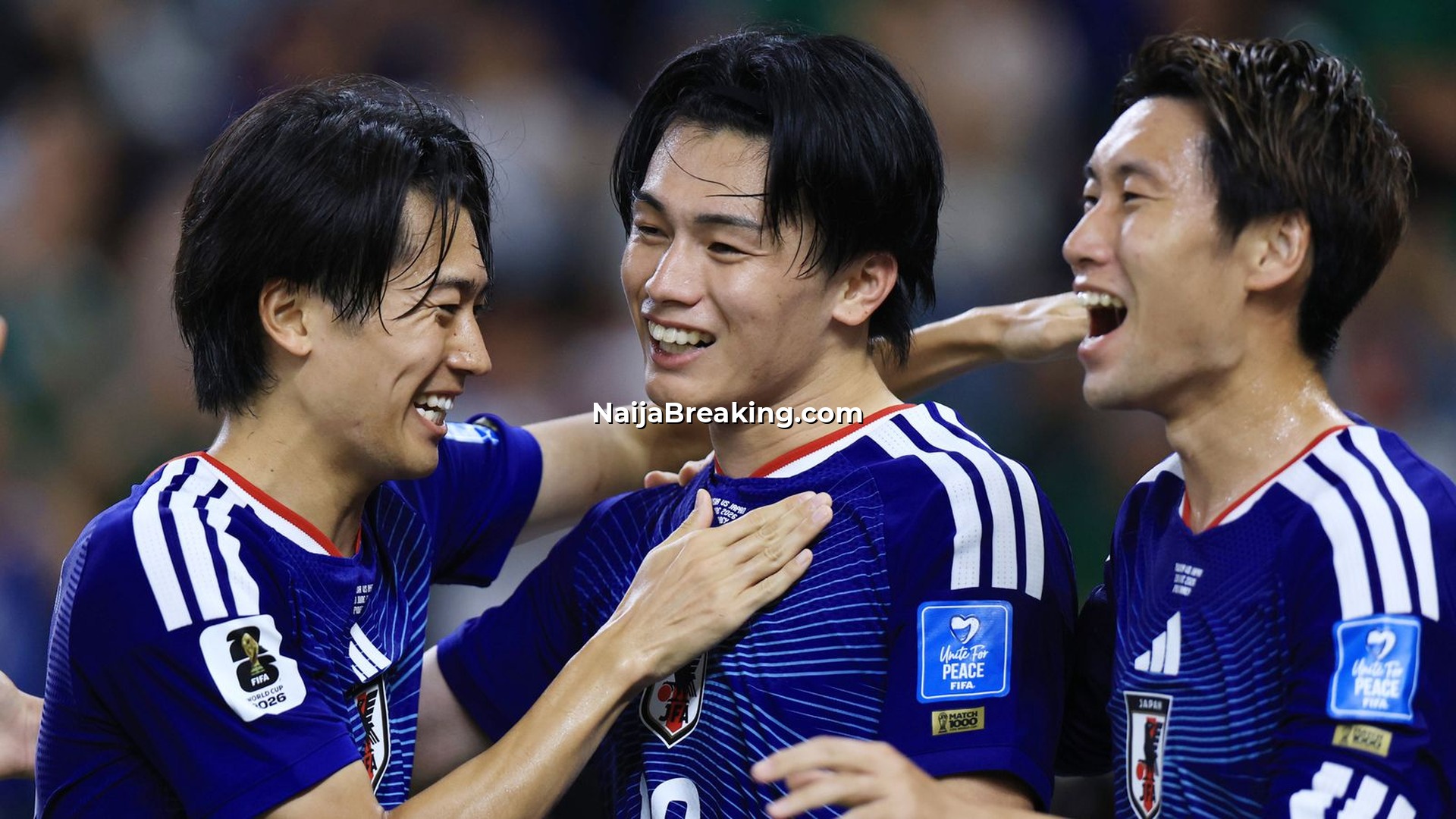

Japan Tunisia World Cup: Japan Demolishes Tunisia 4-0 in Group F Match, Asian Dominance Reshapes Tournament Dynamics
Japan’s commanding 4-0 victory over Tunisia in their FIFA World Cup Group F encounter on 21 June 2026 represents far more than a routine group-stage result—it signals a fundamental shift in how World Cup football is being played at the highest level. The comprehensive nature of the performance, delivered at the Estadio BBVA with 51,243 spectators in attendance, demonstrates that Japan has evolved from a team content with qualification into genuine tournament contenders capable of competing with Europe’s established powers. This Japan Tunisia World Cup match matters to Nigerian football enthusiasts not simply as a result, but as evidence of how strategic organisation, collective discipline, and tactical coherence can compensate for what many observers perceive as a deficit in individual world-class talent. For Nigeria—a nation that has historically viewed the World Cup through the lens of African representation and aspirations—Japan’s dominance offers crucial lessons about defensive structure, team balance, and the diminishing returns of relying solely on star players. The clinical efficiency displayed by Hajime Moriyasu’s side, converting five shots on target into four goals, exemplifies the modern tournament template that threatens to marginalise nations without similar systemic infrastructure. As Nigeria continues its own World Cup project under evolving coaching philosophies, the Japanese blueprint warrants serious study from our football administrators and technical directors at the Nigeria Football Federation.
The Japan Tunisia World Cup encounter showcased everything that modern tournament football demands—precision, discipline, and relentless execution across ninety minutes. Japan’s performance was not characterised by the flamboyant, individual-driven football that captivates television audiences, but rather by the systematic dismantling of an opponent through superior organisation and coordinated team movement. This approach has become increasingly dominant in contemporary international football, where the days of individual brilliance compensating for collective weakness have largely passed. Tunisia entered the contest knowing that against an Asian powerhouse like Japan, they would need to be exceptionally well-organised defensively and lethal on the counter-attack. Instead, they found themselves overwhelmed by Japan’s technical superiority and suffered the consequences of early defensive lapses that snowballed throughout the match. For Nigerian observers, this Japan Tunisia World Cup result provides uncomfortable truths about the state of African football preparation and the widening gap between continental approaches and those employed by more systematically developed football nations.
Background: The Japan Tunisia World Cup Context and Qualifying Journeys
Japan’s football development trajectory over the past two decades has been deliberately constructed around principles of youth development, tactical uniformity, and long-term institutional planning—a stark contrast to the more volatile approaches adopted by many African nations. The Japanese football association invested heavily in establishing a nationwide academy system, implementing standardised coaching philosophies across age groups, and maintaining strategic consistency through multiple managerial cycles. By the time Hajime Moriyasu took charge of the national team, Japan had already developed a recognisable playing identity: possession-based, technically proficient, and defensively compact. This systematic approach to Japan Tunisia World Cup preparation exemplified the philosophical differences between Asian and African football development models.
The journey to this Japan Tunisia World Cup match had been significantly different for both nations. Japan’s qualification campaign was marked by confidence and control—they finished atop their qualifying group with minimal difficulty, demonstrating the maturity that comes from consistent participation in World Cup tournaments. Since their debut in 1998, Japan has featured in seven consecutive World Cups, each tournament adding institutional knowledge and refining their tactical approaches. The experience of competing regularly against elite European opposition in club competitions means Japanese players arrive at World Cups already accustomed to high-intensity football. Many key players in their squad play in top European leagues, a factor that Japanese football administrators deliberately encourage through policy discussions with league representatives.
Tunisia, by contrast, has struggled to maintain competitive consistency since their historic 1978 World Cup qualification—the first African nation ever to reach the tournament. The North African nation qualified for this 2026 tournament through the African qualifying rounds, which themselves proved gruelling and financially draining for the Tunisian Football Federation. Tunisia’s qualification represented genuine progress—they had failed to reach the previous two World Cups—but their trajectory into Group F against Japan, the Netherlands, and Sweden was always going to present severe challenges. Historically, African nations at World Cups have faced systematic disadvantages including limited preparation time, financial constraints that prevent extended pre-tournament training camps, and the continued brain drain of their best players to European leagues, where club commitments often leave insufficient recovery time before international matches. Tunisia’s squad composition reflected these structural challenges—several key players arrived undercooked from their club season, and the coaching staff had limited time to implement sophisticated tactical systems that required extensive drilling and synchronisation.
Match Analysis: How Japan Dominated Tunisia in Their World Cup Encounter
The Japan Tunisia World Cup match unfolded in predictable fashion once Japan secured an early goal, establishing the psychological advantage that proves so valuable in international tournaments. Japan adopted a 4-3-3 formation that prioritised central midfield control, with three disciplined players tasked with recycling possession and shutting down Tunisia’s limited creative outlets. This approach reflected Moriyasu’s understanding that Tunisia possessed neither the quality to break Japan’s defensive structure nor the creative capacity to punish any Japanese lapses in concentration. From the opening whistle, Japan’s pressing intensity suffocated Tunisia’s defenders, forcing hurried clearances that provided the foundation for Japan’s attacking transitions.
Tunisia’s primary challenge lay in the reality that they had entered the Japan Tunisia World Cup without adequate preparation time against opposition of Japan’s calibre. Their defensive shape was inconsistent, with full-backs frequently caught out of position by Japan’s incisive passing movements. The central defensive partnership struggled to cope with Japan’s striker’s movement and the clever runs of attacking midfielders, creating opportunities that a more ruthless opponent might have converted even more ruthlessly. Japan’s first goal arrived through a sequence of sharp passes that exposed Tunisia’s midfield fragility—the ball was played through the lines with precision that suggested Japan had rehearsed this exact pattern dozens of times in training sessions preceding the Japan Tunisia World Cup match.
What distinguished Japan’s performance was not merely their attacking quality, but their defensive discipline and the way they managed to maintain structure even when pressing aggressively. Every outfield player understood their responsibilities without the ball, and there were no individuals attempting to create space for themselves at the expense of collective shape. This contrasted sharply with Tunisia’s approach, where several players seemed uncertain about whether they should defend aggressively or maintain a compact block. This indecision at crucial moments allowed Japan to exploit the space between Tunisia’s lines, and successive defensive errors led to increasingly hopeless situations as the match progressed. By the time Tunisia’s coaching staff recognised the problem and attempted adjustments, Japan had already scored twice and mentally moved into a position of complete control.
Tactical Insights: The Japan Tunisia World Cup and Modern Tournament Football
The Japan Tunisia World Cup encounter provides essential tactical lessons for African football development. Japan operated from a foundation of positional discipline, where every player understood not only their own role but also the functions of teammates in adjacent positions. This level of systematisation requires extensive preparation time and repeated practice—luxuries that many African nations struggle to afford given the demands of domestic league schedules and the limited financial resources available for international preparation. When Hajime Moriyasu took Japan into this Japan Tunisia World Cup match, his squad had enjoyed multiple training camps and tactical sessions focused specifically on Group F opponents. Tunisia, conversely, had their final preparation camp disrupted by injuries and late player releases from European clubs, a familiar African problem that undermines preparation quality.
Japan’s success also reflected a strategic decision to build their team around technical proficiency rather than physical athleticism. While Tunisia possessed players with considerable pace and explosiveness, Japan’s midfielders possessed superior technical ability in tight spaces, allowing them to maintain possession even when under pressure. The ball-retention approach adopted by Japan throughout the Japan Tunisia World Cup match frustrated Tunisia’s attempts to win the ball and launch counter-attacks—Japan controlled possession for extended periods, limiting Tunisia’s opportunities to play the direct, attacking football that might have suited their personnel better.
Another crucial factor was Japan’s mental approach to the Japan Tunisia World Cup match. There was no suggestion of complacency or assumption of superiority; instead, the team played with consistent intensity and focus, executing their tactical plan with mechanical precision. Substitutions were made early enough to maintain this intensity, with fresh legs ensuring that Japan’s press remained relentless even in the final quarter-hour. This professionalism reflects the cultural expectations within Japanese football—underperformance is treated as a genuine failing rather than an acceptable outcome, and players understand that their career trajectory depends on consistent excellence rather than occasional brilliance.
Implications for African Football and Nigerian Development
For Nigeria, the Japan Tunisia World Cup result carries significant implications. The Super Eagles have qualified for the 2026 World Cup and will face their own challenges against elite opposition. Observing how Japan approached this tournament—with systematic preparation, tactical clarity, and disciplined execution—provides valuable lessons for the Nigeria Football Federation and whoever manages the national team heading toward the tournament. While Nigeria possesses players capable of competing with any international side, the absence of systematic tactical frameworks and consistent preparation methodology has historically undermined performance at World Cups. The Japan Tunisia World Cup performance demonstrates that even nations without a surfeit of world-famous players can achieve tournament success through superior organisation and collective discipline.
Tunisia’s experience in the Japan Tunisia World Cup encounter also warns against complacency in qualification campaigns. Reaching the World Cup is merely the first step; the reality of competing at the tournament’s highest level requires substantially greater preparation than most African nations allocate. Financial investment in extended training camps, hiring of elite coaching staff, and investment in detailed opponent analysis can mean the difference between competitive group stages and the kind of comprehensive defeat that Tunisia suffered. For Nigeria, lessons from this Japan Tunisia World Cup match suggest that simply relying on individual talent without corresponding investment in systematic preparation will produce similar outcomes.
Future Outlook: What This Japan Tunisia World Cup Victory Means
Japan’s 4-0 victory over Tunisia positions them as legitimate contenders for progression beyond the group stage and potentially deeper into the 2026 World Cup tournament. The performance confidence gained from such a decisive result cannot be underestimated—Japanese players will enter subsequent matches believing in their capacity to compete with any opponent. Tunisia’s tournament is effectively over; barring an unprecedented turnaround, they face elimination after just one match. This harsh reality of tournament football—where a single poor performance can end months of qualifying effort—underscores why preparation quality matters so intensely. The Japan Tunisia World Cup match demonstrated that talent alone is insufficient; the way teams organise, prepare, and execute their tactical plans determines outcomes far more reliably than individual ability.
Looking forward, the Japan Tunisia World Cup encounter will likely be remembered as a watershed moment in Asian representation at the 2026 tournament. Japan’s dominance provides evidence that Asian nations can compete with traditional powers, challenging the narrative that European and South American teams possess automatic superiority. For Nigeria and other African nations monitoring their World Cup preparations, this Japan Tunisia World Cup result should serve as both inspiration and warning—inspiration that systematic development can elevate any nation’s football, and warning that failure to invest in proper preparation carries severe consequences when competing against opponents who have done so.
The legacy of this Japan Tunisia World Cup match extends beyond the immediate tournament context. It represents a validation of Japanese football’s long-term development strategy and suggests that the investment in youth academies, coaching education, and systematic talent development produces measurable returns. For African nations aspiring to greater World Cup success, the Japan Tunisia World Cup performance provides a template worth studying and potentially emulating within the context of African football’s unique circumstances and resources. As the 2026 World Cup unfolds, the lessons from this Japan Tunisia World Cup encounter will resonate throughout international football, shaping how nations approach preparation and tactical strategy in subsequent tournaments.