Apple’s New Parental Controls Screen Time Management: Why Nigerian Parents Should Care About Digital Safety in 2026
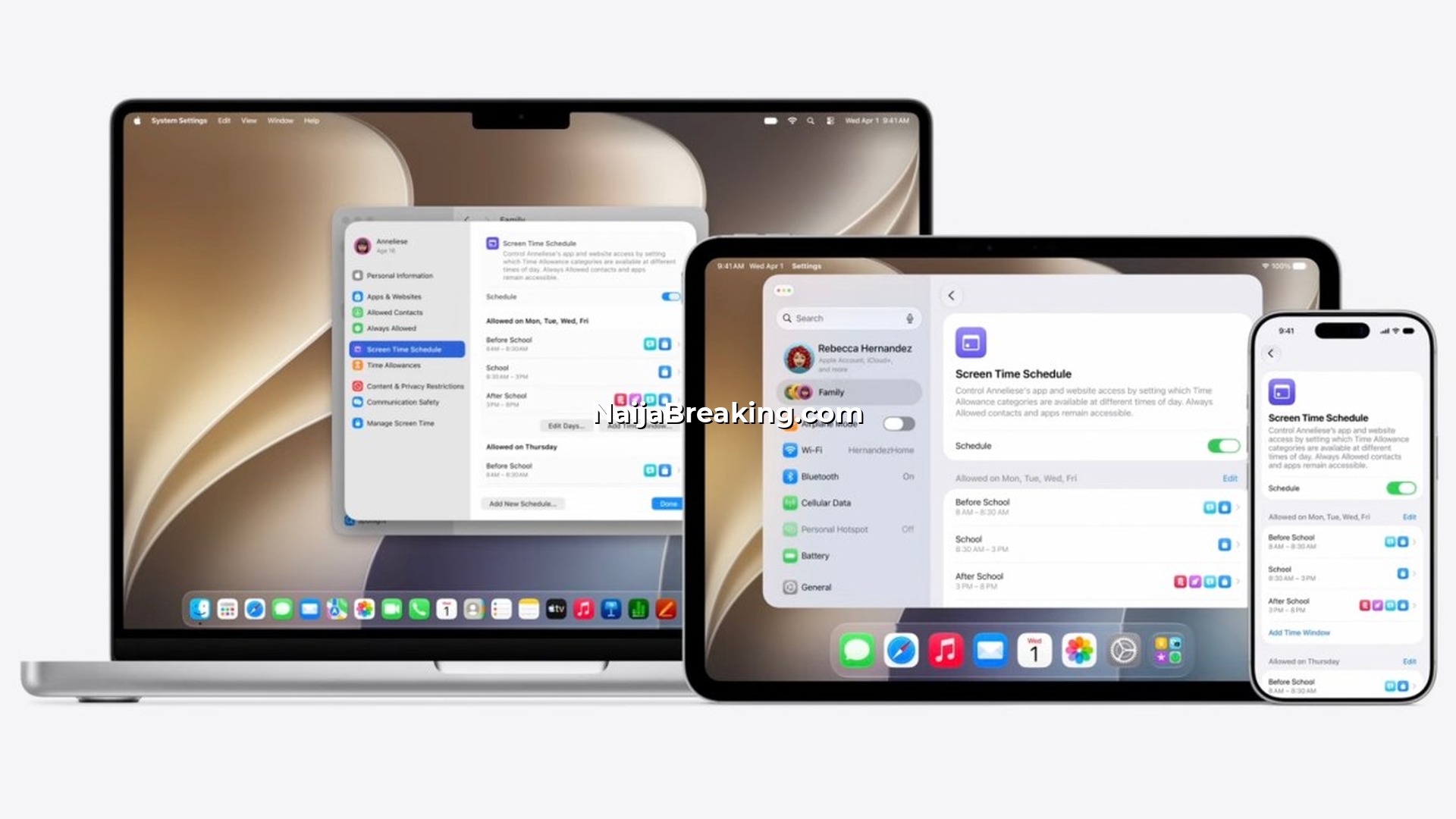
At its Worldwide Developers Conference in June 2026, Apple introduced a significant overhaul to its parental controls screen time management systems, giving parents far more granular control over how their children use iPhones and other Apple devices. The tech giant’s new Screen Time features represent a meaningful shift in how technology companies are responding to growing concerns about children’s digital wellbeing—a conversation that has moved from the periphery to centre stage in Nigeria’s middle-class households. For Nigerian parents grappling with the reality that their children increasingly access smartphones before secondary school, and amid rising concerns about cyberbullying, inappropriate content, and screen addiction, Apple’s latest parental controls screen time tools offer practical solutions that could reshape how families manage technology use at home. The new features allow parents to decide who children can communicate with, which apps they can download, what websites they can browse, and precisely how long they spend on devices each day. These are not marginal tweaks; they represent Apple’s acknowledgement that parents—not algorithms—should have the final say in what their children see and do online.
Understanding parental controls screen time management has become essential knowledge for modern Nigerian parents. The intersection of rapid technological adoption, limited digital literacy among guardians, and insufficient regulatory frameworks has created a landscape where children face unprecedented risks without adequate safeguards. Apple’s enhanced parental controls screen time features arrive at a critical moment when Nigerian families are desperately seeking solutions to manage their children’s device usage effectively.
Background: Why Parental Controls Screen Time Management Matters in Nigeria
The question of children’s digital safety and the need for effective parental controls screen time management has become increasingly urgent in Nigeria over the past five years. According to the National Bureau of Statistics (NBS), smartphone penetration among Nigerian households reached 47% by 2023, with approximately 68% of children in urban areas having access to mobile devices before age twelve. This rapid adoption has outpaced parental literacy and regulatory frameworks designed to manage risks associated with uncontrolled device usage.
The challenge of implementing parental controls screen time restrictions is particularly acute in Nigeria because many parents themselves lack adequate digital literacy. A 2024 survey conducted by the Internet Society Nigeria found that 63% of parents with children aged 5-15 admitted to having little or no understanding of how to use parental controls screen time features on their children’s devices. This knowledge gap leaves millions of Nigerian children vulnerable to inappropriate content, predatory behavior, and the addictive nature of social media platforms that are specifically engineered to maximize engagement time.
The Federal Government, through the Office of the Attorney General of the Federation, has grappled with multiple cases involving cyberbullying, sextortion of minors, and exposure to adult content—often facilitated through social media platforms and unmonitored internet access on children’s devices. High-profile cases in 2023 and 2024 involving TikTok challenges that resulted in injuries and deaths among Nigerian teenagers underscored the urgent need for better parental controls screen time oversight. These incidents revealed that without proper parental controls screen time management systems in place, children can easily access dangerous challenges and harmful content that puts their physical and psychological wellbeing at risk.
Globally, the mental health impact of uncontrolled screen time on children has become a public health emergency. The World Health Organisation has linked excessive device use to anxiety, depression, sleep disorders, and poor academic performance in children aged 8-18. In Nigeria, this concern is compounded by the reality that many schools lack adequate mental health support services, and parents often lack the technical knowledge to implement effective digital boundaries through parental controls screen time features. Teachers at leading private schools in Lagos, Abuja, and Port Harcourt have reported a noticeable decline in children’s attention spans, increased classroom disruption linked to smartphone addiction, and rising anxiety among students who fear missing out on social media interactions if they don’t have constant access to their devices.
The regulatory environment is shifting as well. In 2024, the National Information Technology Development Agency (NITDA) published comprehensive guidelines on data protection and children’s online safety, requiring tech platforms to implement age-appropriate restrictions and encouraging parents to utilize parental controls screen time tools available on their devices. This regulatory push acknowledges that while platforms have a responsibility to protect children, parents need robust parental controls screen time features to maintain authority over what their children access.
Understanding Apple’s Enhanced Parental Controls Screen Time Features
Apple’s new parental controls screen time management system builds upon its existing Screen Time feature but introduces several significant enhancements designed specifically to address modern concerns about children’s digital wellbeing. The updated parental controls screen time system now includes communication controls that allow parents to determine which contacts their children can reach and who can contact them—a critical feature in Nigeria where predatory behavior through messaging apps has increased.
One of the most significant additions to Apple’s parental controls screen time toolkit is enhanced app management capabilities. Previously, parents using parental controls screen time features could only restrict entire categories of apps or set usage limits on specific apps. The new system allows parents to see detailed analytics about how their children spend time across different applications, with breakdowns by hour and day. This granular view of parental controls screen time usage patterns enables parents to make informed decisions about which apps deserve more time and which should be restricted or eliminated altogether.
For Nigerian parents concerned about their children accessing inappropriate content, Apple’s improved parental controls screen time system includes enhanced content filtering that works across Safari, the App Store, and third-party apps. The new parental controls screen time content restrictions use machine learning to identify and block age-inappropriate material, including pornographic content, violent media, and gambling-related apps. This represents a significant advancement for Nigerian families where teaching children about digital safety is complicated by parents’ own limited technical knowledge about how parental controls screen time systems function.
Another critical feature in Apple’s updated parental controls screen time arsenal is downtime scheduling. This allows parents to set specific times when their children’s devices become essentially unusable except for emergency calling and designated essential apps. For example, a parent can use parental controls screen time to ensure that between 9 PM and 7 AM, their child’s device enters downtime mode, preventing access to social media, games, and entertainment apps. This feature addresses the growing problem of sleep deprivation among Nigerian teenagers caused by late-night phone usage and social media scrolling.
The parental controls screen time system also includes a new “Family Library” feature that allows parents to manage app purchases and downloads for multiple children simultaneously. Rather than each child having independent access to the App Store, all downloads must be approved by the parent, giving them control over which apps their children can access and when. This parental controls screen time feature prevents children from downloading expensive apps without parental knowledge or from accessing apps with age ratings inappropriate for their developmental stage.
How Nigerian Parents Can Implement Parental Controls Screen Time Management
Implementing effective parental controls screen time strategies requires understanding both the technical tools available and the family dynamics that should inform their use. For Nigerian parents, the first step in implementing parental controls screen time management is to have an open conversation with their children about why these restrictions are necessary. Research shows that parental controls screen time systems are most effective when children understand that they are tools for protection rather than punishment.
To set up Apple’s parental controls screen time features, Nigerian parents should begin by creating a family group in iCloud, which enables parental controls screen time management across multiple devices. This process requires the parent to have an Apple ID, which is a significant barrier for some Nigerian parents who may not be familiar with creating and managing Apple accounts. Once the family group is established, parents can then configure specific parental controls screen time settings for each child based on their age and maturity level.
When establishing parental controls screen time limits, Nigerian parents should consider their child’s age, academic schedule, and extracurricular commitments. A 12-year-old might reasonably be allocated 2-3 hours of screen time daily, while a 15-year-old could have greater flexibility. The key to effective parental controls screen time management is consistency—limits should be applied uniformly across all applications and enforced without exception. When parents make exceptions to parental controls screen time rules, children learn that boundaries are negotiable, undermining the entire system’s effectiveness.
Nigerian parents implementing parental controls screen time systems should also take advantage of content filtering and app restrictions. Rather than allowing children unlimited access to social media apps and then trying to monitor what they see, parents can use parental controls screen time features to prevent access to apps entirely until the child reaches an appropriate age. This approach is particularly important for platforms like TikTok, Instagram, and Snapchat, which research indicates can be psychologically harmful to children under 13.
The parental controls screen time communication features deserve particular attention from Nigerian parents. In a country where child safety concerns are paramount, being able to restrict who your child can contact and who can contact them is invaluable. Parents can use these parental controls screen time settings to ensure their children can only communicate with family members, trusted adults, and a pre-approved list of friends. This prevents children from accidentally or intentionally making contact with potentially dangerous individuals who may exploit them.
Addressing Challenges in Implementing Parental Controls Screen Time Systems
Despite the benefits of Apple’s new parental controls screen time features, Nigerian parents will face several challenges when attempting to implement these systems effectively. The first challenge is technical literacy. Many Nigerian parents lack sufficient familiarity with Apple devices to navigate the interface for setting up parental controls screen time restrictions. This problem is compounded by the reality that Apple’s documentation and support materials are often written in English that assumes a baseline level of technological knowledge that many Nigerian parents don’t possess.
A second significant challenge is resistance from children themselves. Adolescents, in particular, may view parental controls screen time restrictions as invasive violations of their privacy. In Nigerian culture, where respect for parental authority remains strong, children may not openly rebel against parental controls screen time systems, but they may seek ways to circumvent them—including using friends’ devices, creating alternative accounts, or finding technical workarounds. Successful parental controls screen time implementation requires ongoing communication between parents and children about why these restrictions exist and what behaviors trigger changes in parental controls screen time settings.
A third challenge specific to Nigeria is the proliferation of affordable Android devices, many of which lack parental controls screen time features comparable to Apple’s offerings. While Apple’s parental controls screen time tools are genuinely advanced, they only protect children who are using Apple devices. Many Nigerian families operate in mixed-device environments where some family members use iPhones while others use Android devices, creating inconsistent parental controls screen time coverage.
Cost represents another significant barrier to implementing Apple’s parental controls screen time solutions in Nigeria. While the parental controls screen time features themselves don’t cost extra, accessing them requires an iPhone, iPad, or Mac—devices that are significantly more expensive than their Android counterparts. For many Nigerian families, the investment required to equip children with Apple devices solely for the purpose of accessing advanced parental controls screen time features is prohibitively expensive.
Best Practices for Parental Controls Screen Time Management in Nigeria
Nigerian parents seeking to implement effective parental controls screen time systems should consider several best practices based on research and expert recommendations. First, parents should establish clear, written rules about device usage before implementing parental controls screen time restrictions. Children should understand what their screen time limits are, what content is restricted, and what consequences follow if parental controls screen time limits are exceeded or bypassed.
Second, parents should model healthy screen time habits themselves. Children whose parents spend hours on their own devices daily are unlikely to accept parental controls screen time restrictions as reasonable. Effective parental controls screen time management requires that parents demonstrate the digital discipline they expect from their children by maintaining their own appropriate screen time limits and avoiding excessive phone usage during family time.
Third, Nigerian parents should regularly review and adjust parental controls screen time settings as their children mature. A restriction that makes sense for a 10-year-old becomes increasingly inappropriate for a 16-year-old who may need device access for schoolwork. Annual reviews of parental controls screen time settings provide opportunities to gradually grant more autonomy while maintaining appropriate safeguards against harmful content and excessive usage.
Fourth, parents should combine parental controls screen time tools with open dialogue about digital safety. Technology can restrict access to harmful content and limit the time children spend on devices, but it cannot replace the guidance parents provide through conversation about navigating the digital world safely and responsibly. Nigerian parents who implement parental controls screen time systems without also teaching their children critical thinking about online interactions miss an opportunity to develop their children’s digital literacy.
The Future of Parental Controls Screen Time Management in Nigeria
As technology continues to evolve and Nigerian society becomes increasingly digital, parental controls screen time management will remain a critical concern for families. Apple’s enhanced parental controls screen time features represent important progress, but they are not a complete solution to the complex challenge of raising digitally responsible children in an environment saturated with addictive technologies and harmful content.
The future of parental controls screen time management in Nigeria will likely involve greater collaboration between technology companies, parents, educators, and government regulators. Schools should incorporate digital literacy education that teaches children not just how to use technology but why responsible technology use matters for their wellbeing. Parents must become more informed about available parental controls screen time tools and understand how to use them effectively. Technology companies must continue improving parental controls screen time features while resisting the temptation to design addictive features that undermine parental efforts to restrict children’s device usage.
Ultimately, parental controls screen time management is about empowering Nigerian parents to maintain authority over their children’s relationship with technology during critical developmental years. Apple’s new features provide tools that, when properly implemented, can help parents accomplish this goal. By understanding these parental controls screen time features and applying them thoughtfully within the context of open communication and consistent boundaries, Nigerian families can create healthier relationships with technology that support children’s development while protecting them from digital risks.