
Smart Home Tech in Nigeria: Why Philips Hue’s SpatialAware Matters for African Tech Adoption
The global smart home market is experiencing rapid growth, but in Nigeria, adoption of advanced home automation technologies remains a niche pursuit confined largely to affluent urban professionals in Lagos and Abuja. However, recent innovations in smart home technology—particularly Philips Hue’s latest SpatialAware feature—signal an important shift that Nigerian tech enthusiasts and early adopters should understand. Smart home technology Nigeria is no longer purely aspirational; it’s becoming increasingly accessible and functional for the growing middle class. When international tech companies introduce features like SpatialAware, which intelligently maps lighting colours across a room based on spatial awareness, it creates ripple effects across emerging markets. Understanding these innovations matters because they influence pricing strategies, market entry decisions, and ultimately, what technology becomes available to Nigerian consumers. The SpatialAware breakthrough demonstrates how processing power and artificial intelligence are making smart homes more intuitive—and potentially more affordable—for users who previously found traditional smart lighting too complicated or expensive to justify.
Background
Nigeria’s consumer technology landscape has undergone significant transformation over the past decade. The telecommunications boom driven by companies like MTN and Airtel created a foundation for digital adoption, with internet penetration reaching approximately 42% of the population by 2023, according to data from the National Bureau of Statistics (NBS). However, smart home technology adoption has lagged far behind smartphone and internet usage. This gap exists because of several interconnected factors: inconsistent electricity supply from the national grid, low disposable income among average Nigerians, and limited local technical support infrastructure for advanced consumer electronics.
The history of consumer technology in Nigeria shows a pattern where innovations first appear in Lagos, spreading gradually to secondary cities like Abuja, Port Harcourt, and Kano over several years. When smartphones became ubiquitous in 2010-2015, they solved immediate problems—communication and information access—that resonated with mass-market consumers. Smart home devices, by contrast, have been positioned as luxury lifestyle upgrades rather than essential tools. This perception has limited their market penetration despite falling global prices.
What has changed recently is the rise of Nigeria’s high-net-worth individuals (HNWIs) and the expansion of the upper-middle class. According to Afrobarometer surveys and reports from the World Bank, Nigeria’s wealthy households have grown significantly since 2015, creating a demographic with both purchasing power and international lifestyle aspirations. These consumers, who frequently travel to London, Dubai, and the United States, encounter smart home technology abroad and increasingly demand similar systems in their Nigerian homes. This demand has begun attracting attention from international tech companies considering African market expansion strategies.
Key Details
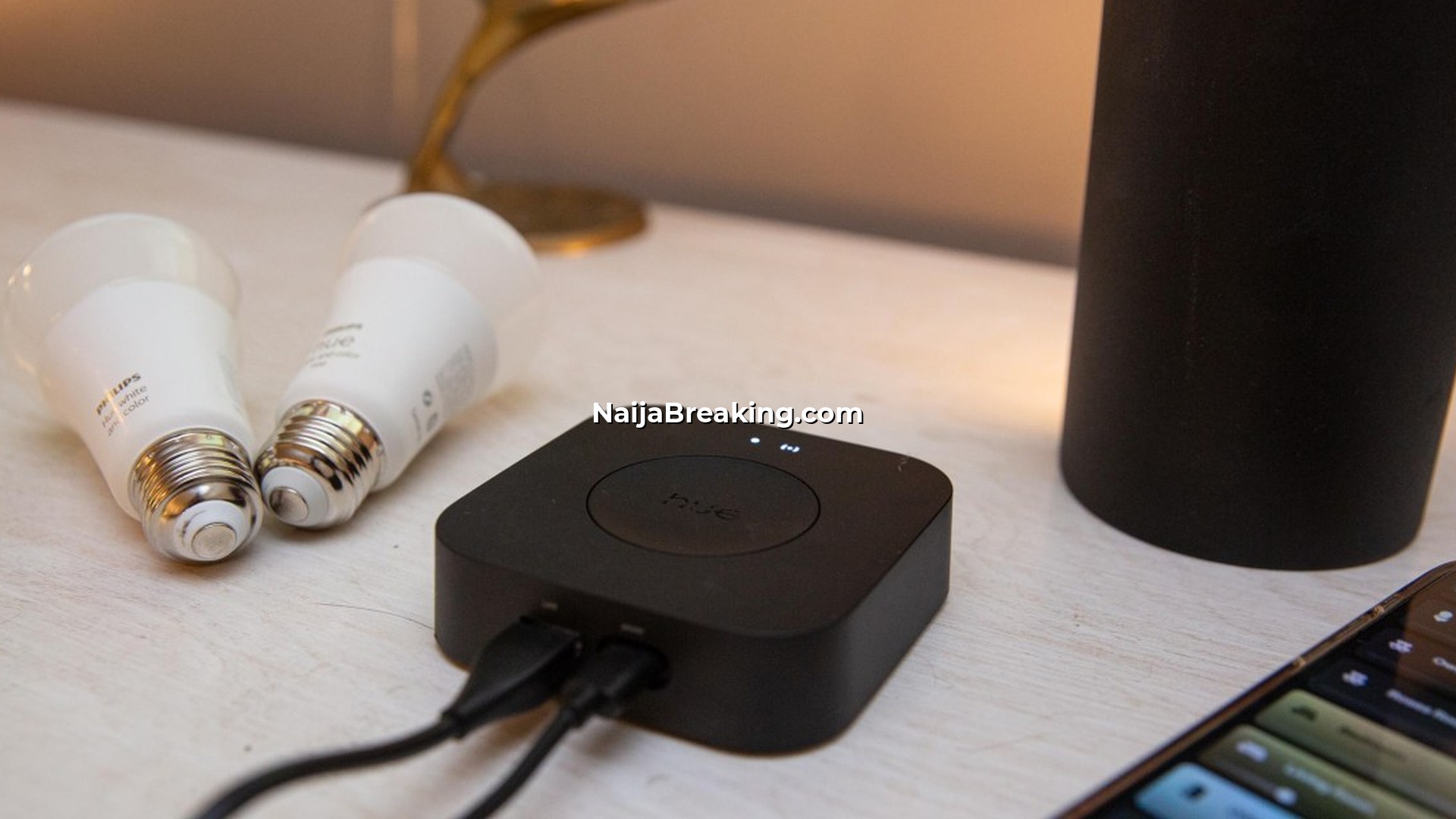
Philips Hue’s Bridge Pro, which launched in September 2023, represents a significant evolution in home automation hardware. According to The Verge’s comprehensive review, the Bridge Pro features a quad-core processor and 1GB of RAM—specifications that enable advanced features impossible on previous-generation bridges. The device supports enhanced motion detection through MotionAware functionality, which transforms standard Hue bulbs into motion sensors without requiring additional hardware purchases. This is particularly relevant for Nigerian consumers because it reduces the overall system cost compared to purchasing separate motion sensors.
However, the feature that truly distinguishes the Bridge Pro is SpatialAware, introduced in April 2024. This technology uses spatial mapping to understand where lights are positioned within a room and then intelligently distributes colour and tone across them when users activate lighting scenes. Rather than applying the same colour to all bulbs uniformly, SpatialAware creates depth and visual dimension by adjusting colours based on spatial location. The Verge’s testing revealed that this produces a noticeably more sophisticated lighting experience that justifies the upgrade investment for serious smart home enthusiasts. The Bridge Pro costs approximately $99 USD, making it accessible to upper-income consumers in Nigeria when converted to Naira at current exchange rates (approximately ₦15,000-₦17,000 depending on retailer margins).
The technical capability that enables SpatialAware—advanced local processing—represents a broader industry trend toward “edge computing” rather than cloud-dependent smart home systems. This distinction matters significantly for Nigeria. Edge computing means the device makes decisions locally without relying on internet connectivity for every function. Given Nigeria’s irregular internet access and data costs (among the highest in Africa), locally-processing smart home systems offer advantages over cloud-dependent alternatives. Users in Nigeria experiencing internet interruptions would still maintain basic lighting functionality rather than losing all automation capabilities during network outages.
Impact and Analysis
The introduction of SpatialAware and similar intelligent lighting systems signals an important shift in how technology companies view emerging market opportunities. Rather than offering stripped-down versions of products for developing nations, companies like Philips are now developing features that enhance core functionality in ways that appeal to globally-connected consumers who demand sophisticated experiences. This approach respects the intelligence and aspirations of Nigerian buyers while acknowledging real infrastructure constraints.
For Nigeria specifically, the implications are multilayered. First, products with local processing capabilities address a genuine pain point—internet reliability—that cloud-dependent alternatives cannot solve. Second, the availability of these systems locally (through online retailers and some physical stores in Lagos) reduces barriers to adoption. When Nigerian consumers can purchase smart home devices without international shipping delays and customs complications, conversion rates improve. Third, and most subtly, products like SpatialAware make smart home technology less intimidating. Rather than requiring users to understand complex automation routines and integration logic, SpatialAware automates intelligent decisions based on spatial understanding, making the technology more intuitive for non-technical users.
The broader economic impact touches several sectors. As smart home adoption expands among Nigeria’s affluent households, opportunities emerge for local installers, electricians, and smart home integration specialists. Several Lagos-based technology service companies have already begun offering smart home installation and customization services, creating skilled employment. Additionally, increased consumer demand for high-end electronics signals confidence in the purchasing power of Nigeria’s upper-middle class, potentially encouraging international retailers to expand their Nigerian operations.
Expert Perspectives
Dr. Folake Okunbor, a technology policy analyst at the Lagos Institute for Technology and Innovation, offers critical perspective on what SpatialAware’s arrival means for Nigeria’s tech ecosystem: “What we’re witnessing is not simply another smart home gadget arriving in Nigeria. SpatialAware represents a category of technology designed to work within constraints rather than around them. The local processing capability directly addresses our electricity and internet reliability challenges. This is the kind of innovation that could genuinely transform how affluent Nigerians think about home automation—from a luxury import to a practical system that works in our environment.”
Contrasting this view, Chinedu Amadi, a consumer technology researcher at the Centre for Digital Rights in Nigeria, urges caution about over-optimism: “While SpatialAware is impressive technically, we must acknowledge that the Bridge Pro and compatible Hue bulbs remain out of reach for 85% of Nigerians. The cost structure ensures this technology serves only the wealthy elite. Rather than celebrating imported innovations, we should be asking why Nigeria isn’t developing comparable smart home solutions locally. The real question is whether foreign tech companies are genuinely committed to inclusive innovation or simply harvesting profits from our small affluent class while ignoring the majority.”
What This Means for Nigerians
For a Lagos-based marketing executive earning ₦5 million annually, SpatialAware offers tangible quality-of-life improvements. Imagine returning home after a long day in Lagos traffic to lighting that automatically adjusts colour temperature to promote relaxation, with spatial distribution creating ambiance rather than mere brightness. The system learns patterns—recognizing when you typically arrive home, adjusting lights accordingly—without requiring complex manual programming. For tech-savvy professionals, this represents real value that justifies the investment.
For small business owners, smart lighting systems with motion detection reduce electricity costs through automatic switching when rooms are unoccupied. A retail shop owner in Lekki or a service business in Abuja could deploy Hue lights with MotionAware to ensure customer areas are well-lit while reducing consumption in storage areas. The cumulative savings over a year could be substantial given Nigeria’s high electricity tariffs, which increased significantly following the NERC’s tariff adjustments in 2023.
However, for the vast majority of Nigerians—those earning between ₦100,000 and ₦500,000 monthly—the Bridge Pro and compatible Hue ecosystem remain inaccessible luxuries. These consumers face more pressing concerns: reliable electricity access, fuel for generators during supply disruptions, and basic internet connectivity. Smart lighting systems will not reach middle-class Nigerian households for several years, if at all, unless dramatic price reductions occur or local manufacturers develop comparable solutions.
Editor’s Take
At NaijaBreaking, we believe the SpatialAware story reveals an uncomfortable truth about technology adoption in Nigeria: we are fundamentally divided into two technology nations. One nation, primarily Lagos-based and affluent, accesses global innovations at near-parity with developed markets. The other nation—the vast majority—experiences severe technological lag. The Bridge Pro’s arrival in Nigeria is undoubtedly positive for the first nation, but it masks our collective failure to develop indigenous tech capabilities. Why should Nigerian consumers depend entirely on Philips’ interpretation of smart home needs rather than supporting local innovators addressing Nigerian-specific challenges? What remains unexamined is whether international tech companies see Nigeria as a genuine market to serve or merely a demographic to extract wealth from.
What to Watch Next
Three developments warrant close monitoring in the coming months. First, observe whether major Nigerian retailers like Jumia, Konga, and Slot expand their smart home product selections and pricing in response to growing affluent consumer interest. Second, watch for announcements regarding local smart home installation and support services—their emergence indicates genuine market maturation beyond online purchases. Third, monitor whether local Nigerian tech companies respond to the competitive threat by developing comparable systems; this would signal whether innovation can remain domestically rooted rather than entirely imported. The key question now is whether SpatialAware’s success in Nigeria proves that the affluent segment is large enough to sustain a true smart home market here, or whether we’ll see this technology remain another boutique import consumed exclusively by the already-wealthy?
Conclusion
Philips Hue’s SpatialAware technology represents genuine innovation that makes smart home systems more intuitive and environmentally-suited to Nigeria’s infrastructure constraints. For affluent urban Nigerians, the Bridge Pro and SpatialAware offer real improvements in home automation and daily convenience. However, the story extends beyond product review—it illuminates the broader reality that technology adoption in Nigeria remains starkly unequal, with the wealthy accessing global innovations while the majority remains dependent on basic connectivity. As we celebrate technological breakthroughs, we must simultaneously ask harder questions about who benefits and whether Nigeria is building internal innovation capacity or simply becoming a market for imported solutions.
Share your thoughts in the comments below—what do you think this means for Nigeria’s future? Should we be celebrating international tech companies’ entry into the Nigerian market, or demanding that local innovators receive equivalent investment and support?