Nuro Gets Driverless Testing Permit for Uber Robotaxi Service Launch: What This Means for Nigeria
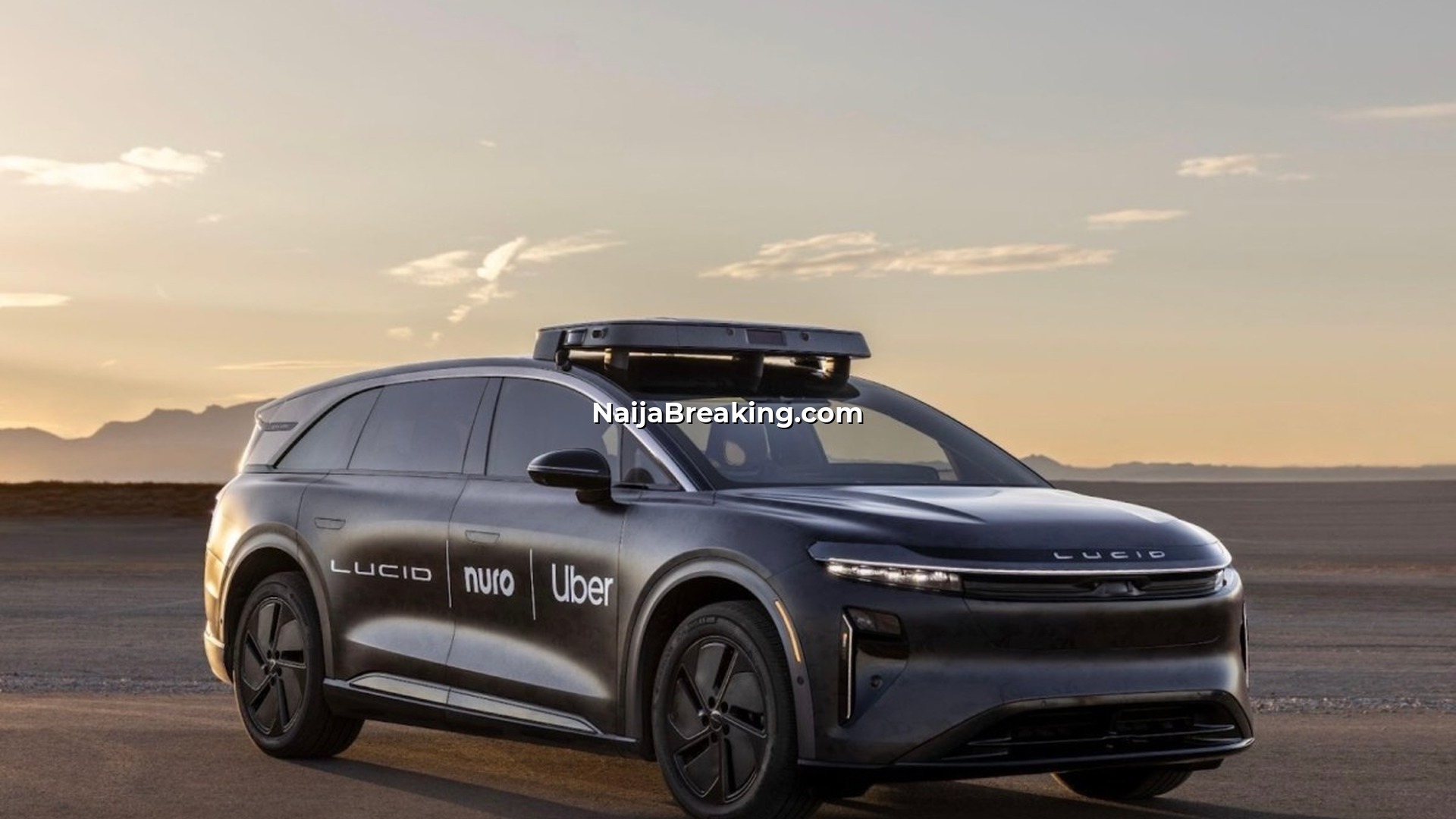
Silicon Valley autonomous vehicle startup Nuro has secured a significant regulatory milestone by receiving a driverless testing permit from California’s Department of Motor Vehicles, clearing the path for Lucid Gravity SUVs equipped with its autonomous technology to operate on public roads without a human safety driver. This driverless testing permit represents a major step forward in the development of Uber’s premium robotaxi service, which aims to revolutionise ride-hailing through fully autonomous vehicles. According to TechCrunch, the California Department of Motor Vehicles confirmed the permit modification on Tuesday, marking a pivotal moment in autonomous vehicle commercialisation. However, despite holding this crucial regulatory approval, Nuro has indicated it is not yet ready to commence driverless testing operations. The company expects to begin its testing programme later in the year, signalling a cautious but determined approach to deploying this transformative technology. For tech enthusiasts and industry observers across Nigeria and Africa, this development underscores the accelerating pace of autonomous vehicle innovation and raises important questions about when such technology might reach African markets and what implications it holds for Nigeria’s transportation and logistics sectors.
Understanding the Driverless Testing Permit: A Regulatory Breakthrough
The driverless testing permit that Nuro has obtained represents one of the most stringent and carefully regulated approvals in the autonomous vehicle industry. In California, the Department of Motor Vehicles maintains a rigorous framework for autonomous vehicle testing and deployment, with multiple levels of permits that correspond to different capabilities and operational domains. The driverless testing permit sits at the highest level of this regulatory hierarchy, signifying that the California DMV has determined Nuro’s autonomous driving system is sufficiently mature and safe to operate on public roads without any human intervention, including the absence of a safety driver behind the wheel ready to take manual control in emergency situations.
To obtain this driverless testing permit, Nuro had to demonstrate extraordinary technical competence and safety standards. The company submitted extensive documentation detailing its autonomous driving system’s capabilities, limitations, and safety features. This included thousands of hours of simulation data, real-world testing logs, sensor specifications, and algorithmic documentation. The California DMV conducted thorough reviews of Nuro’s autonomous vehicle technology stack, which encompasses perception systems utilising advanced lidar, radar, and camera technologies; planning algorithms that generate safe trajectories through complex urban environments; and control systems that execute precise vehicle movements with minimal latency and maximum reliability.
The driverless testing permit specifically authorises Nuro to deploy Lucid Gravity vehicles equipped with its autonomous driving technology across designated areas of California. These vehicles will be able to navigate public roads, interact with other traffic participants, and respond to dynamic environmental conditions without any human operators. This represents a fundamental departure from earlier autonomous vehicle testing regimes, which always required a trained safety driver to remain alert and prepared to assume control immediately if the autonomous system encountered unexpected situations or technical failures. The elimination of this safety driver requirement demonstrates the confidence regulators have developed in Nuro’s technology, though it also underscores the immense responsibility the company bears in maintaining the highest safety standards.
Background: Nuro’s Evolution and Strategic Pivot
The journey of Nuro towards obtaining its driverless testing permit spans several years of regulatory navigation and strategic pivots in California’s increasingly sophisticated autonomous vehicle ecosystem. Founded as a robotics company focused on autonomous delivery solutions, Nuro initially held a driverless permit that was specifically limited to low-speed delivery vehicles—compact, purpose-built robots designed to transport packages and parcels across neighbourhoods and parking lots. This initial regulatory approval, which Nuro has maintained for six years, represented one of the earliest instances of California’s Department of Motor Vehicles granting permission for driverless vehicle operations on public roads, establishing Nuro as an early pioneer in the autonomous vehicle space. However, as the autonomous vehicle industry evolved and market opportunities shifted, Nuro made a critical strategic decision to pivot its business model away from small delivery robots and towards licensing its proprietary autonomous driving technology to larger automotive and mobility companies.
This transition reflected broader industry trends recognising that the genuine commercial viability of autonomous vehicles lay not in niche delivery applications but in comprehensive ride-hailing and passenger transportation services that could scale across entire metropolitan areas. Nuro recognised that while autonomous delivery robots represented interesting technical proof-of-concepts, the real market opportunities lay in passenger mobility. The company therefore redirected its research and development efforts towards creating autonomous driving systems capable of handling the complexities, edge cases, and safety requirements of transporting human passengers in full-size vehicles. This strategic pivot required significant technological advancement, as passenger transportation presents fundamentally different challenges than autonomous delivery of packages.
The partnership between Nuro, Uber, and luxury automaker Lucid Motors emerged from this strategic realignment. Uber, struggling with its own autonomous vehicle initiatives and seeking to accelerate its robotaxi programmes, recognised Nuro’s sophisticated autonomous driving technology and began discussions about a potential partnership. Simultaneously, Lucid Motors, freshly recovered from its near-collapse and seeking applications for its advanced electric vehicle platform, became interested in integrating Nuro’s autonomous systems into their premium Gravity SUV model. This three-way partnership combined Nuro’s cutting-edge autonomous driving technology, Uber’s massive ride-hailing network and customer base, and Lucid’s sophisticated vehicle engineering and manufacturing capabilities. The resulting collaboration positioned the driverless testing permit as a critical regulatory gateway enabling the next phase of development for Uber’s premium robotaxi service.
The Significance of the Driverless Testing Permit for Uber’s Robotaxi Ambitions
Uber’s pursuit of autonomous vehicle technology represents one of the most ambitious and complicated endeavours in the company’s history. The ride-hailing giant acquired autonomous vehicle company Otto in 2016 for approximately $680 million and subsequently invested billions into developing its own autonomous driving capabilities through Uber Advanced Technologies Group. However, the company’s autonomous vehicle programme encountered significant setbacks, including a fatal accident in Arizona in 2018 when an Uber autonomous vehicle struck and killed a pedestrian, Elaine Herzberg. This tragedy prompted widespread regulatory scrutiny, internal restructuring, and a fundamental reassessment of Uber’s autonomous vehicle strategy. The company eventually spun off its autonomous vehicle division and eventually sold it to competitor Aurora, representing a substantial pivot away from developing proprietary autonomous driving technology.
Instead of continuing to build its own autonomous systems, Uber shifted towards a partnership-based model, seeking collaborations with companies that had already made significant progress in autonomous vehicle development. This is where Nuro entered the picture. By partnering with Nuro to integrate the startup’s autonomous driving technology into Lucid Gravity vehicles, Uber gains access to mature, tested autonomous systems without bearing the full burden of in-house development. The driverless testing permit accelerates this timeline significantly, enabling Nuro and Uber to transition from controlled testing environments to real-world public road operations. This transition is crucial for the development of commercial robotaxi services, as real-world data proves invaluable for refining autonomous systems, identifying edge cases, and building the safety track record necessary for eventual commercial deployment.
The driverless testing permit also signals to investors, regulators, and customers that Nuro’s technology has achieved a critical maturity threshold. Many potential customers and partners in the autonomous vehicle space were hesitant to commit substantial resources to Nuro until the company demonstrated that its technology could pass the highest regulatory scrutiny in the most demanding market—California. By obtaining the driverless testing permit, Nuro removes a significant uncertainty factor and signals that its autonomous driving system meets world-leading safety standards. This provides Uber with greater confidence in its partnership, potentially accelerating the timeline for commercial robotaxi service launches in major metropolitan areas.
Technical Specifications and Autonomous Driving Capabilities
Nuro’s autonomous driving technology represents the culmination of years of research, development, and testing across multiple sensory systems and computational frameworks. The driverless testing permit enables deployment of this technology in Lucid Gravity vehicles, which serve as sophisticated platforms for autonomous operation. Understanding the technical foundations of Nuro’s system provides insight into why the company has successfully navigated California’s stringent regulatory requirements.
The perception layer of Nuro’s autonomous driving system integrates multiple sensor modalities, including high-resolution lidar sensors that create three-dimensional maps of the surrounding environment with extraordinary precision. These lidar systems can detect objects as small as a tennis ball at distances exceeding 100 metres, providing the autonomous system with comprehensive environmental awareness. Complementing the lidar systems are advanced camera arrays mounted at strategic positions around the vehicle, providing high-resolution visual data that enables identification of traffic signals, road markings, and pedestrian behaviour. Radar sensors add additional redundancy and adverse weather performance, allowing the system to function effectively in rain, fog, and other conditions where camera and lidar performance might degrade. This multi-sensor fusion architecture provides extraordinary robustness, ensuring that the loss or degradation of any single sensor does not compromise the vehicle’s ability to navigate safely.
The planning and decision-making systems that process this sensory data represent equally sophisticated technological achievements. Nuro’s algorithms must constantly evaluate potential vehicle trajectories, predict the future movements of other traffic participants, and select actions that maximise safety while progressing towards the destination. These systems operate in real-time, making critical decisions within milliseconds while accounting for hundreds of potential hazards and variables. The algorithms must handle extraordinarily complex scenarios, including navigating congested urban intersections, responding to unexpected pedestrian movements, and adapting to unpredictable behaviour from other road users. Machine learning systems trained on millions of miles of driving data continuously improve these decision-making processes, allowing the autonomous system to become increasingly adept at navigating novel situations.
Regulatory Framework and the Path to the Driverless Testing Permit
California’s Department of Motor Vehicles operates under Assembly Bill 375, which established the framework for autonomous vehicle testing and deployment in the state. This regulatory structure distinguishes between several permit categories, each corresponding to different levels of autonomous capability and operational complexity. Understanding this framework illuminates why the driverless testing permit represents such a significant achievement and why its requirements are so stringent.
The first category of permits authorises companies to conduct autonomous vehicle testing with a trained safety driver present. During this phase, companies test their autonomous systems on public roads while maintaining human oversight through a safety driver who can assume control immediately if the autonomous system fails or encounters unexpected situations. Many autonomous vehicle companies have operated under this permit category for years, accumulating millions of miles of testing data while maintaining the safety net of human intervention capability.
The second category of permits authorises driverless testing, which is what Nuro has now achieved. To obtain this permit, companies must demonstrate extraordinary technical maturity, extensive testing data, comprehensive safety protocols, and confidence in their systems’ ability to operate independently without human intervention. The California DMV requires submission of detailed technical documentation, failure mode analysis, redundancy specifications, and extensive testing results before granting driverless testing permits. Companies must also establish protocols for responding to emergency situations, maintaining detailed logs of all autonomous operations, and continuously monitoring system performance.
The third category encompasses deployment permits, which authorise commercial operation of autonomous vehicles providing paid transportation services to customers. These permits represent the final regulatory gate before autonomous vehicles can genuinely participate in commerce, transporting paying customers and generating revenue. The pathway from driverless testing permits to deployment permits requires additional years of real-world operational data, demonstration of safety metrics, and regulatory confidence that the autonomous system performs as reliably in genuine commercial operations as in controlled testing scenarios.
Implications for Nigeria and African Autonomous Vehicle Development
While Nuro’s driverless testing permit represents a significant milestone for autonomous vehicle development in Silicon Valley and California, the implications of this achievement extend far beyond North America. For Nigeria and other African nations, Nuro’s success signals important realities about the trajectory of autonomous vehicle technology and the timeline for potential adoption across the continent. Understanding these implications requires examining Nigeria’s current transportation landscape, the potential benefits and challenges of autonomous vehicle adoption, and the regulatory frameworks that would need to develop to support such technology.
Nigeria’s transportation sector faces significant challenges that autonomous vehicle technology might eventually help address. Traffic congestion in Lagos, Abuja, and other major metropolitan areas imposes enormous economic costs through lost productivity, increased fuel consumption, and extended commute times. Road accidents in Nigeria claim thousands of lives annually, with many casualties attributable to human error, driver fatigue, and unsafe driving practices. The development of autonomous vehicles could potentially reduce traffic fatalities by eliminating driver error as a causal factor in accidents. Additionally, autonomous vehicles could increase transportation efficiency, reduce fuel consumption, and improve mobility access for individuals unable to drive themselves due to age, disability, or other factors.
However, Nigeria’s adoption of autonomous vehicle technology faces significant practical barriers. The country’s road infrastructure, traffic patterns, and traffic enforcement systems differ substantially from those in developed markets like California, where Nuro is conducting testing. Nigerian roads often lack clear lane markings, standardised signage, and consistent traffic rules enforcement. Traffic participants in Nigeria frequently ignore formal traffic regulations, creating unpredictable and challenging environments for autonomous systems trained primarily on developed-market data. The prevalence of motorcycles, informal public transportation systems, and pedestrians occupying roadways creates edge cases and scenarios that existing autonomous systems may not handle effectively.
Furthermore, autonomous vehicle adoption in Nigeria would require significant regulatory development. The country would need to establish legal frameworks defining liability for autonomous vehicle accidents, safety standards for autonomous systems, testing and deployment procedures, and insurance mechanisms for vehicles operating without human drivers. These regulatory frameworks do not currently exist in Nigeria, and developing them would require substantial effort from government agencies, industry stakeholders, and technical experts. Additionally, successful autonomous vehicle deployment in Nigeria would require investment in vehicle communication infrastructure, potentially including 5G networks and vehicle-to-infrastructure communication systems that would enhance autonomous system performance in complex urban environments.
The Future of Autonomous Ride-Hailing and Commercial Implications
Nuro’s driverless testing permit represents a crucial milestone not only for the company and Uber but for the entire autonomous ride-hailing industry. As Nuro conducts real-world testing of fully autonomous vehicles without safety drivers, the company will accumulate invaluable data about system performance, failure modes, edge cases, and operational challenges. This data will directly inform the development of commercial robotaxi services, which Uber aims to deploy in multiple cities within the coming years. The driverless testing permit accelerates this timeline substantially, potentially enabling Uber to launch commercial robotaxi services in California and other markets sooner than previously anticipated.
The commercial implications of successful autonomous ride-hailing are profound and far-reaching. If Nuro’s technology proves reliable and safe in real-world operations, Uber could eventually transition significant portions of its ride-hailing fleet to autonomous vehicles, reducing the need for human drivers and potentially increasing profitability substantially. This transition would have enormous implications for employment, urban transportation economics, and the structure of the ride-hailing industry. Autonomous ride-hailing services could also improve customer experience through increased safety, reduced costs, and enhanced convenience. The absence of human drivers would enable vehicles to operate continuously, potentially providing 24/7 transportation services and improving vehicle utilisation rates, which would further reduce transportation costs.
However, the transition to autonomous ride-hailing also raises important questions about economic equity, employment disruption, and the distribution of autonomous vehicle benefits. If autonomous ride-hailing successfully eliminates the need for human drivers at scale, millions of individuals employed as drivers could face employment displacement. Policy frameworks would need to develop to address these employment transitions, potentially including retraining programmes, income support systems, or other mechanisms to ensure that autonomous vehicle benefits accrue broadly across society rather than concentrating wealth among autonomous vehicle technology companies and vehicle owners. These considerations extend globally, including to Nigeria and other emerging markets where transportation and logistics sectors employ millions of individuals.
Conclusion: A Milestone on the Road to Autonomous Mobility
Nuro’s driverless testing permit represents a genuine milestone in autonomous vehicle development, signifying that fully autonomous technology has matured to the point where regulators in the most demanding markets have authorised deployment on public roads without human safety drivers. This achievement results from years of dedicated research, development, testing, and regulatory engagement, demonstrating Nuro’s technical capabilities and safety standards. The permit enables accelerated real-world testing and development of Uber’s premium robotaxi service, potentially moving commercial autonomous ride-hailing deployment timelines forward substantially.
For Nigeria and the broader African continent, Nuro’s achievement highlights both the extraordinary pace of autonomous vehicle innovation occurring in global technology hubs and the timeline for potential adoption of such technology in emerging markets. While fully autonomous vehicles may not arrive in Nigeria within the immediate future, the technology trajectory suggests that Africa will eventually face the necessity of developing regulatory frameworks, safety standards, and policy approaches to autonomous vehicle adoption. Nigerian policymakers, technologists, and industry leaders would be wise to monitor global autonomous vehicle developments closely, preparing the regulatory and infrastructure groundwork necessary to ensure that when autonomous vehicle technology does arrive in Africa, it integrates successfully with local conditions and generates broadly distributed benefits across society rather than creating disruption and inequity.
The driverless testing permit that Nuro has obtained represents not merely a regulatory approval for a single company but rather a signal of the rapid evolution of transportation technology and the transformation of mobility systems globally. As autonomous vehicles continue advancing, the implications for transportation economics, employment, urban planning, and environmental sustainability will grow increasingly significant. Nigeria and other emerging markets must engage proactively with these developments, ensuring that autonomous vehicle technology eventually benefits their populations while mitigating potential negative consequences of rapid technological change.