
Pacific Fusion’s 440-Gigawatt Breakthrough: What Clean Energy Innovation Means for Nigeria’s Power Crisis
Pacific Fusion, a California-based clean energy startup, has achieved what many thought impossible: delivering 440 gigawatts of power in an 80-nanosecond burst from a prototype pulser module, marking a significant milestone in commercial fusion energy development. The fusion energy breakthrough demonstrates that inertial confinement fusion—a technology previously confined to military and academic research—is now moving rapidly toward grid-scale power generation. For Nigeria, a nation wrestling with one of Africa’s most intractable energy challenges, this advancement carries profound implications that extend far beyond Silicon Valley boardrooms into the heart of Lagos traffic jams, manufacturing plants in Kano, and hospitals across rural communities desperately awaiting reliable electricity.
Nigeria’s electricity crisis has defined economic life for over two decades. With a population exceeding 220 million people, the nation generates approximately 13,000 megawatts of capacity but consistently delivers less than 5,000 megawatts to end users—a shortfall that costs the economy an estimated $29 billion annually in lost productivity, according to analyses by the World Bank and the Central Bank of Nigeria (CBN). Against this backdrop, breakthrough innovations in fusion technology represent not merely scientific curiosity but a potential pathway out of the energy poverty that constrains Nigeria’s development. As Pacific Fusion moves toward commercial demonstration with its power plant launching this summer, the global energy landscape is shifting in ways that will eventually reach Nigerian policymakers and entrepreneurs seeking solutions.
Background
Nigeria’s energy crisis is rooted in decades of underinvestment, policy inconsistency, and competing interests between government, private operators, and international stakeholders. The nation inherited a fragile power infrastructure at independence and failed to expand it proportionally with population growth. The Electricity Development and Related Matters Bill (now the Electricity Act 2023) attempted reforms through privatisation, but results have been mixed, with distribution companies struggling against technical losses, commercial losses from non-payment, and aging infrastructure inherited from the defunct Power Holding Company of Nigeria (PHCN).
Meanwhile, global energy markets have accelerated toward renewable and clean energy solutions, driven by climate imperatives and rapidly declining costs in solar and wind technologies. Nigeria, blessed with abundant sunshine and coastal wind resources, has made incremental progress—the Lekki Solar Park and various rooftop installations represent early-stage adoption—but fossil fuels, particularly natural gas from the Nigerian National Petroleum Company Limited (NNPC), remain the backbone of grid electricity. The nation flares an estimated 600 million standard cubic feet of gas daily, representing both wasted revenue and environmental damage.
Fusion energy represents a conceptual leap beyond current renewables. Unlike solar panels or wind turbines, which depend on weather and geography, fusion reactors promise baseload power generation with zero carbon emissions and minimal fuel input—a single kilogram of fusion fuel contains the energy equivalent of multiple tons of fossil fuels. For a nation like Nigeria, where energy poverty directly undermines educational achievement, healthcare delivery, manufacturing competitiveness, and entrepreneurial ambition, technological breakthroughs in fusion could reshape the continent’s energy future. The timing of Pacific Fusion’s advancement coincides with growing African interest in next-generation energy solutions, particularly among Nigeria’s young, technology-savvy population increasingly aware of climate realities.
Key Details
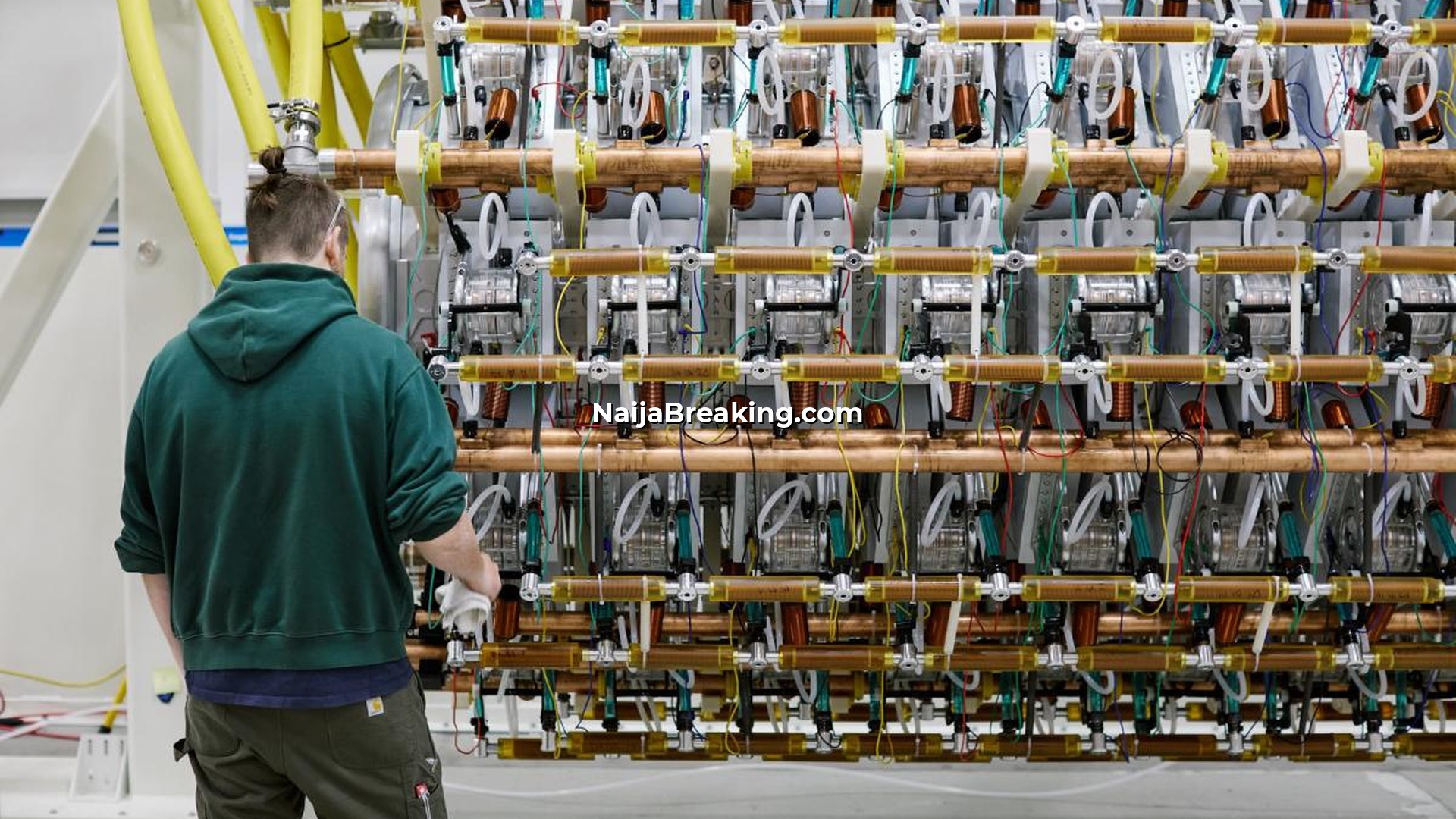
Pacific Fusion unveiled its latest pulser module prototype on Tuesday, delivering the impressive 440-gigawatt power output during an 80-nanosecond burst—an extraordinarily brief but intense electrical pulse designed to trigger fusion reactions in a fuel target. According to TechCrunch’s exclusive report, this achievement unlocked an additional funding tranche from Pacific Fusion’s Series A round, which now exceeds $1 billion USD total. The company has not disclosed the specific size of this latest investment round, but the milestone-based funding model allows the startup to remain focused on technical development rather than constant capital-raising activities.
Keith LeChien, Pacific Fusion’s Chief Technology Officer, explained to TechCrunch that the tranche-based funding model—more commonly used in biotech—enables the team to concentrate on engineering challenges without the distraction of ongoing fundraising. “It means that we can lean into the future without spending 20% to 50% time constantly looking for the next piece of capital,” he stated. This funding discipline matters because fusion development demands sustained, focused engineering effort across multiple technical domains simultaneously.
The company’s technology relies on inertial confinement fusion (ICF), which uses 156 pulser modules in its planned demonstration power plant. Each module delivers an enormous electrical jolt to a fuel pellet roughly the size of an eraser, creating magnetic fields that compress the fuel target until atoms fuse and release massive energy. The demonstration power plant, expected to begin construction this summer, aims to achieve “net energy gain”—producing more electricity than the facility consumes in operations, a milestone no commercial facility has yet achieved. The transition from prototype to full-scale module to demonstration plant represents a compressed engineering timeline driven by competition in the rapidly heating fusion power race.
Impact and Analysis
Pacific Fusion’s breakthrough matters because it shifts fusion from theoretical possibility to engineering reality with a clear commercial pathway. The company is not chasing fundamental physics questions—those were solved decades ago by military weapons research and the National Ignition Facility at Lawrence Livermore Laboratory. Instead, Pacific Fusion is engineering a repeatable, scalable system that can reliably deliver fusion reactions on demand, 24/7, eventually feeding power into commercial grids. This distinction is crucial: the gap between proving something is physically possible and building it as a reliable power plant is often larger than the original scientific breakthrough.
For Nigeria specifically, this development underscores a critical reality about energy poverty in the Global South: solutions often emerge from innovation hubs in wealthy nations but can be adapted and deployed globally with proper policy frameworks and investment. Nigeria’s challenge is not primarily one of technology availability but of institutional capacity, financing mechanisms, and governance clarity around energy infrastructure. The CBN and the Nigerian Electricity Regulatory Commission (NERC) must begin horizon-scanning for emerging technologies and preparing regulatory frameworks that could accommodate fusion power plants—should they become commercially viable—within the next 15-20 years. Waiting until fusion reaches Nigeria’s shores unprepared would repeat the error made with renewable energy integration, where policy lagged technical possibility.
The economics of fusion, once commercialised, could dramatically alter Nigeria’s comparative advantages. A nation with reliable baseload fusion power could attract energy-intensive industries—semiconductor manufacturing, steel production, petrochemical refinement—that current grid instability prevents. Manufacturing competitiveness depends critically on electricity costs and reliability; even a 10% reduction in energy costs could shift investment decisions favoring Nigerian facilities over regional competitors. Beyond economics, reliable electricity directly impacts health outcomes, educational quality, water access, and social stability in ways that economic models often underestimate but communities experience daily.
Expert Perspectives
Dr. Emeka Okafor, a Lagos-based energy economist at the Centre for Strategic and Development Studies, offers a measured assessment: “Pacific Fusion’s achievement is significant, but we must be realistic about timelines. Even if their demonstration plant succeeds within the next five years, commercialisation at scale typically requires another decade minimum. Nigeria cannot wait passively for fusion. We need urgent investment in renewable deployment—solar, wind, hydro—while positioning ourselves to benefit from fusion when it arrives. The real opportunity is in our youth: Nigerian engineers should be participating in global fusion development now, building expertise that serves both international projects and eventual domestic deployment.”
Conversely, Chinyere Adeyemi, senior policy researcher at the Centre for Democracy and Development (CDD), emphasises the structural challenges: “Technology alone cannot solve Nigeria’s electricity crisis without addressing governance, regulatory capture, and funding mechanisms. We’ve seen promises from natural gas, renewables, and efficiency improvements—all technically sound—yet the system remains broken. Fusion energy is a future option, but present urgency demands focus on deployment of proven technologies and fixing institutional failures at NERC, distribution companies, and the Ministry of Power. Without that institutional work, fusion technology will likely bypass Nigeria, being deployed instead in countries with stable regulatory environments and reliable payment mechanisms.”
What This Means for Nigerians
For a Lagos-based entrepreneur running a manufacturing business, energy costs currently consume 15-25% of operating expenses—far above global norms of 5-8%. This cost structure makes Nigerian manufacturers uncompetitive in export markets, forcing businesses either to relocate or shrink operations. If fusion energy becomes a commercial reality within 15-20 years, electricity costs could fall dramatically, potentially returning manufacturing viability to Nigeria’s factories. That translates to jobs: thousands of employment opportunities in sectors like textiles, electronics assembly, food processing, and light manufacturing that depend on cheap, reliable power.
For a student in Kano without reliable electricity at home, Pacific Fusion’s breakthrough represents hope for educational access. Currently, millions of Nigerian students study by lantern light or solar-powered lamps—devices that provide inadequate illumination for serious study, forcing educational disadvantage that compounds through life. Reliable grid electricity would enable internet connectivity, lighting for evening study, access to online educational resources, and the productive environment necessary for competing in a knowledge-driven global economy. That gap between students with reliable electricity and those without represents not merely convenience but inequality hardened into educational and economic trajectories.
For a healthcare facility in rural Adamawa State, electricity means the difference between operating theatre sterility, vaccine refrigeration, diagnostic equipment functionality, and maternal mortality prevention. Currently, generators consuming expensive diesel fuel provide backup power, inflating healthcare costs while consuming fuel resources. Reliable baseload fusion power, if deployed across Nigeria’s grid, could make rural healthcare facilities economically viable and medically effective in ways currently impossible. These ground-level impacts—jobs, education, healthcare—often remain invisible in discussions of energy technology but represent the true measure of energy security’s human value.
Editor’s Take
At NaijaBreaking, we believe Pacific Fusion’s achievement reveals a fundamental truth about Nigeria’s energy future: solutions will not fall from the sky to rescue a nation unwilling to build institutional capacity and governance frameworks that attract innovation and investment. Fusion energy is exciting and represents genuine technological progress, but it is not destiny. Nigeria’s energy crisis persists not because the necessary technology doesn’t exist—we possess abundant solar radiation, wind resources, natural gas reserves, and hydroelectric potential—but because we have failed to build and maintain the regulatory, financial, and governance institutions required to deploy those resources effectively. Pacific Fusion’s success should motivate Nigerian policymakers to action on proven technologies today, not encourage passivity awaiting fusion salvation tomorrow. The countries that will benefit most from fusion energy are those that have already demonstrated competence in deploying renewable energy at scale, attracting investment capital, and maintaining stable regulatory environments. Nigeria is not yet in that category, and the clock is running.
What to Watch Next
Watch for three critical developments: First, Pacific Fusion’s summer construction announcement for its demonstration plant will either deliver concrete progress or encounter unforeseen challenges—either outcome will signal timelines for commercial fusion viability. Second, observe whether major oil and gas companies like Shell, TotalEnergies, or ExxonMobil begin investing substantially in fusion ventures, signalling that even fossil fuel majors view fusion as inevitable. Their investment choices often shape national energy policy conversations globally. Third, monitor whether Nigeria’s Ministry of Power and the CBN initiate any policy dialogue about fusion energy integration, regulatory frameworks, or technology scouting—current silence suggests preparedness for fusion advancement remains minimal.
Additionally, watch for announcements from other fusion startups (Commonwealth Fusion Systems, TAE Technologies, Helion Energy) regarding funding or milestone achievements. The fusion race is genuinely competitive, and success by any major competitor will accelerate commercialisation timelines. What remains to be seen is whether Nigerian policymakers will proactively position the nation to benefit from fusion energy advancement or, as with previous energy transitions, lag behind waiting for external pressure to force adaptation.
Conclusion
Pacific Fusion’s 440-gigawatt burst represents a genuine engineering milestone in humanity’s quest for clean, abundant energy. For Nigeria, a nation of 220 million people struggling with electricity access that constrains every dimension of development—health, education, economic opportunity, dignity—this breakthrough carries symbolic and practical significance. Yet symbolism alone changes nothing. Nigeria’s energy future depends not on fusion energy’s eventual arrival but on immediate, disciplined action to deploy proven renewable technologies, strengthen regulatory institutions, attract investment capital, and build the governance capacity that will position the nation to benefit whenever next-generation energy solutions become commercially available.
The question before Nigeria is not whether fusion energy will change global power systems—it almost certainly will—but whether Nigeria will be prepared to benefit. Will Nigerian engineers participate in that development? Will Nigerian companies manufacture components? Will Nigerian grid operators integrate fusion plants? Will Nigerian citizens access the economic and social advantages that reliable, cheap electricity provides? The answers depend on choices made today, not on breakthroughs achieved in California. Pacific Fusion’s achievement should inspire not passivity but urgency: urgency to fix energy institutions, deploy proven solutions, invest in workforce development, and build the foundation upon which Nigeria’s future energy security—fusion-powered or otherwise—must rest.
Share your thoughts in the comments below—what do you think this breakthrough means for Nigeria’s path toward energy security and economic transformation?