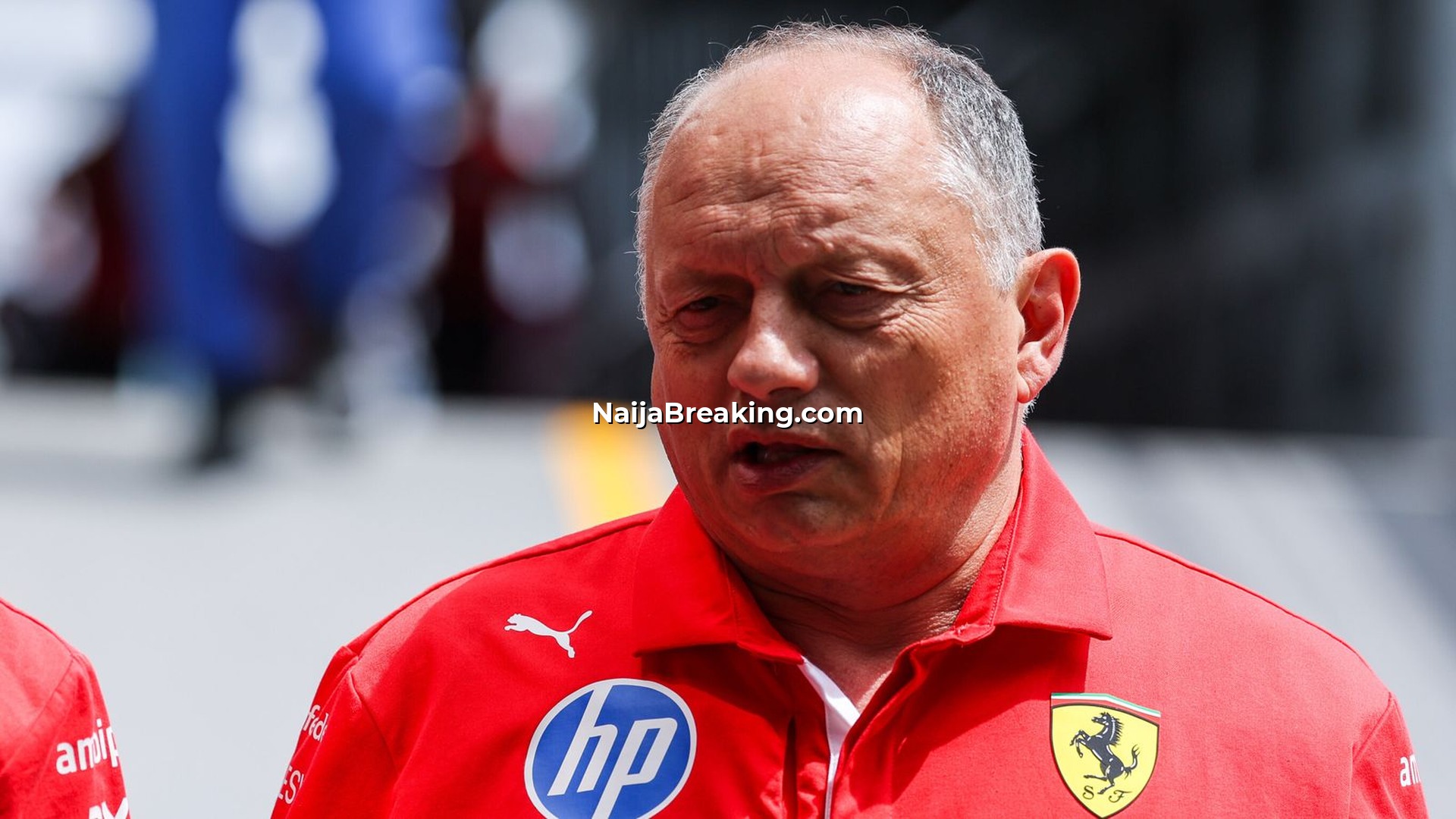
Ferrari Chief Frederic Vasseur Hospitalised Before Monaco Grand Prix Qualifying
Ferrari team principal Frederic Vasseur has been hospitalised after undergoing medical checks overnight at the Monaco Grand Prix, forcing him to miss Saturday’s qualifying session. The 58-year-old was observed at a local medical facility near the circuit following unspecified health concerns, with Ferrari releasing a statement on Saturday morning confirming his absence from the track. This development comes at a critical juncture for the Scuderia, who arrive in Monaco as favourites for victory, having posted dominant performances during Friday’s practice sessions with Lewis Hamilton and Charles Leclerc securing a one-two finish in both FP1 and FP2. While specific details about Vasseur’s medical condition remain undisclosed—Ferrari stated “no further medical information will be provided”—his temporary absence underscores the intense pressure and physical demands of leading one of motorsport’s most prestigious teams during a pivotal championship battle. For Nigerian motorsport enthusiasts and business leaders who follow Formula One as a barometer of global excellence and strategic management, Vasseur’s hospitalisation raises important questions about leadership continuity, decision-making structures within elite organisations, and how world-class teams maintain competitive momentum during unexpected operational disruptions.
Background
Frederic Vasseur assumed the role of Ferrari team principal in January 2023, arriving at the Maranello-based outfit after a distinguished career managing Alfa Romeo Racing and Sauber. His appointment marked a significant strategic shift for Ferrari, a team seeking to restore its competitive edge after years of inconsistent performances and championship droughts stretching back to 2007. Vasseur brought a reputation for operational excellence, technical innovation, and the ability to extract maximum performance from limited resources—qualities that had earned him respect across the paddock despite managing smaller-budget teams. Since taking charge, Vasseur has implemented structural reforms, bolstered Ferrari’s engineering departments, and secured high-profile driver signings, most notably the recruitment of seven-time world champion Lewis Hamilton for the 2025 season. His tenure has coincided with Ferrari’s resurgence in competitiveness, with the team challenging Red Bull Racing and Mercedes for championship honours during 2023 and 2024. The Monaco Grand Prix represents one of the season’s marquee events, traditionally favoured by Ferrari due to the circuit’s slow and medium-speed corner characteristics that suit the SF-24’s handling profile. With championship battles intensifying and Hamilton’s debut year on the horizon, leadership stability has become increasingly critical to Ferrari’s strategic planning and morale maintenance.
Key Details
According to Sky Sports F1, Vasseur was present at the circuit during Friday’s practice sessions, where he engaged with media and oversaw Ferrari’s preparation. He was observed walking out of the Monaco paddock in the evening after both practice sessions concluded, appearing to be in normal condition. However, overnight medical checks prompted his hospitalisation at a local medical facility near the principality. Ferrari’s official statement, released early Saturday morning, confirmed: “Fred Vasseur will not be present at the circuit today. Following some medical checks, Fred will remain under observation at a local medical facility. No further medical information will be provided. We wish Fred a speedy recovery and look forward to seeing him back at the track soon.” The team did not disclose the nature of the medical concern, timing of the hospital admission, or expected duration of his absence. Saturday’s schedule included final practice at 11:30 AM, with qualifying commencing at 3:00 PM (preceded by 2:15 PM build-up coverage on Sky Sports F1). Ferrari did not announce a replacement team principal or designate an acting leader for qualifying and Sunday’s race, suggesting the absence may be temporary. Vasseur’s comments following Friday’s second practice proved prescient: “We have to do a job. It’s a very long way from Friday to Qualifying and the race. The most difficult thing is you have to anticipate the evolution of the track, the grip.”
Impact and Analysis
Vasseur’s hospitalisation carries significant implications for Ferrari’s operational coherence during one of the season’s most technically demanding and politically sensitive weekends. Monaco’s street circuit demands meticulous setup precision, with minimal margin for error—every tenth of a second derives from intensive collaboration between drivers, engineers, and leadership. The absence of the team principal during qualifying removes a senior decision-maker from real-time strategic discussions regarding tyre selection, fuel management, brake bias adjustments, and pit-wall communications. This is particularly consequential for Ferrari, where Vasseur has cultivated a hands-on leadership style, directly influencing major tactical decisions. The psychological dimension matters equally: team morale and confidence can fluctuate when senior leadership is unexpectedly absent during critical moments, potentially affecting driver focus and engineer concentration. However, Ferrari possesses sufficiently mature organisational structures and experienced deputy leaders to execute qualifying and the race competently. The team’s engineering hierarchy includes capable individuals capable of managing strategic decisions, though the loss of Vasseur’s institutional authority and experience may create micro-level inefficiencies. For context, Ferrari earned pole position at Monaco in both 2021 and 2022, demonstrating the organisation’s capability to perform under pressure. The timing—occurring after dominant Friday performances—suggests Ferrari enters the decisive weekend with momentum despite leadership disruption. Key question remains whether this absence will impact Ferrari’s competitive positioning or merely prove a brief interruption in an otherwise strong weekend.
Expert Perspectives
Dr. Adekunle Okonkwo, a Lagos-based sports management consultant and Formula One analyst, observes that “Vasseur’s temporary absence highlights a critical vulnerability in elite sports organisations—over-reliance on single leaders. While Ferrari’s technical capability is undeniable, the absence of principal leadership during qualifying creates decision-making delays and reduces strategic flexibility. The question isn’t whether Ferrari can qualify competitively—they clearly can—but whether this disruption affects the psychological intangibles that separate championship winners from merely competitive teams.” Okonkwo emphasises that “successful teams like Ferrari build redundancy into leadership structures precisely to handle such scenarios, and this weekend will test whether those systems function effectively.”
Conversely, Chinyere Adeyemi, a senior sports policy analyst at the Centre for Democracy and Development in Abuja, argues that “modern Formula One has professionalized to the extent that individual absence, even at leadership level, should not materially impact performance during a single weekend. Ferrari’s engineering staff, strategists, and senior technical directors are world-class professionals who have executed at this level countless times. If anything, Vasseur’s absence may force the organisation to demonstrate operational maturity and collective capability rather than depending on hierarchical authority. This could ultimately strengthen team coherence and prove that Ferrari’s recent success stems from systematic excellence, not individual brilliance.” Adeyemi notes that “temporary leadership absences occur in all major organisations, and how teams respond often reveals deeper truths about their culture and preparedness.”
What This Means for Nigerians
While Formula One exists geographically distant from Nigeria’s immediate concerns, the sport carries surprising relevance to Nigerian business leaders, entrepreneurs, and professionals who increasingly view F1 as a lens through which to understand global excellence, organisational dynamics, and crisis management. Vasseur’s hospitalisation presents a case study in leadership continuity planning—a challenge Nigerian corporations confront regularly, where sudden executive absence can paralyse operations or expose structural weaknesses. For Nigerian CEOs managing multinational subsidiaries, family businesses, or ambitious startups, this situation illustrates why succession planning, documented decision-making protocols, and distributed leadership authority matter. Many Nigerian companies still operate with excessive centralisation around founding leaders or principal executives, leaving organisations vulnerable when that individual becomes unavailable through illness, travel disruption, or personal emergency. The Monaco situation demonstrates that even world-class organisations with unlimited resources face coordination challenges when senior leaders disappear unexpectedly—Nigerian companies operating with fewer resources must build even more robust systems. Additionally, the Monaco Grand Prix attracts global sponsorship, investment, and broadcast revenues; Nigeria’s limited motorsport infrastructure and absent Formula One presence represents a missed opportunity. Countries like South Africa, Kenya, and Zimbabwe have developed more substantial motorsport ecosystems, creating opportunities for automotive development, talent cultivation, and international prestige. For Nigerian investors and sports entrepreneurs, the spectacle of Monaco—with its luxury brands, high-net-worth viewership, and aspirational branding—highlights why sports infrastructure investment generates returns beyond immediate sporting outcomes. Vasseur’s absence, ultimately, underscores how seamless global operations depend on systematic preparation and distributed responsibility—lessons directly applicable to Nigerian organisations seeking world-class performance standards.
Editor’s Take
At NaijaBreaking, we believe Vasseur’s hospitalisation—while concerning on a human level—reveals something important about modern sport’s demands and the often-invisible toll of leading elite organisations. Formula One remains one of the world’s most demanding professional environments, requiring leaders to navigate intense competitive pressure, complex stakeholder dynamics, media scrutiny, and relentless performance expectations. The fact that a capable, experienced leader like Vasseur required hospitalisation and medical observation suggests that even at the highest levels of global sport, burnout, stress-related illness, and physical strain remain genuine occupational hazards. What’s striking is Ferrari’s refusal to disclose specifics—a choice that both respects privacy while simultaneously highlighting how organisations handle adversity through institutional discretion rather than dramatic public disclosure. We believe this represents a healthier approach than the sensationalism often accompanying leadership disruptions. The real story isn’t scandal or dramatic failure; it’s simply that humans lead organisations, and humans occasionally require rest and medical attention. Nigerian organisations could learn from Ferrari’s matter-of-fact handling of disruption: acknowledge the situation, activate contingency systems, avoid unnecessary drama, and focus on performance continuation.
What to Watch Next
Over the coming days, observe: (1) Whether Vasseur returns for Sunday’s race or remains hospitalised beyond Saturday, signalling a more serious condition requiring extended recovery; (2) Ferrari’s qualifying and race strategic decisions, particularly whether decision-making appears sluggish or compromised compared to their Friday performance level; (3) Lewis Hamilton and Charles Leclerc’s performances—if Ferrari pilots deliver dominant results without Vasseur trackside, it validates the team’s operational depth; (4) Whether Ferrari issues updated medical statements or maintains information blackout (current approach suggests privacy respect rather than secrecy); and (5) Commentary from other team principals and paddock observers regarding how Vasseur’s absence affects championship dynamics heading toward mid-season. The key question now is: Does Ferrari’s performance this weekend demonstrate that the organisation has matured beyond dependency on singular leadership, or does Vasseur’s absence reveal structural vulnerabilities that competitors might exploit as the season intensifies?
Conclusion
Frederic Vasseur’s hospitalisation at Monaco represents a sobering reminder that even the most successful leaders occasionally require medical attention and temporary absence from operational duties. For Ferrari, this weekend will test whether the organisation possesses genuine institutional depth or remains overly dependent on its principal’s direct involvement. The significance extends beyond motorsport: it demonstrates that modern elite organisations must balance visionary leadership with systematic resilience, ensuring that individual absence doesn’t cascade into collective failure. This moment reveals truths about Ferrari’s maturity as an institution and the sustainability of its recent competitive resurgence. For Nigerian readers observing from afar, Vasseur’s situation underscores enduring lessons about building organisations that transcend individuals, a principle as relevant to Lagos-based corporations as to Italian racing teams competing on Monaco’s legendary streets.
Share your thoughts in the comments below—what do you think Vasseur’s absence reveals about modern leadership, organisational resilience, and whether Nigerian companies adequately prepare for sudden executive disruptions?