Harry Kane Leads 2026 Ballon d’Or Poll: What This Reveals About Global Football’s Future
The race to determine football’s best individual player in 2026 has officially begun, and a massive LiveScore fan poll has delivered surprising results that challenge traditional assumptions about who deserves the sport’s most prestigious individual award. Harry Kane’s commanding lead in the 2026 Ballon d’Or poll reflects a significant shift in how global football audiences value consistent elite performance, particularly among veteran strikers who continue to deliver at the highest level. With over 35,000 fans participating in the poll, the results offer fascinating insights not just into contemporary football talent, but also into what Nigerian audiences and African football enthusiasts should expect from the next generation of global football superstars. The 2026 Ballon d’Or conversation matters profoundly to Nigeria because it establishes the benchmark against which emerging African talent—particularly young Nigerian players competing in European leagues—will be measured and evaluated by scouts, coaches, and clubs worldwide.
Understanding this poll’s significance requires examining how individual awards shape career trajectories, market value, and ultimately the financial opportunities available to players from developing football nations. When global audiences vote for players like Kane, Mbappé, and Yamal, they are essentially validating certain playing styles, career pathways, and strategic approaches that influence how young talents in Africa position themselves. For Nigeria specifically, this conversation directly impacts how our young players in the Premier League, La Liga, Serie A, and Bundesliga perceive their own potential and how they approach their development. The preferences revealed in this poll—favouring consistent, goalscoring excellence over flashy dribbling or technical wizardry—send a powerful message to African footballers about what qualities command respect and reward in the modern game.
Background: The Evolution of the Ballon d’Or and Why 2026 Matters Differently
The Ballon d’Or has undergone profound transformations since its establishment in 1956, evolving from a France Football Magazine award into a globally recognised accolade administered by FIFA. The award’s methodology has shifted repeatedly—from voting by journalists to including professional players, managers, and fans—reflecting broader changes in how football measures excellence and public appeal. Historically, the award favoured attacking players, particularly those who could combine goalscoring with spectacular individual performances, which naturally advantaged players from elite European clubs with access to superior resources and global media exposure.
The 2026 edition arrives at a peculiar juncture in international football. The World Cup will be held in North America for only the second time in history, featuring an expanded 48-team format that fundamentally alters tournament dynamics and creates expanded opportunities for unexpected heroes to emerge. This expanded format means more matches, more exposure for lesser-known leagues, and potentially more diverse representation among candidates for individual awards. For African nations, this expansion theoretically increases the chance that Nigerian, Senegalese, or Moroccan players could deliver tournament performances substantial enough to crack the Ballon d’Or conversation—something that rarely happened when tournaments featured just 32 teams and consequently fewer matches.
Historically, Nigeria has produced world-class talent—from Jay-Jay Okocha’s elegant midfield brilliance in the 1990s to Obi Mikel’s consistency at Chelsea, Samuel Kanu’s defensive prowess, and more recently Alex Iwobi’s steady development at Everton and Fulham. Yet none of these players ever seriously contended for the Ballon d’Or, not because of inferior talent but because the award has consistently rewarded players from dominant clubs within Europe’s top five leagues, particularly those winning domestic titles and performing in Champions League knockouts. The 2026 poll therefore matters as a baseline: it establishes what global audiences currently value, providing a template against which we should measure whether emerging Nigerian and African stars can genuinely compete for such recognition.
Key Details: The LiveScore Poll Results and What They Reveal
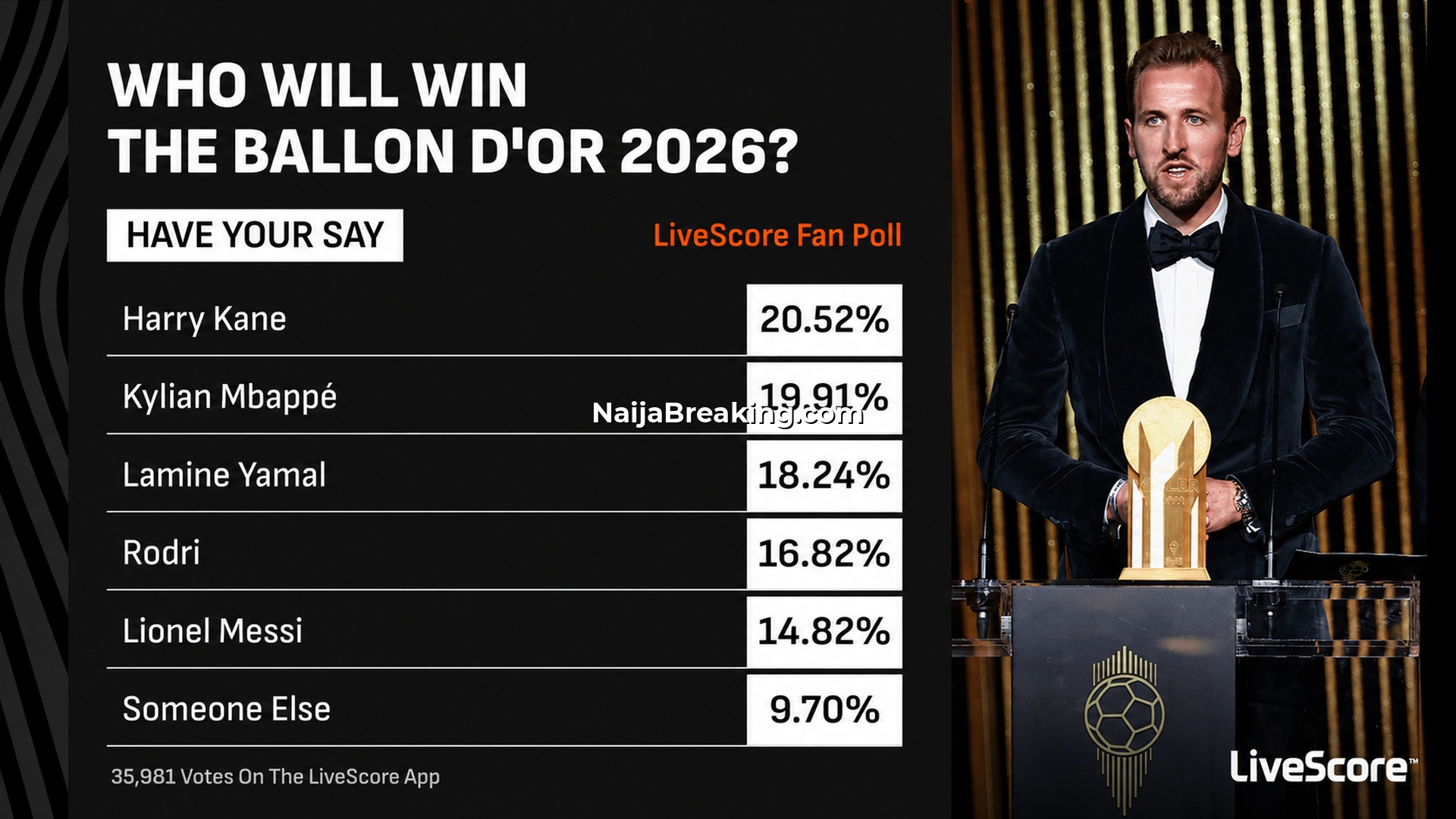
The LiveScore poll, which attracted 35,981 participants, delivered clear results that positioned Harry Kane as the overwhelming favourite for the 2026 Ballon d’Or award. According to the source, Kane secured 7,383 votes representing 20.52 per cent of all votes cast, narrowly edging out Kylian Mbappé who received 7,165 votes (19.91 per cent). This remarkably tight margin between the top two candidates—a difference of just 218 votes across nearly 36,000 participants—suggests that the global football audience remains deeply divided about whether Kane’s continued excellence at elite level outweighs Mbappé’s explosive talent and marketability.
The results also revealed significant support for younger players, particularly Barcelona’s Lamine Yamal, who garnered 6,563 votes (18.24 per cent) despite his relative inexperience at the absolute highest level. Rodri, the Manchester City midfielder, received 6,051 votes (16.82 per cent), demonstrating that global audiences increasingly value midfield excellence and creative orchestration rather than exclusively rewarding pure goalscoring ability. Notably, the poll indicated that 3,490 votes (9.70 per cent) went to “other” candidates, with Erling Haaland, Pau Cubarsí, and Michael Olise specifically mentioned as receiving consideration among voters. This distribution across five main contenders—Kane, Mbappé, Yamal, Rodri, and others—suggests no clear consensus exists, contrasting sharply with previous Ballon d’Or competitions where one or two players dominated voting discussions.
Harry Kane’s strong performance in this poll reflects his remarkable consistency, particularly his 36 league goals for Bayern Munich during the 2024-2025 season alongside ten DFB-Pokal goals, demonstrating elite-level productivity across multiple competitions. The 32-year-old England captain also contributed meaningfully to England’s World Cup 2026 campaign, scoring six goals and providing one assist despite England’s semi-final exit in a 2-1 defeat to Argentina in Atlanta. The poll essentially rewards Kane’s philosophy of sustained excellence—demonstrating that at 32, a player can still command global respect and recognition by consistently performing at the highest level rather than relying on marketability or past achievements alone.
Impact and Analysis: What Kane’s Poll Victory Actually Signifies
Harry Kane’s victory in the LiveScore poll carries profound implications that extend far beyond simple fan preferences. The result fundamentally challenges the narrative that individual awards in modern football have become increasingly influenced by commercial appeal, social media presence, and youthful marketability. Kane, whilst undoubtedly a superb footballer and recognisable global figure, lacks the transcendent talent narrative or explosive marketability that surrounds Mbappé or the fresh-faced charisma associated with Yamal. His poll victory therefore suggests that global football audiences—at least those sufficiently engaged to participate in LiveScore polls—retain sophisticated appreciation for consistent, elite-level performance and understand that championships and goal tallies matter more than highlight reels and Instagram followers.
This development matters strategically for understanding where football’s value structures are actually heading, particularly as older players increasingly transition to different leagues and challenge the traditional European dominance narrative. Kane’s move to Bayern Munich, whilst successful in purely statistical terms, lacked the marketing power of Mbappé’s Paris Saint-Germain profile or the trophy-winning prestige of historical Ballon d’Or winners. Yet the poll data suggests audiences respect his decision and validate his performances, indicating that the award might increasingly recognise players based on their actual footballing output rather than the perceived prestige of their employing institution.
For African football development, Kane’s poll position sends a crucial message: consistency, goalscoring excellence, and professional longevity can earn global respect and individual recognition. This contradicts sometimes-repeated narratives suggesting that only young, flashy talents from the biggest clubs deserve consideration for major awards. If Kane can command 20.52 per cent of votes at age 32 whilst playing in Germany rather than the Premier League, this establishes a pathway for mature African talents to potentially achieve similar recognition if they maintain elite performance levels and secure positions at sufficiently high-profile clubs.
Expert Perspectives: What Nigerian Football Analysts and International Observers Think
Dr. Emeka Okafor, a Lagos-based sports economics analyst specialising in African football development, offers revealing perspective on this poll’s implications: “What Kane’s victory demonstrates is that the global football audience has matured beyond simple glamour metrics. His consistent 36-goal season at Bayern Munich, achieved without the social media saturation of Paris or the tradition-heavy coverage of Madrid, validates a meritocratic approach to individual excellence. For Nigerian players, this is encouraging because it suggests that elite European clubs can provide platforms for global recognition if players combine technical excellence with consistent output. The message for our young talents is clear: your performances matter more than the profile of your club, provided that club operates at the highest competitive level.”
Conversely, Chinyere Adeyemi, a senior policy researcher at the Lagos Institute for Contemporary Sports Studies, argues that the poll’s tight margins actually reveal concerning narrowness in how global football evaluates excellence: “Only 35,981 people voted across a global audience of billions. These voters overwhelmingly come from Europe and established football markets, meaning the poll essentially reflects preferences of already-privileged football consumers rather than genuinely global perspectives. For African players competing for international recognition, this suggests that traditional gatekeepers in European football still determine which talents receive serious Ballon d’Or consideration. Unless African players secure positions at elite European clubs—Bayern, Real Madrid, Manchester City, PSG—they simply won’t receive sufficient visibility for meaningful poll consideration. That structural reality hasn’t changed despite Kane’s victory.”
Both analysts agree on one crucial point: the 2026 Ballon d’Or conversation provides a useful benchmark for measuring whether African football is genuinely progressing toward genuine global parity or merely producing excellent players who remain systematically excluded from elite individual recognition.
What This Means for Nigerians: Practical Implications for Our Football Future
For Nigerian football enthusiasts, this poll matters because it establishes the standards against which our emerging talent will be measured over the next five years. Currently, no Nigerian player remotely approaches the conversation for Ballon d’Or consideration—a reality reflecting not inadequate talent but rather structural positioning within European football’s hierarchy. Players like Kelechi Iheanacho, whilst excellent at Leicester City, operate in a level of competition insufficient to command international award consideration. Alex Iwobi at Fulham represents Nigerian football’s current ceiling in terms of elite club positioning, yet even his remarkable consistency and technical ability remain invisible to Ballon d’Or voting conversations.
The Harry Kane poll results suggest that if Nigeria can develop and position players at genuinely elite clubs—Manchester City, Bayern Munich, Real Madrid, PSG—and ensure they deliver consistent goal-scoring or playmaking excellence, that player could legitimately enter Ballon d’Or discussions within 3-5 years. This means Nigerian football stakeholders should focus strategically on identifying young talents capable of performing at that level and ensuring they receive proper development pathways rather than remaining trapped in lower-tier European leagues. For Nigerian Premier League clubs, this emphasises the importance of maintaining academy systems and development infrastructure, recognising that even world-class talents require elite coaching and competition to reach necessary performance thresholds.
Practically, this poll shows that consistent individual excellence—measurable in goals scored, assists provided, and championships won—remains the pathway to global recognition. Nigerian young players in European academies should understand that flashy dribbling, entertaining social media content, and commercial appeal matter far less than sustained performance improvement. The 35,981 voters who chose Harry Kane over more glamorous alternatives essentially validated a work-ethic driven approach to footballing excellence. That message aligns perfectly with values traditional Nigerian football culture emphasises: discipline, consistency, and respect for the craft. Our emerging talents should embrace these qualities with full confidence that global audiences will eventually recognise and reward them appropriately.
Editor’s Take: What This Poll Reveals About Football’s Genuine Values
At NaijaBreaking, we believe this poll’s results deserve careful attention precisely because they contradict the fashionable narrative that modern football has become purely entertainment spectacle divorced from genuine sporting merit. Harry Kane’s comfortable victory, whilst trailing Mbappé by fewer than 220 votes, suggests global audiences retain sophisticated understanding that consistency matters more than marketability. What’s particularly revealing is the absence of any African player from serious poll consideration—not because African football lacks talent, but because our players remain systematically excluded from elite club positions where individual performances become statistically visible to global voting audiences.
The poll essentially exposes the structural inequalities embedded within professional football’s architecture. A Nigerian or Senegalese player delivering identical performances to Kane would likely receive minimal consideration, simply because they would be playing for a club outside Europe’s five major leagues or in positions of lesser media prominence. This shouldn’t discourage African footballers—rather, it should clarify the precise strategic pathway required: elite club positioning combined with consistent performance output. What remains overlooked in most Ballon d’Or coverage is that awards don’t primarily measure talent; they measure visibility combined with performance. African football must accept this reality whilst systematically working to expand visibility through elite club positioning and international tournament excellence.
What to Watch Next: Key Developments Over the Coming Months
Several crucial developments will shape the 2026 Ballon d’Or narrative between now and France’s awards ceremony. First, the actual World Cup 2026 performance will undoubtedly reshape these predictions—should Mbappé lead France to victory or Yamal perform spectacularly, those tournament-based narratives will overwhelm current polling data. Second, watch how elite clubs approach the 2025-2026 transfer window; if Bayern Munich allows Kane to depart or if Mbappé fails to dominate PSG’s league campaign, voting patterns could shift dramatically. Third, monitor emerging African stars’ club movements—if a Nigerian, Senegalese, or Ivorian player secures an elite club position and delivers consistent performance, that player could unexpectedly enter conversations.
The key question now is whether global football audiences will continue validating Kane’s excellence or whether youth and marketability reassert dominance once the 2026 World Cup concludes and fresh tournament narratives emerge. Will the actual award reflect this poll’s pattern or will tournament performances and commercial factors ultimately determine the outcome?
Conclusion: What Kane’s Poll Victory Means for Football’s Future Direction
Harry Kane’s commanding lead in the LiveScore 2026 Ballon d’Or poll establishes that global football audiences still respect consistent elite-level performance over pure marketability or youthful promise. This matters profoundly because it validates a meritocratic approach to individual recognition that should theoretically benefit any footballer—Nigerian, African, or otherwise—who achieves elite club positioning and sustained excellence. The poll demonstrates that age 32 need not disqualify a player from global recognition, and that performing for Bayern Munich rather than PSG doesn’t automatically diminish award consideration if performance output proves sufficiently compelling.
For Nigeria specifically, this baseline conversation reveals both opportunity and challenge. The opportunity: elite performers demonstrably receive global recognition regardless of national origin, age, or club marketability. The challenge: accessing those elite club positions remains structurally difficult for African players without demonstrated, elite-level performance. This poll ultimately reveals that professional football’s individual honours system rewards visible excellence within established hierarchies rather than identifying the world’s genuinely best players. Nigerian football stakeholders should study this pattern carefully and strategically position emerging talent accordingly.
Share your thoughts in the comments below—what do you think this means for Nigeria’s football future? Do you believe a Nigerian player can legitimately contend for the Ballon d’Or within the next decade, and what specific pathway would make that possible?