Starlink and Nigeria’s Infrastructure Crisis: The Cost of Choosing Satellites Over Systems
Nigeria’s digital future is increasingly dependent on satellites orbiting 550 kilometres overhead, a sobering reflection of a telecommunications infrastructure gap that has widened despite nearly two decades of mobile broadband expansion. Starlink Nigeria infrastructure gap represents not just a technological reality but a policy failure—one that shows how private enterprise can fill the void left by government neglect, yet at a cost ordinary Nigerians cannot sustain. On Lagos Island this morning, as in Abuja, Kano, and Port Harcourt, thousands of professionals and entrepreneurs are relying on Elon Musk’s satellite constellation because terrestrial networks, built by MTN Nigeria, Airtel, Glo Mobile, and Spectranet, have failed to deliver reliable, affordable broadband to businesses and homes. This is not a story about innovation; it is a story about the infrastructure gap in Nigeria that has become so acute that a private American billionaire now holds more economic influence over Nigerian digital commerce than the Nigerian Communications Commission (NCC).
The numbers tell a striking story: nearly 92,000 Nigerian subscribers now pay N57,000 monthly (or N159,000 for business-grade service) to access Starlink, money that flows directly to SpaceX’s balance sheet. Meanwhile, the CBN’s foreign exchange reserves face constant pressure from imports, and Nigerians’ purchasing power erodes. Yet for many—fintech analysts, software developers, remote workers, and small business owners—Starlink represents the only viable option when local providers cannot guarantee uptime, speed, or consistency. The question is not whether Starlink fills a need; it demonstrably does. The question is why Nigeria allowed this need to exist in the first place, and what it costs the nation to depend on foreign infrastructure for digital economic participation.
Background
Nigeria’s telecommunications sector was meant to be a success story. When the government licensed private operators in the 1990s following the deregulation of telecommunications, the expectation was that competition would drive innovation and coverage. MTN Nigeria entered in 2001, Airtel (Celtel) in 2002, and Glo Mobile in 2003. By 2010, Nigeria had become Africa’s largest mobile subscriber base with over 90 million connections. The mobile revolution was real, but it was exclusively centred on voice and basic 2G/3G services. Broadband infrastructure—fibre optic cables, data centres, and backbone networks—remained fragmented and underinvested.
In 2007, the Nigerian government launched the National Broadband Plan, with ambitious targets to connect 40% of the population by 2015. That deadline came and went. By 2019, only 28% of Nigerians had broadband access according to the NCC. The Federal Inland Revenue Service (FIRS) and the Central Bank of Nigeria (CBN) continued to tax telecommunications companies aggressively, discouraging capital-intensive fibre deployment. The Excise Tax on telecommunications, introduced in 2016, added further pressure. Meanwhile, electricity infrastructure remained unreliable—the Transmission Company of Nigeria (TCN) and distribution companies could not provide stable power for cell tower operations, forcing telecom providers to run generators that consumed millions of litres of diesel monthly.
The policy environment was chaotic. The NCC struggled to enforce universal service obligations. License fees were expensive. Property rights were uncertain in many states, making fibre route deployments legally precarious. By 2023, as remote work became permanent for many Nigerians post-pandemic, the gap between demand for high-speed internet and supply became undeniable. That gap was where Starlink entered, not as a solution to a solved problem, but as a lifeline to a market abandoned by domestic providers who found fibre deployment unprofitable given Nigeria’s regulatory and infrastructural constraints.
Key Details
Starlink launched commercial operations in Nigeria in February 2024 and by mid-2026 had attracted approximately 92,000 subscribers, making Nigeria one of Africa’s largest Starlink markets. According to source reporting on the phenomenon, residential users pay N57,000 monthly (approximately $38 USD) after a one-time hardware cost of N590,000 (roughly $390 USD). Business-tier subscriptions cost N159,000 monthly. These are significant sums in a nation where the National Bureau of Statistics reported that 42.9% of the population lived below the poverty line as of 2023, yet they are perceived as value for money by professionals earning in dollars or pound sterling via remote employment.
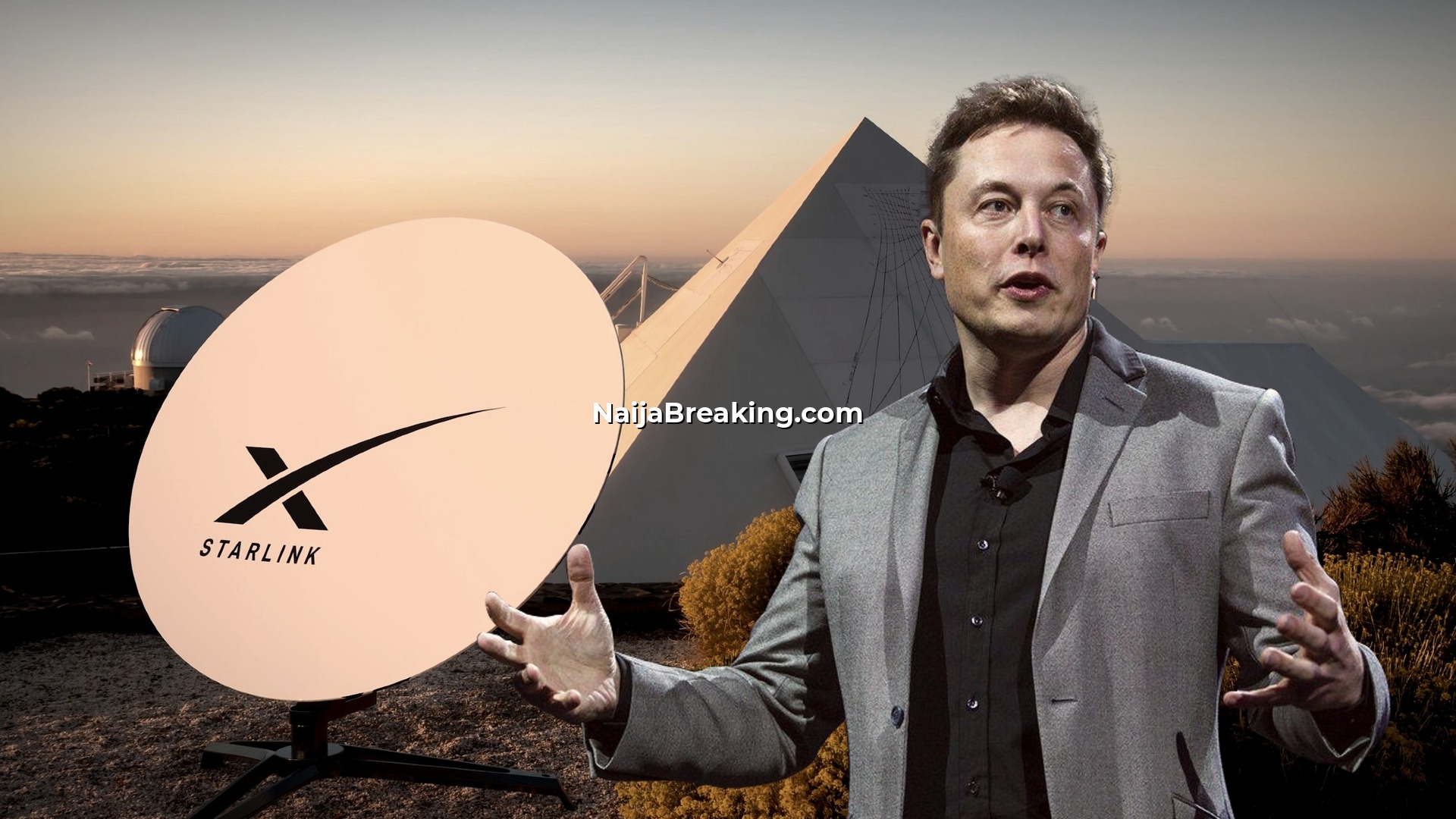
The hardware—a flat white satellite dish—is elegantly simple but represents a dependence on supply chains Nigerians do not control. Each dish connects to SpaceX’s Starlink constellation, which as of June 2026 comprises over 6,000 operational satellites. The service offers speeds of 50-150 Mbps for downloads, far superior to the 5-15 Mbps typical of congested LTE networks in Lagos. SpaceX simultaneously filed for its largest initial public offering in corporate history in June 2026, raising $75 billion at a valuation of $1.77 trillion, cementing Starlink as not a side venture but a core profit centre. Musk’s personal wealth, boosted by SpaceX’s public listing, reportedly crossed $1 trillion, making him the world’s first trillionaire.
On the domestic side, Nigeria’s telecom providers responded with expanded LTE deployments, but without major fibre backbone investments, LTE networks remained congested. The NCC reported in its 2024 annual report that fixed broadband penetration stood at just 11.4%, while mobile broadband penetration was 32.5%—figures that mask severe urban-rural divides. Starlink’s entry did not trigger the expected price wars. Instead, it created a bifurcated market: those who could afford satellites (professionals, expatriates, tech companies) and those dependent on terrestrial networks. The Central Bank’s monthly BDC rate pressures meant that N57,000 monthly represented an increasing burden for middle-class Nigerians as the naira depreciated.
Impact and Analysis
The emergence of Starlink as a primary internet solution exposes a structural failure in Nigeria’s economic planning. A nation that produces oil wealth, hosts Africa’s largest technology ecosystem, and generates substantial government revenue has failed to build the basic digital infrastructure required for its own growth. This is not a failure of private enterprise—MTN, Airtel, and Glo have built what was economically rational within Nigeria’s constraints. It is a failure of government to create conditions where fibre deployment is incentivised, property rights are secure, taxation is proportional, and electricity is reliable.
The economic cost is substantial and distributed unevenly. Every naira spent on Starlink subscriptions is a naira that leaves Nigeria. For a fintech analyst earning $3,000 monthly and spending N57,000 monthly on Starlink, the cost is proportionally manageable. For a small business owner earning N500,000 monthly and paying N159,000 for business-tier Starlink, it becomes 32% of operational costs dedicated solely to internet. Compare this to Bangladesh, where Grameenphone and other terrestrial providers offer broadband at less than 3% of median income, or India, where Jio’s infrastructure investments created broadband packages at under 2% of income. Nigeria’s reliance on Starlink is not optimal; it is a symptom of deeper failure.
Furthermore, the concentration of critical digital infrastructure in foreign hands raises questions of sovereignty and resilience. During periods of geopolitical tension or if SpaceX faces regulatory challenges in the United States, Nigerian businesses and professionals could face service disruption with no domestic alternative. The NCC lacks leverage to enforce local standards, data residency requirements, or network priorities. If a critical national event occurs—elections, banking crisis, security emergency—Nigeria cannot compel Starlink to prioritise national traffic. This is not theoretical; it is a structural vulnerability that grows with every additional subscriber who chooses satellites over terrestrial networks.
Expert Perspectives
Dr. Adekunle Ogunfunmiwo, a senior telecommunications policy analyst at the Lagos Business School, frames the situation bluntly: “Starlink is a symptom, not a solution. What we are seeing is the private sector solving for individual demand while the public sector abdicates responsibility for collective infrastructure. If the NCC and FCC had created a regulatory environment where fibre deployment was profitable—through tax incentives, right-of-way guarantees, and clear universal service obligations—Nigerian companies would have invested domestically. Instead, we have created conditions where a foreign billionaire’s satellite constellation is more reliable than our own networks. That is not innovation; that is outsourcing sovereignty.”
Conversely, Chisom Okonkwo, a venture capitalist focused on African fintech, argues there is nuance: “I don’t believe we should demonise Starlink. Yes, it represents a gap in domestic infrastructure. But for the fintech ecosystem, for software companies, for remote workers, Starlink has been transformative. It has enabled Nigerian tech talent to compete globally without the infrastructure penalty that would have been a constraint five years ago. The question is not whether we should ban Starlink but whether we can simultaneously build domestic alternatives. Starlink buys us time to get our terrestrial networks right. The mistake would be to become complacent and assume Starlink solves the problem permanently.”
What This Means for Nigerians
For the fintech analyst in Ikoyi, Starlink means she can reliably take client calls, maintain her professional reputation, and qualify for remote contracts that pay in dollars. Without it, she loses income. For the small business owner in Abuja running an e-commerce operation, Starlink means consistent inventory management, customer communication, and payment processing—services that terrestrial networks frequently fail to support during peak hours. For the university student in Kano studying software engineering via online courses, Starlink means access to global learning platforms without the buffering and dropout that defines experience on overloaded LTE networks.
But this access has a price that reflects geography and income starkly. A young professional in Lagos earning N800,000 monthly sees N57,000 Starlink as a legitimate business expense. A trader in Benin City with identical connectivity needs but earning N400,000 monthly experiences Starlink as a luxury. And a student in a rural area earning nothing faces a service she simply cannot access, regardless of the infrastructure available. This is the inequality Starlink crystallises: it is not democratic infrastructure. It is premium infrastructure that follows money and education, not need. The FCC’s regulatory approval of Starlink in Nigeria, which came without conditions tied to affordability targets or rural service obligations, meant that the public interest was subordinated to private profit.
For job prospects, remote work—which exploded during 2020-2023 pandemic lockdowns—remains hostage to reliable broadband. Nigerian software developers, customer service agents, and content creators competing in global markets need the same infrastructure as their American or British counterparts. Starlink enables this. But it also means Nigerian talent is geographically concentrated where Starlink is affordable: Abuja, Lagos, Port Harcourt, Ibadan. Kano, Katsina, and Yobe fall further behind, widening Nigeria’s internal digital divide and reinforcing existing economic inequality by region and gender.
Editor’s Take
At NaijaBreaking, we believe this story reveals a uncomfortable truth about Nigeria’s governance and economic priorities. The fact that a private American company now provides more reliable internet to Nigerian professionals than the domestic telecommunications providers we have licensed and taxed for twenty years is not a triumph of free markets. It is an indictment of state capacity and policy coherence. What appals us is not that Starlink exists—it is that the NCC, the Ministry of Communications and Digital Economy, and the Federal Government allowed the gap to grow so wide that Starlink became necessary.
More troubling is the silence. Nigerian media has celebrated Starlink’s arrival without demanding accountability from those responsible for the infrastructure gap. Where are the investigations into why fibre deployment has moved at glacial speed? Where are the questions about why the CBN allows continuous naira depreciation that makes imported satellite services increasingly unaffordable? What remains unexamined is the policy choice: did Nigeria consciously decide that satellite infrastructure was acceptable, or did policymakers simply fail to plan? The distinction matters, because one is a choice and the other is negligence. What this story reveals is the cost of governance by drift.
What to Watch Next
Three developments will determine whether Nigeria’s satellite dependence becomes permanent or catalyses domestic action. First, watch the NCC’s broadband targets for 2027-2030. If they remain ambitious (40%+ coverage) without specifying fibre deployment milestones and regulatory incentives, they are marketing, not policy. Second, monitor the FCC’s approval of additional satellite operators—Amazon’s Project Kuiper, Intelsat, and others are queuing for Nigerian licenses. Fragmented foreign infrastructure is worse than concentrated dependence. Third, track whether any Nigerian telecom provider (most likely MTN, Airtel, or a new entrant) receives significant capital investment in fibre backbone. If MTN commits N200 billion to fibre in the next 18 months, there is hope for competition. If not, Starlink’s dominance becomes structural.
The key question now is whether Nigerians will demand accountability from policymakers or accept that satellite broadband from abroad is the new normal. What policy changes would make domestic fibre deployment profitable? What incentives would convince MTN or Airtel to accelerate backbone investment? These are the conversations that should dominate debates about Nigeria’s digital future, not celebrations of Starlink’s convenience.
Conclusion
Starlink’s rapid adoption in Nigeria is a story about failure—the failure of a nation to build the infrastructure its own economy requires. It is also a story about resilience and adaptation: Nigerians have found a way to bridge a gap through technology and private capital. But resilience and adaptation should not be confused with victory. Every Starlink subscription that reaches 100,000 or 500,000 users represents money leaving Nigeria, infrastructure dependency on a foreign power, and an acceptance that our government will not prioritise our digital future.
The question Nigeria must answer in the coming months is whether this dependence on satellite infrastructure catalyses urgent policy reform or becomes the new baseline. Will the NCC and Ministry of Communications use Starlink as a wake-up call, or will they accept it as a solution that absolves them of responsibility? Nigeria’s digital economy—its fintech sector, software development, creative industries, and remote workforce—depends on the answer. The infrastructure gap that Starlink reveals is not an indictment of Elon Musk or SpaceX. It is an indictment of Nigerian governance. What we choose to do about it now will define whether the next decade sees recovery or deeper decline.
Share your thoughts in the comments below—what do you think Nigeria’s government should do to compete with Starlink and build domestic broadband infrastructure?