Curacao’s World Cup Fairytale: How a Tiny Caribbean Nation’s Goalless Draw Challenges Global Football Hierarchy
The Curacao World Cup fairytale continues to defy the conventional logic of international football. On Saturday in Kansas City, the Dutch Caribbean island—a nation with just 150,000 people—secured their first-ever point in World Cup history with a stunning 0-0 draw against Ecuador, a country that finished second in South American qualifying. This moment represents far more than a single match result; it symbolises how smaller, historically marginalised nations are beginning to challenge the entrenched power structures that have long dominated global football. For Nigerian readers, the Curacao story offers a profound lesson about resilience, strategic planning, and the possibility of punching above one’s weight on the world stage—a narrative that resonates deeply with Nigeria’s own aspirations to reclaim continental and global football prominence.
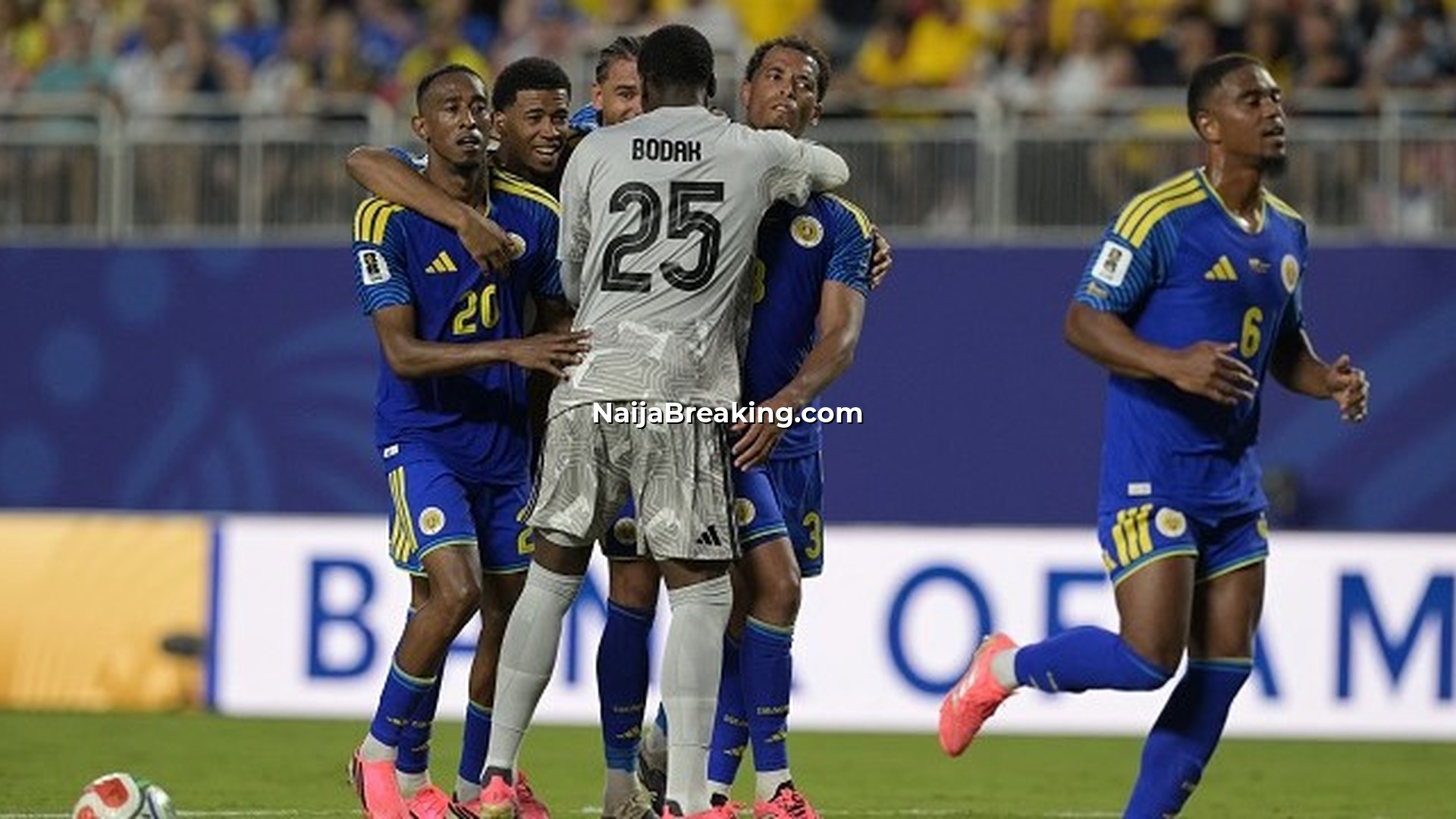
The narrative surrounding this match is extraordinary. Curacao, competing at their first World Cup, faced Ecuador—a nation with significantly more footballing infrastructure, resources, and historical experience on the global stage. Yet Miami FC goalkeeper Eloy Room delivered the performance of his life, making 15 saves, the most recorded by any goalkeeper in a non-extra-time World Cup match since 1966, according to source. This single match encapsulates something increasingly important in modern football: that tactical discipline, psychological resilience, and exceptional individual performances can sometimes overcome overwhelming statistical disadvantages. For Nigeria, a nation that has historically punched above its weight in African football but has struggled to maintain consistent World Cup success, the Curacao model presents intriguing strategic lessons worth examining.
Background
Understanding Curacao’s improbable journey to the 2026 World Cup requires context about how global football has evolved and how smaller nations have begun to access international football’s highest levels. Historically, World Cup participation remained concentrated among nations with established footballing traditions, significant economic resources, and large player pools. The Caribbean has rarely featured prominently in World Cup tournaments; nations from this region typically compete in qualifying tournaments dominated by concacaf powerhouses like Mexico, the United States, and Costa Rica. Curacao’s qualification represents a seismic shift in this dynamic, driven partly by UEFA’s decision to allow Caribbean nations greater access to European club football pathways and partly by systematic investment in youth development programmes.
The island’s football programme, managed by Dutch coach Dick Advocaat—a figure with extensive European managerial experience—reflects a strategic pivot toward leveraging diaspora connections and European-based talent. Remarkably, 25 of Curacao’s 26-player squad were born in the Netherlands, a testament to how Caribbean nations with historical ties to European countries can mobilise diaspora talent pools to compete globally. This strategy mirrors approaches increasingly adopted by nations like Japan and South Korea, which systematically integrated foreign-based players into their national teams. Nigeria, by contrast, has historically struggled to develop coherent diaspora engagement strategies, with many Nigerian players eligible to represent the national team either declining opportunities or facing bureaucratic complications in switching eligibility.
Curacao’s qualification also reflects broader shifts in global football democratisation. The expansion of professional pathways in European lower divisions and the increasing fluidity of player mobility across continents have created new opportunities for smaller nations. Where once only elite footballing nations could field competitive World Cup teams, the modern era allows nations with strategic planning and effective diaspora connections to compete at the highest levels. This contextual shift is critical: it suggests that football’s traditional hierarchies are becoming more permeable, though certainly not equal. For Nigeria—a nation with enormous domestic talent but often fragmented player identification and development systems—this lesson about strategic diaspora engagement and systematic youth development carries significant weight.
Key Details
The Curacao versus Ecuador match on Saturday delivered several remarkable statistical narratives that deserve detailed examination. Ecuador dominated possession and created numerous opportunities, registering 28 shots overall with 15 on target, according to source. By any conventional measure of football analysis, Ecuador should have won decisively. The South American nation, which finished second in CONMEBOL qualifying—a qualifying group widely regarded as the most competitive on the planet—created multiple clear scoring opportunities throughout the 90 minutes. In the third minute alone, former West Ham forward Enner Valencia broke through Curacao’s defensive line but encountered the extraordinary reflexes of goalkeeper Eloy Room, who diverted the shot around the post.
Eloy Room’s performance became the decisive factor in this match. The Miami FC goalkeeper made 15 saves, a figure that represents the highest number recorded by any goalkeeper in a World Cup match without extra-time since official records began in 1966. This statistic places Room’s performance in rarefied historical company, alongside some of the most memorable individual goalkeeping displays in football history. Ecuador’s captain, Enner Valencia, had multiple opportunities to break the deadlock but found Room immovable. Jordy Alcivar and other attacking midfielders tested the Curacao defence repeatedly, yet the Caribbean side’s defensive organisation, combined with Room’s extraordinary shot-stopping ability, proved sufficient to preserve the clean sheet.
The match dynamic was distinctly asymmetrical: Ecuador controlled 65 percent of possession in the first half alone, yet Curacao demonstrated characteristic efficiency on the counter-attack. The Caribbean nation’s attacking opportunities were limited but dangerous, with players like Sherel Floranus testing Ecuador’s goalkeeper with direct runs on the break. This 0-0 result keeps Curacao’s knockout stage qualification hopes alive, extending what the team’s official social media described as a “history-making” World Cup campaign. The draw comes after Curacao suffered a 7-1 defeat to Germany in their opening match—a result that could have psychologically devastated a team competing at their first World Cup, yet paradoxically provided motivation for a more defensive, organised approach against Ecuador.
Impact and Analysis
This match result carries implications that extend well beyond the immediate World Cup context. The Curacao-Ecuador draw demonstrates that modern international football is becoming increasingly competitive and unpredictable, with traditional hierarchies no longer guaranteeing success. Ecuador, despite superior resources, infrastructure, and qualifying group experience, could not overcome a well-organised, tactically disciplined opponent with an exceptional goalkeeper. This outcome challenges the assumption—long held in football analysis—that possession dominance and shot quantity automatically translate into victory. Statistical superiority, while generally predictive of success, is not deterministic, particularly when one team has organised defensive structures and exceptional individual performances.
The broader implication is that football’s democratisation is real and accelerating. Smaller nations can now compete at the World Cup level, not through magic or fortune, but through strategic planning, systematic player development, and intelligent tactical organisation. Curacao’s approach—leveraging diaspora talent, hiring an experienced European coach, and developing a clear defensive identity—represents a replicable model. For Nigeria, this carries both encouraging and cautionary lessons. Nigeria possesses significantly more domestic talent than Curacao, yet has often failed to mobilise this talent as effectively as smaller nations with more coherent long-term strategies. The fact that Curacao can hold Ecuador to a scoreless draw while Nigeria has historically struggled against comparable opponents in World Cup qualifying suggests that structural organisation and strategic clarity matter more than raw talent availability.
Additionally, this result raises questions about what constitutes success at the World Cup. Traditionally, World Cup participation itself has been viewed as success for smaller nations, with knockout stage qualification reserved for elite football nations. Curacao’s trajectory—a 7-1 loss followed by a goalless draw—demonstrates a team learning, adapting, and improving match-by-match. This incremental improvement narrative is psychologically significant and could create momentum for future campaigns. For Nigeria, whose recent World Cup campaigns have often featured inconsistency and tactical confusion, the Curacao model of systematic improvement and defensive solidity offers a template worth studying.
Expert Perspectives
Dr. Chinyere Adeyemi, a Lagos-based sports analyst specialising in global football development at the Institute for Strategic Studies, observes that “Curacao’s draw with Ecuador represents a watershed moment in how smaller nations approach international football. They’ve deliberately constructed a team around a singular strategic objective—remaining competitive defensively while minimising risk on the offensive. This is not the attacking, possession-based football traditionally celebrated in European contexts, but it’s proving increasingly effective. Nigeria, by contrast, has often pursued high-possession strategies that leave us vulnerable to tactical opponents with superior discipline. Curacao shows us that football philosophy matters more than talent abundance.”
Kayode Okafor, a former Nigerian national team scout currently advising West African football federations, adds: “What impresses me about Curacao’s approach is their clarity about player identification and their willingness to invest in lower-profile European leagues where diaspora players compete. They’ve essentially created a pipeline of talent from Dutch football into their national team. Nigeria has vastly more natural talent but lacks this systematic identification and development infrastructure. We have thousands of talented young Nigerians scattered across European academies, yet our national team recruitment often feels ad-hoc and reactive rather than strategic. Curacao’s success should force Nigerian football administrators to fundamentally reconsider our player development model.”
What This Means for Nigerians
For ordinary Nigerians invested in football—and this encompasses millions of passionate supporters across Lagos, Abuja, Kano, and beyond—the Curacao story carries direct implications for how we should think about Nigerian football’s future. The Super Eagles, historically one of Africa’s elite teams, have recently struggled to qualify for World Cups and deliver consistent performances at continental competitions. Watching Curacao, a nation with a fraction of Nigeria’s population and resources, compete credibly at the World Cup stage should prompt uncomfortable questions about where Nigerian football administration has gone wrong. Why hasn’t Nigeria, with its vast talent pool, larger economy, and stronger football infrastructure than Curacao, been more successful in recent World Cup campaigns?
The practical implications extend to how Nigerian football academies, the Nigerian Football Federation, and individual clubs approach player development. Curacao’s success demonstrates that having a clear, long-term strategic vision—selecting players based on philosophical alignment, developing a cohesive team identity, and maintaining tactical discipline—matters more than simply assembling the most talented individuals available. For young Nigerian players aspiring to represent their country, the Curacao model suggests that demonstrating tactical intelligence, defensive solidity, and psychological resilience matters as much as technical ability. Nigerian youth players should understand that the future of international football increasingly rewards complete footballers who understand positional discipline and team organisation, not just individually gifted performers.
Additionally, the Curacao case demonstrates that smaller nations can punch above their weight through strategic use of diaspora networks and European-based talent pathways. Nigeria has millions of diaspora members, many of whom have played professional football or could contribute expertise to player development. Yet Nigeria has never systematically leveraged this diaspora connection as effectively as smaller nations like Curacao. For Nigerian football supporters and administrators, this represents an opportunity: Nigeria could develop more systematic programmes to identify and develop Nigerian diaspora players, creating a larger accessible talent pool from which national teams could draw.
Editor’s Take
At NaijaBreaking, we believe the Curacao story is fundamentally a story about strategic clarity triumphing over assumed natural advantages. This carries uncomfortable implications for Nigerian football, an institution historically celebrated for talent abundance but increasingly characterised by administrative chaos and tactical inconsistency. What the Curacao-Ecuador match reveals is that global football is no longer forgiving of nations that rely on raw talent without systematic development structures. The Caribbean island has demonstrated that smaller nations can compete at the World Cup level through disciplined planning, coherent player identification systems, and willingness to embrace defensive solidity rather than chasing idealistic attacking football.
Nigeria’s football establishment should study this case study intently. We possess more natural talent than Curacao, yet consistently underperform on the international stage. This disparity reflects not talent shortage but systemic failure—failure to identify talent systematically, failure to develop coherent tactical philosophies, failure to leverage diaspora connections, and failure to maintain continuity in coaching and administrative leadership. The Curacao fairytale, while inspiring, should provoke Nigerian football administrators to confront hard truths about institutional dysfunction. Until Nigerian football develops the strategic coherence demonstrated by a Caribbean nation with 150,000 people, we should expect continued underperformance on global football’s biggest stages.
What to Watch Next
Several critical developments will determine whether Curacao’s World Cup fairytale continues or ends prematurely. First, Curacao’s final group-stage match—likely against a major World Cup contender—will reveal whether their defensive strategy can sustain success or whether the Ecuador result represented a statistical anomaly. Second, watch how other smaller nations replicate or adapt Curacao’s strategic model in future World Cup campaigns. Will other Caribbean, African, or Asian nations invest similarly in diaspora talent and European-based player development pipelines? Third, observe how Nigeria’s football administration responds to Curacao’s success. Will the Nigerian Football Federation conduct strategic reviews of their own player identification and development systems, or will this moment pass without meaningful institutional change?
Additionally, monitor Eloy Room’s career trajectory post-World Cup. Exceptional individual performances at World Cups have historically launched careers; whether Room’s 15-save display translates into moves to elite European clubs will signal whether Curacao’s World Cup presence creates lasting opportunities for their players. Finally, track how Curacao’s qualification influences FIFA’s strategic thinking about World Cup expansion and whether smaller nations become permanent fixtures on football’s biggest stage. The key question now is: will Curacao’s success catalyse systematic change in how smaller nations approach international football development, or will it remain an inspirational one-off story that other nations struggle to replicate?
Conclusion
Curacao’s 0-0 draw with Ecuador represents a significant moment in global football history—proof that smaller nations can compete credibly at the World Cup through strategic planning, disciplined organisation, and exceptional individual performances. The Caribbean island’s fairytale journey challenges traditional assumptions about football’s hierarchies and demonstrates that resource advantage is no longer deterministic of success. For Nigeria, this story carries urgent lessons about the importance of systematic player development, strategic diaspora engagement, and coherent tactical philosophy over reliance on raw talent abundance. The Super Eagles have historically celebrated individual genius; perhaps it’s time to celebrate instead the kind of collective discipline that allowed a nation of 150,000 people to hold Ecuador scoreless.
This moment reveals fundamental truths about contemporary international football: that democratisation is real, that smaller nations can access World Cup competition through intelligent strategy, and that traditional football powers can no longer assume automatic dominance. For Nigeria, watching Curacao outperform expectations should provoke serious institutional self-reflection. Nigeria possesses exponentially more resources and talent than the Caribbean island, yet continues to underperform on international stages. The question is whether Nigerian football administration will learn from Curacao’s strategic coherence or remain content with talented underachievement. The coming weeks will demonstrate whether Curacao’s breakthrough represents a sustainable new reality in global football or an inspiring anomaly.
Share your thoughts in the comments below—what do you think Nigeria’s football administration should learn from Curacao’s World Cup success, and how can the Super Eagles rebuild their international competitiveness?