
FIFA Launches Disciplinary Inquiry into Post-Match Scuffle Following Spain’s World Cup Final Victory
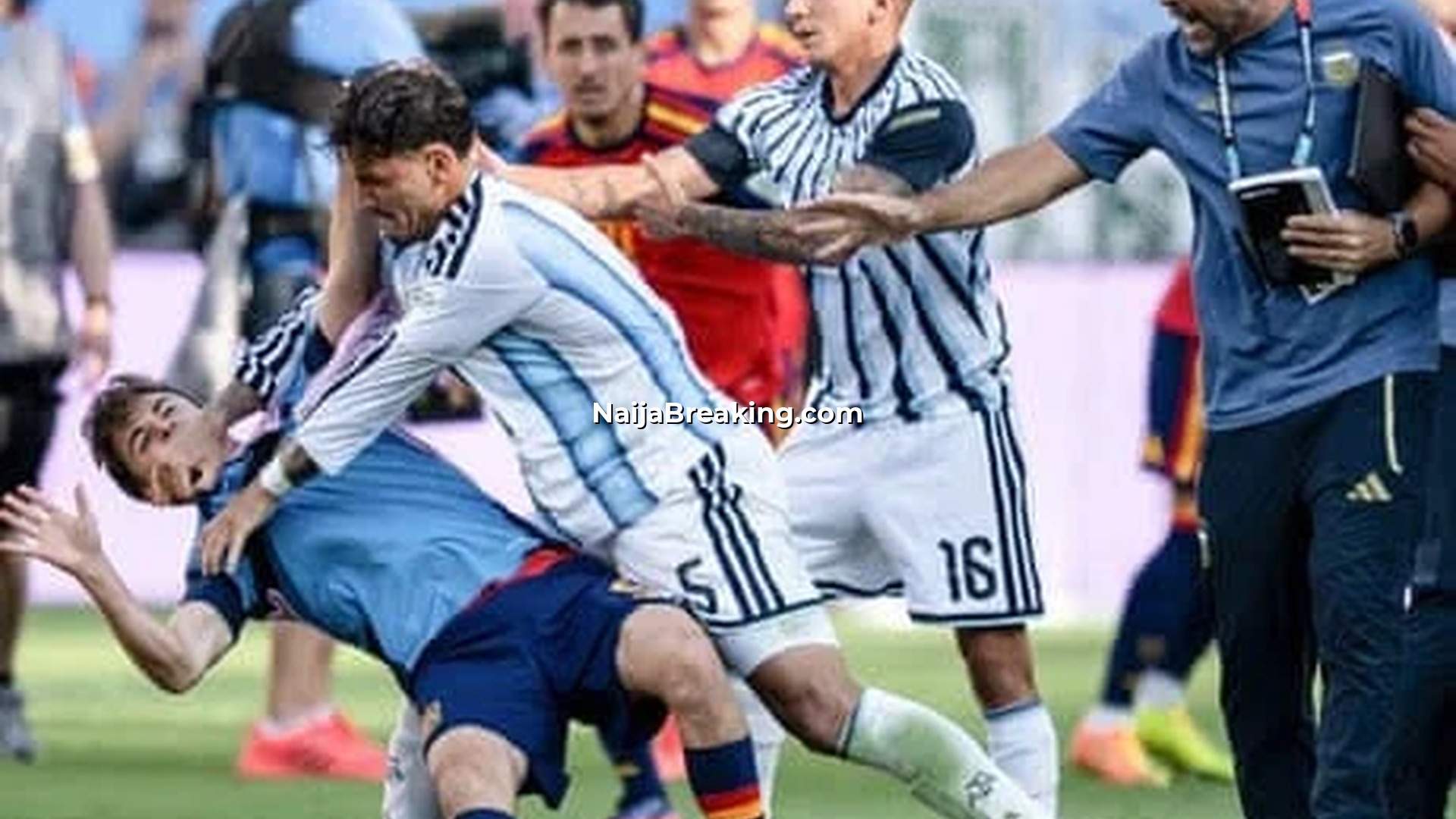
FIFA has opened a formal disciplinary investigation into a post-match scuffle between Argentine and Spanish players following Spain’s dramatic 1-0 World Cup final victory in New Jersey. The governing body announced the inquiry on Monday, revealing that its disciplinary panel had reviewed official match reports documenting the chaotic scenes that erupted at the conclusion of an emotionally charged contest settled in extra time. This FIFA post-match scuffle investigation marks another significant moment in international football governance, raising critical questions about player conduct, emotional management under pressure, and how sporting bodies enforce discipline during their most high-stakes competitions. For Nigerian sports fans and administrators watching how global sporting institutions handle such incidents, the FIFA inquiry offers important lessons about institutional standards and accountability in competitive athletics.
Background
The World Cup final between Spain and Argentina represented far more than a simple football match—it was a clash between two football philosophies and two nations with deeply invested emotional stakes. Spain, seeking to reclaim global supremacy after years of tournament disappointment, faced Argentina, the defending champions who had held the World Cup trophy since their triumphant 2022 campaign. The match itself was played in an atmosphere of intense pressure, with both teams’ coaching staffs visibly frustrated throughout the encounter. Argentina’s manager, Lionel Scaloni, and his Spanish counterpart had both invested considerable tactical and emotional energy into preparing their squads for this ultimate showdown.
International football has witnessed escalating tensions in recent World Cup tournaments, with post-match incidents becoming increasingly common as competition intensifies and players experience the crushing disappointment of elimination. The culture surrounding World Cup finals creates an environment where emotions run extraordinarily high—for some players, this represents the pinnacle of their sporting careers, a once-in-a-lifetime opportunity to win global recognition. When that dream evaporates in the final moments, the psychological impact can manifest in physical confrontations. Spain’s narrow 1-0 victory meant Argentina’s players had experienced a devastating loss on the sport’s biggest stage, while Spanish players experienced euphoria at claiming their second world championship. This emotional disparity created the conditions for the post-match confrontation that would subsequently trigger FIFA’s disciplinary response.
The incident occurred within a broader context of increased scrutiny on player behaviour in international competitions. In recent years, FIFA has attempted to strengthen its disciplinary frameworks, introducing stricter protocols for violent conduct, offensive language, and unsporting behaviour. The governing body has been under pressure from multiple quarters—human rights organisations, player welfare advocates, and national football associations—to demonstrate that it takes player safety seriously and that elite football operates under consistent, transparent rules. The Spain-Argentina scuffle therefore arrived at a moment when FIFA was particularly attentive to maintaining disciplinary standards and demonstrating institutional credibility.
Key Details
According to reports from the match, the physical confrontation between Spanish and Argentine players erupted immediately as the final whistle sounded. FIFA’s Disciplinary Committee appointed a Disciplinary and Ethics Prosecutor to investigate “potential breaches of the FDC with regard to the post-match incidents,” according to the governing body’s official statement to Al Jazeera. The investigation process would involve reviewing official match reports, video footage, and potentially witness statements from match officials who were present during the chaotic scenes.
The specific incidents captured on footage showed Spain’s Lamine Yamal kneeling in what appeared to be gratitude, whilst simultaneously showing Argentine players engaged in physical altercations with their Spanish counterparts. Argentina’s Leandro Paredes, a midfielder known for his combative playing style, grabbed Spain’s Eric Garcia around the neck in a chokehold-style manoeuvre. When Spanish substitute Gavi attempted to intervene and separate the two players, Paredes responded by pushing him down to the ground. Argentine manager Lionel Scaloni himself intervened in the melee, sprinting onto the pitch to physically pull Paredes away from the Spanish players, though Paredes continued attempting to shove other Spanish players until teammates restrained him. The incident lasted approximately 30-45 seconds but involved multiple players on both sides, making it a significant breach of post-match conduct protocols.
FIFA’s statement confirmed that the investigation would examine all infractions that occurred, with the organisation pledging to release its conclusions once the review process was complete. The governing body did not specify a timeline for the investigation, though historically such inquiries typically conclude within 7-14 days of the incident. The potential consequences could range from fines to player suspensions, though suspensions would technically apply only to future matches, given that the World Cup had concluded. For the Argentine players involved, the disciplinary action would likely manifest as financial penalties and official warnings that become part of their FIFA disciplinary records. Spanish players similarly faced potential sanctions, though footage suggested Argentine players were more actively aggressive in the physical confrontation.
Impact and Analysis
The FIFA post-match scuffle investigation reveals a fundamental tension within elite international football: the sport demands extraordinary emotional investment and competitive intensity, yet simultaneously expects players to maintain perfect composure in moments of maximum stress. This investigation highlights how modern football governance struggles to balance acknowledgment of human emotional response with firm enforcement of professional standards. The incident’s occurrence at the sport’s highest stage—the World Cup final—amplifies its significance, suggesting that even the most accomplished, experienced players can lose emotional control under competitive pressure.
The investigation also raises important questions about institutional responsibility. Should FIFA bear some accountability for creating an environment where such confrontations become foreseeable? Match officials maintained order on the field during the game itself, yet were apparently unable to prevent post-match violence involving multiple players simultaneously. This suggests that FIFA’s matchday protocols may require revision to address the emotional intensity present immediately after decisive final matches. The governing body might need to consider increased security presence, clearer separation procedures for rival teams immediately after conclusion, and perhaps modified post-match protocols that allow for emotional decompression before players approach opposing teams.
Furthermore, this incident demonstrates how individual players’ actions can undermine institutional credibility and overshadow collective achievement. Spain’s World Cup victory becomes partially defined by post-match violence rather than the quality of their football or tactical superiority. For Argentina, the incident compounds the disappointment of losing the championship and reinforces narratives about emotional instability. The investigation therefore carries significance beyond disciplinary outcomes—it shapes how these nations’ performances are remembered and discussed for years to come.
Expert Perspectives
Dr. Emeka Okonkwo, a Lagos-based sports ethics researcher with extensive experience analysing international sporting governance, offers critical perspective on FIFA’s investigative approach. “What this investigation demonstrates is that FIFA remains reactive rather than proactive in addressing player conduct,” Dr. Okonkwo explains. “They wait for incidents to occur, then investigate after the fact, rather than implementing preventative frameworks that address the emotional intensity of World Cup finals before violence becomes possible. Nigeria has experienced similar challenges with post-match incidents in local football—the NPFL has seen dangerous confrontations that might have been prevented through better emotional management protocols and clearer separation procedures.”
Conversely, Chinyere Adeyemi, a senior sports policy researcher at the Centre for Democracy and Development in Abuja, argues that FIFA’s disciplinary investigation represents necessary institutional action. “Elite sports require elite standards of conduct,” Adeyemi contends. “If FIFA allows post-match violence to proceed without meaningful consequences, they signal that physical aggression is acceptable behaviour in international competition. This sets a terrible precedent for domestic football systems, including Nigerian clubs and the Super Eagles. Players must understand that whatever the emotional stakes, physical violence has consequences. FIFA’s investigation, when properly concluded, sends that message clearly.”
What This Means for Nigerians
For ordinary Nigerians who follow international football passionately, this FIFA post-match scuffle investigation offers important lessons about professional conduct and institutional standards. Many Nigerian workers and young people idolise international football stars, treating them as role models for aspiration and success. When these athletes engage in violent post-match behaviour, it normalises physical aggression as an acceptable response to disappointment—a message that contradicts values of discipline and professionalism that Nigerians need to cultivate in all sectors of society.
The incident also carries implications for how Nigerian football administrators approach player discipline. The Nigerian Football Federation (NFF) and domestic league operators observe how FIFA handles such situations and often model their own disciplinary approaches accordingly. If FIFA applies weak sanctions to post-match violence, Nigerian football organisations might similarly tolerate aggressive player behaviour, leading to deteriorating standards of conduct in the NPFL and national team competitions. Conversely, strong FIFA disciplinary action encourages Nigerian institutions to maintain similar standards, benefiting players, officials, and fans who expect professional conduct.
For Nigerian entrepreneurs and businesspeople who invest in football—through sponsorship, media rights, or club ownership—the incident highlights risks associated with emotional volatility in sports. Investors want their brands associated with excellence and professionalism, not violence and loss of control. When international football’s highest-profile events feature post-match confrontations, it potentially dampens sponsorship appetite and reduces the commercial value of football properties. This has cascading effects on prize money, salaries, and investment in development, ultimately affecting Nigerian players trying to build careers in professional football.
Editor’s Take
At NaijaBreaking, we believe this FIFA post-match scuffle investigation exposes a critical gap in modern sports governance: the failure to adequately address the psychological and emotional dimensions of elite competition. FIFA’s reactive disciplinary approach treats symptoms rather than causes. International football needs proactive frameworks—mandatory emotional management training, sports psychology integration, clearer matchday protocols, and institutional acknowledgement that World Cup finals create psychological conditions that require active management. What this incident reveals is that sporting institutions have prioritised commercial interests and spectacle over player welfare and institutional credibility. Nigerians watching global football should demand that FIFA evolve beyond simple fines and suspensions toward comprehensive approaches that acknowledge human emotion whilst maintaining professional standards. The Super Eagles and Nigerian clubs deserve to compete within systems that value both passionate competition and disciplined conduct.
What to Watch Next
Three critical developments will shape how this FIFA post-match scuffle investigation unfolds over the coming weeks. First, observe whether FIFA’s Disciplinary Committee releases detailed findings that specify which players committed which infractions and what evidence supported those determinations. Second, monitor the specific sanctions imposed—are they substantial enough to meaningfully deter future post-match violence, or do they appear token and insufficient? Third, watch whether FIFA simultaneously announces structural changes to post-match protocols, such as revised security procedures or mandatory emotional management standards for international teams. Each outcome will signal whether FIFA views this as an isolated incident requiring punishment or a systemic problem requiring institutional reform. The key question now is: will FIFA’s response strengthen or further damage global football’s credibility with players and fans who increasingly expect transparency and consistency in disciplinary action?
Conclusion
The FIFA investigation into the post-match scuffle between Spain and Argentine players represents far more than an isolated disciplinary matter—it reflects broader questions about how international sporting institutions maintain standards, manage emotions, and enforce accountability at football’s highest level. The incident occurred at the World Cup, sport’s most watched event, meaning millions globally observed the behaviour that FIFA now investigates. What this story reveals is that even elite professional athletes struggle under maximum psychological pressure, suggesting that sporting institutions must evolve beyond simple punishment toward comprehensive emotional management and prevention frameworks. Share your thoughts in the comments below—what do you think this means for Nigeria’s future in international football, and how should our national sports administrators approach similar incidents in Super Eagles matches?