
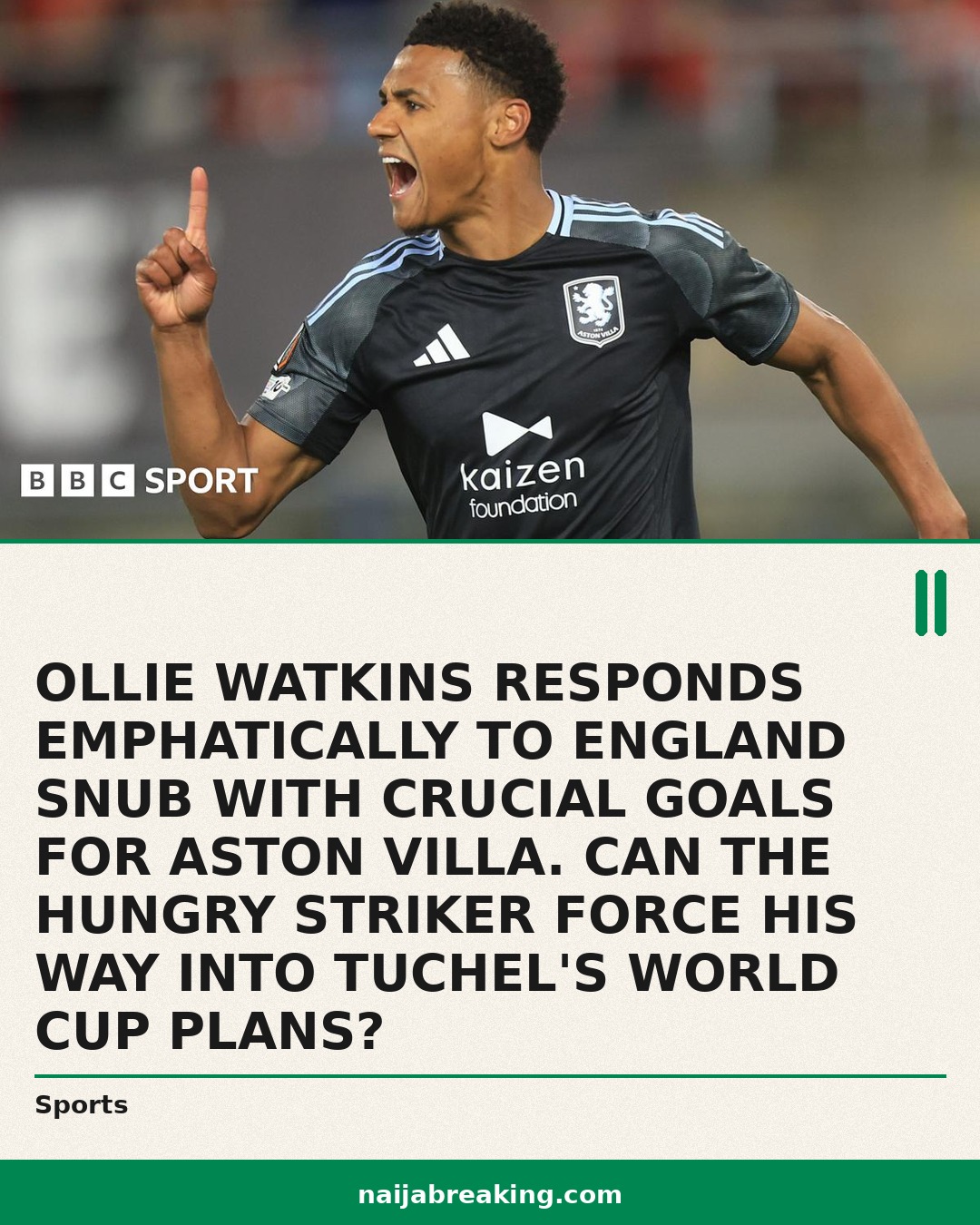
In the high-stakes world of international football, few things motivate a player more than being overlooked for national team selection. Ollie Watkins has exemplified this perfectly, responding to his England snub with a string of emphatic performances that have put Thomas Tuchel on notice. The Aston Villa striker’s recent goal-scoring exploits, including a crucial brace against Bologna in the Europa League, demonstrate why he remains one of England’s most compelling attacking options heading into the World Cup.
The England Snub That Sparked a Fire
When Thomas Tuchel announced his expanded 35-man England squad in March, the absence of Ollie Watkins raised eyebrows across the football community. The Aston Villa striker, who had been struggling for form with just one goal in his previous nine Premier League matches, found himself on the outside looking in as England prepared for crucial friendlies against Uruguay and Japan.
Tuchel’s explanation was diplomatic but telling: “Watkins is not with us but this is more down to the fact that I know what he can bring to the group – I know him very well.” Despite the manager’s reassuring words, the message was clear – current form trumped past performances, and Watkins needed to rediscover his scoring touch to force his way back into contention.
The timing couldn’t have been more critical. With the World Cup in the United States, Canada and Mexico just over two months away, every match represents an opportunity for players to stake their claim. For a 30-year-old striker like Watkins, time is not on his side, making his response to the setback all the more crucial.
Villa’s European Journey Provides the Perfect Stage
Aston Villa’s impressive Europa League campaign has provided Ollie Watkins with the ideal platform to showcase his abilities on the international stage. The quarter-final first leg against Bologna in Italy proved to be a watershed moment, not just for Villa’s European ambitions, but for Watkins’ England hopes.
After Ezri Konsa had given Villa an early lead against the run of play, it was Watkins who eased the visitors’ nerves early in the second half. Demonstrating the predatory instincts that have defined his career, he pounced on a defensive error from Torbjorn Heggem and coolly finished through the legs of goalkeeper Federico Ravaglia.
But Watkins wasn’t done there. When Bologna threatened to mount a comeback with Jonathan Rowe’s 90th-minute strike, the Villa forward stepped up once again. In the 94th minute, he restored his team’s two-goal cushion with a well-taken effort from a corner, effectively securing Villa’s passage to the semi-finals and underlining his big-game credentials.
Statistical Renaissance
The numbers tell the story of Watkins’ remarkable turnaround. His three goals in his last five games across all competitions represent a stark contrast to the barren spell that preceded his England omission. Perhaps most significantly, his three goals in three Europa League games equal his tally from his previous 24 appearances in major European competitions – a statistic that highlights both his previous struggles on the continental stage and his current purple patch.
With 12 goals in 44 appearances for Aston Villa this season, Watkins has shown consistency throughout the campaign, even during his leaner periods. This goal tally becomes even more impressive when considered within the context of Villa’s demanding schedule, competing across multiple competitions while establishing themselves as a force in European football.
The Harry Kane Conundrum
Central to Ollie Watkins‘ World Cup hopes is the ongoing debate about England’s striking options beyond Harry Kane. The Bayern Munich forward remains England’s captain and record goalscorer, but at 32, questions about succession planning are becoming increasingly relevant.
Tuchel’s concerns about his limited alternatives were laid bare during the recent international break. England laboured for goals without Kane during friendlies against Uruguay and Japan, highlighting the team’s over-reliance on their talismanic striker. This dependency becomes problematic when considering the physical demands of a World Cup tournament, where squad depth often proves decisive.
Former Scotland winger Pat Nevin, speaking to BBC Radio 5 Live, perfectly encapsulated the significance of Watkins’ timing: “It’s good timing, isn’t it? Lots of things happening at the end of this season. There is the possibility of the centre-forward position waiting with England at the World Cup, there’s a chance at securing Champions League football and there’s a possible European final, and here he is scoring two goals and looking very sharp and very lively indeed.”
Competition for Places
Watkins isn’t operating in a vacuum when it comes to England’s striking options. The likes of Ivan Toney, Dominic Calvert-Lewin, and other forwards are all vying for limited spots in Tuchel’s World Cup squad. However, Watkins’ unique profile – combining Premier League experience with European pedigree and a proven track record at international level – gives him distinct advantages in this competition.
His previous England appearances have shown glimpses of his potential on the international stage. The challenge now is to build on those experiences and demonstrate that he can be a reliable alternative to Kane when called upon. His recent performances suggest he’s ready to embrace that responsibility.
Villa’s European Dream and Watkins’ Personal Mission
The convergence of Aston Villa’s European ambitions and Ollie Watkins‘ personal mission creates a compelling narrative for the remainder of the season. Villa’s progression to the Europa League semi-finals represents their best European run in decades, and Watkins’ contributions have been instrumental in this success.
“It’s the back end of the season and I’m raring to go,” Watkins told TNT Sports after the Bologna victory. “I could play another 90 minutes. I’m excited for the next few games. I’m hungry.” This hunger – both literal and metaphorical – encapsulates the striker’s current mindset as he chases both club and international glory.
The remaining fixtures present Watkins with multiple opportunities to cement his World Cup claims. Villa’s pursuit of Champions League qualification through their league position, combined with their European semi-final, ensures regular high-profile matches where strong performances will be impossible to ignore.
The Pressure of Expectation
With great opportunity comes great pressure, and Watkins must now maintain his current form levels while managing increased scrutiny. Every touch, every chance, and every performance will be analyzed through the lens of World Cup selection. The striker’s experience and maturity will be crucial in handling this pressure constructively.
His comments after the Bologna match suggest he’s embracing rather than shrinking from this pressure. The confidence to declare himself ready for “another 90 minutes” immediately after a demanding European quarter-final demonstrates both his physical conditioning and mental resilience.
Tactical Fit and Tuchel’s Philosophy
Ollie Watkins‘ style of play aligns well with Thomas Tuchel’s tactical preferences. The German manager favors forwards who can contribute beyond just goal-scoring – players who press intensively, link play effectively, and create space for teammates. Watkins’ work rate and intelligent movement tick these boxes, making him an attractive option for Tuchel’s system.
His versatility also works in his favor. Capable of playing as a central striker or drifting wide, Watkins offers tactical flexibility that could prove valuable during tournament football. This adaptability becomes even more important when considering the compact squad sizes permitted at major tournaments.
The timing of his resurgence couldn’t be better strategically. With England not playing again until summer, Tuchel will be closely monitoring club performances to finalize his World Cup squad. Strong showings in Villa’s remaining matches, particularly in high-pressure European fixtures, will carry significant weight in these deliberations.
The Broader Context of English Football
Watkins’ journey reflects broader themes within English football. The competition for places in the national team has never been more intense, with talented players across all positions fighting for limited spots. This depth represents both a luxury and a challenge for Tuchel as he seeks to balance experience with form, potential with proven ability.
The Premier League’s global profile means that strong domestic performances carry international weight. Watkins’ consistency in England’s top flight, combined with his European exploits, positions him well in this competitive landscape.
For Nigerian football fans following the English game, Watkins’ story resonates with themes of perseverance and redemption that transcend national boundaries. His journey from rejection to potential redemption offers lessons about resilience and self-belief that apply universally in football.
Looking Ahead: The Road to World Cup Selection
The path ahead for Ollie Watkins is clearly defined. Continued strong performances for Aston Villa, particularly in their remaining European fixtures, will keep him in Tuchel’s thoughts. The semi-final second leg against Bologna and any subsequent European matches represent prime opportunities to showcase his abilities on football’s biggest stages.
Villa’s pursuit of Champions League qualification through their league position adds another dimension to this narrative. Success in securing top-four status would cap a remarkable season for the club and further enhance Watkins’ profile heading into World Cup selection discussions.
The striker’s age – 30 – adds urgency to his mission. This World Cup likely represents his best, and possibly last, chance to play a significant role in a major tournament for England. This reality appears to be driving his current performances, adding an edge to his play that could prove decisive in Tuchel’s considerations.
International Football’s Unpredictable Nature
History shows that World Cup squads often include surprising selections and omissions. Form at the right time, tactical fit, and squad harmony all play roles in final decisions. Watkins’ current trajectory suggests he’s positioning himself well across all these criteria.
His relationship with teammates, both at club and international level, could prove crucial. Squad dynamics often influence selection decisions, particularly for tournaments where team cohesion becomes paramount. Watkins’ reputation as a positive dressing room presence works in his favor in this regard.
Conclusion: A Striker Reborn
Ollie Watkins‘ response to his England snub has been nothing short of exemplary. His recent goal-scoring exploits, crowned by the crucial brace against Bologna, demonstrate the hunger and determination that define elite athletes. The convergence of personal ambition and team success creates a compelling narrative as both Watkins and Aston Villa chase historic achievements.
For Thomas Tuchel, the question isn’t whether he’ll take notice – Watkins’ performances are impossible to ignore. The real question is whether the England manager will have the courage to reward this form with World Cup selection, potentially at the expense of more established names.
The coming weeks will be crucial in determining whether Watkins’ hunger translates into World Cup opportunity. One thing is certain: he’s doing everything possible to force Tuchel’s hand, and football fans worldwide are witnessing a masterclass in how to respond to professional setbacks.
As this fascinating story continues to unfold, we want to hear from you. Do you think Ollie Watkins deserves a place in England’s World Cup squad? How important is current form versus past international experience? Share your thoughts in the comments below and join the conversation about one of football’s most compelling selection debates.
Source: BBC Sport


