
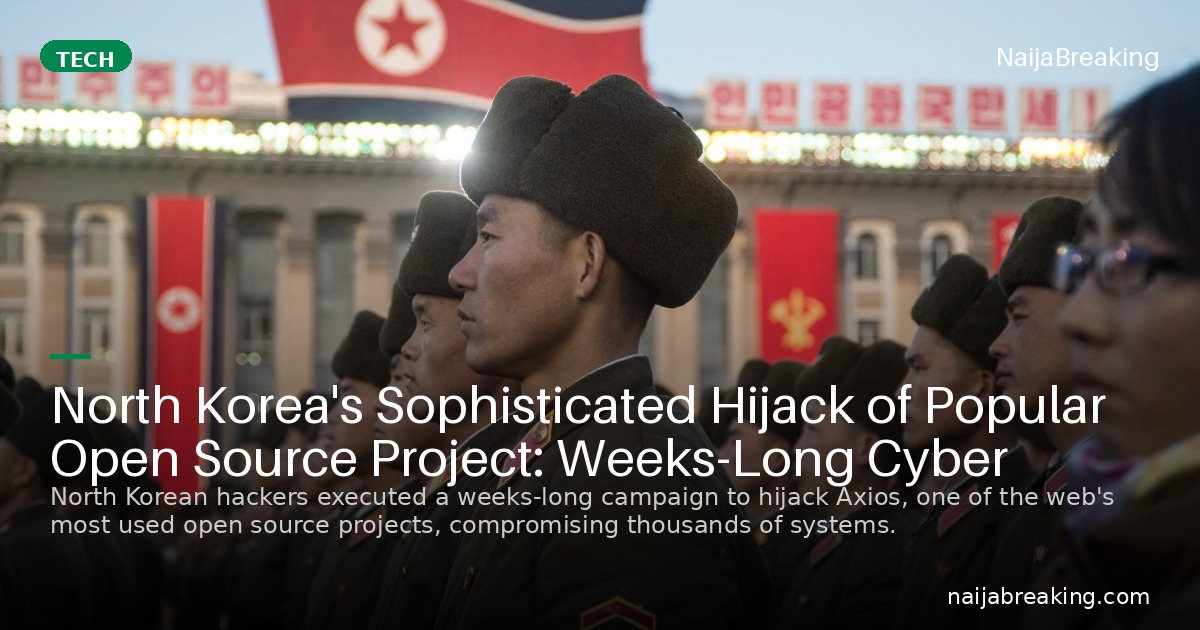
In an alarming demonstration of sophisticated cyber warfare tactics, North Korean hackers have successfully executed a meticulously planned cyber hijack operation targeting one of the internet’s most widely used open source projects. The attack on the popular Axios project, which serves millions of developers worldwide, represents a significant escalation in state-sponsored cybercrime and highlights the growing vulnerabilities in our digital infrastructure.
The recent cyber hijack incident, which unfolded on March 31, 2026, was not a spontaneous attack but rather the culmination of a weeks-long campaign designed to infiltrate and compromise critical software infrastructure. This sophisticated operation demonstrates how North Korean cyber operatives are evolving their tactics to target the very foundations of modern web development, potentially affecting countless Nigerian businesses and developers who rely on these essential tools.
The Anatomy of a Sophisticated Cyber Attack
The cyber hijack of the Axios project began approximately two weeks before the actual compromise, according to Jason Saayman, the project’s maintainer. This extended timeline reveals the patient and methodical approach that North Korean hackers have adopted in their pursuit of high-value targets. Rather than relying on quick, opportunistic attacks, these state-sponsored operatives invested significant time and resources in building credibility and trust with their intended victim.
The attackers demonstrated remarkable attention to detail in their preparation phase. They created an elaborate facade that included establishing a fake company, developing a realistic Slack workspace complete with multiple employee profiles, and crafting convincing communication strategies. This level of preparation indicates the involvement of well-resourced cybercriminal organizations with substantial backing from the North Korean state.
The social engineering component of this cyber hijack was particularly sophisticated. By posing as legitimate business professionals, the hackers were able to engage Saayman in what appeared to be routine business communications. They gradually built rapport and trust over the course of several interactions, making their eventual malicious invitation seem entirely reasonable and expected.
The Malware Deployment Strategy
The final phase of the cyber hijack involved a carefully orchestrated web meeting invitation that served as the delivery mechanism for the malware. When Saayman attempted to join what he believed was a legitimate business meeting, he was prompted to download what appeared to be a necessary software update to access the call. This update was, in reality, sophisticated malware designed to grant the attackers remote access to his computer.
This technique mirrors previous attacks attributed to North Korean cyber groups, particularly those targeting cryptocurrency holders and developers. The hackers’ ability to create convincing technical scenarios that require immediate action from their targets demonstrates their deep understanding of common business practices and software deployment procedures.
Once the malware was successfully installed on Saayman’s computer, the attackers gained comprehensive remote access to his system. This access allowed them to navigate his development environment, access his credentials, and ultimately push malicious updates to the Axios project repository.
The Global Impact of Open Source Vulnerabilities
The successful cyber hijack of the Axios project highlights a critical vulnerability in the global software ecosystem that particularly affects developing technology markets like Nigeria. Open source projects form the backbone of modern web development, with millions of applications and websites depending on these freely available code libraries for basic functionality.
For Nigerian developers and technology companies, this incident serves as a stark reminder of the interconnected nature of modern software development. Many local fintech companies, e-commerce platforms, and digital service providers rely heavily on open source projects like Axios to power their applications. The compromise of such fundamental tools can have cascading effects across entire digital ecosystems.
The two malicious packages released during this cyber hijack were available for approximately three hours before being detected and removed. However, this brief window was sufficient for potentially thousands of systems worldwide to download and install the compromised code. The automated nature of modern software deployment means that many systems could have been infected without their operators’ immediate knowledge.
Implications for Nigerian Technology Sector
Nigeria’s rapidly growing technology sector, particularly in Lagos and Abuja, relies heavily on international open source projects for development efficiency and cost-effectiveness. The cyber hijack of projects like Axios poses significant risks to local startups and established companies alike, potentially exposing sensitive customer data, financial information, and proprietary business logic.
The attack’s focus on stealing cryptocurrency credentials is particularly relevant given Nigeria’s position as one of Africa’s largest cryptocurrency markets. According to recent studies, Nigeria ranks among the top countries globally for cryptocurrency adoption, making Nigerian users prime targets for such sophisticated cyber hijack operations.
Local developers and IT security professionals must now reassess their dependency on external open source projects and implement additional security measures to protect against supply chain attacks. This includes establishing more rigorous code review processes, implementing automated security scanning, and maintaining updated inventories of all third-party dependencies.
North Korea’s Expanding Cyber Warfare Operations
The Axios cyber hijack represents just one example of North Korea’s increasingly sophisticated and aggressive cyber warfare capabilities. Intelligence reports suggest that the Kim Jong Un regime has developed one of the world’s most capable state-sponsored hacking operations, with thousands of operatives working under the direction of military intelligence services.
These cyber operations serve multiple strategic purposes for the North Korean government. Beyond the immediate financial gains from cryptocurrency theft and ransomware attacks, these activities provide valuable intelligence gathering opportunities and demonstrate the regime’s ability to disrupt global digital infrastructure when necessary.
The financial motivation behind North Korean cyber hijack operations cannot be understated. Security researchers estimate that North Korean hackers stole at least $2 billion in cryptocurrency during 2025 alone. These funds play a crucial role in circumventing international sanctions and funding the country’s nuclear weapons development program.
Technical Sophistication and Resource Investment
The weeks-long preparation period for this cyber hijack demonstrates the substantial resources that North Korea dedicates to its cyber operations. Unlike opportunistic cybercriminals who seek quick profits, state-sponsored hackers can afford to invest significant time and effort in highly targeted campaigns against strategic objectives.
The creation of fake companies, realistic employee profiles, and functional business communication channels requires substantial coordination and expertise. This level of operational sophistication suggests the involvement of dedicated teams with specialized skills in social engineering, malware development, and target reconnaissance.
Furthermore, the attackers’ ability to identify and target the maintainer of such a crucial open source project indicates comprehensive intelligence gathering capabilities. They likely conducted extensive research to identify high-value targets within the open source ecosystem and developed detailed profiles of potential victims before initiating contact.
Protecting Against Advanced Persistent Threats
The successful cyber hijack of the Axios project offers valuable lessons for developers, organizations, and governments worldwide. Traditional cybersecurity measures that focus primarily on technical defenses are insufficient against sophisticated social engineering attacks that exploit human psychology and trust relationships.
Nigerian organizations and developers must adopt a multi-layered approach to cybersecurity that addresses both technical vulnerabilities and human factors. This includes implementing comprehensive security awareness training, establishing clear protocols for handling unsolicited business communications, and maintaining healthy skepticism about unexpected meeting invitations or software update requirements.
For open source project maintainers, this incident highlights the need for additional security measures around code publishing and repository access. Multi-factor authentication, code signing, and automated security scanning can help detect and prevent malicious modifications to critical software components.
Industry-Wide Response and Collaboration
The cyber hijack of such a widely used project has prompted discussions within the global cybersecurity community about the need for improved protection mechanisms for critical open source infrastructure. Organizations like the Cybersecurity and Infrastructure Security Agency are working with industry partners to develop better detection and response capabilities for supply chain attacks.
International cooperation remains essential in combating state-sponsored cyber threats. The attribution of this cyber hijack to North Korean operatives relies on intelligence sharing and technical analysis conducted by security researchers across multiple countries and organizations.
Nigerian cybersecurity professionals can contribute to these global efforts by sharing threat intelligence, participating in international cybersecurity initiatives, and implementing robust security practices that serve as models for other developing technology markets in Africa and beyond.
Looking Forward: Strengthening Digital Resilience
The Axios cyber hijack serves as a wake-up call for the global technology community about the evolving nature of state-sponsored cyber threats. As Nigeria continues to develop its digital economy and technology sector, building resilience against such sophisticated attacks becomes increasingly critical for national security and economic prosperity.
Government agencies, private sector organizations, and individual developers must work together to create a more secure and resilient digital ecosystem. This includes investing in cybersecurity education, supporting local security research capabilities, and developing incident response procedures that can quickly contain and remediate supply chain compromises.
The international nature of modern software development means that cyber hijack incidents affecting projects in one part of the world can have immediate impacts on systems and users globally. Nigerian organizations must therefore maintain awareness of global cybersecurity trends and adapt their security practices accordingly.
As we move forward, the technology community must balance the benefits of open collaboration and shared development resources with the security risks inherent in widely distributed software ecosystems. The successful cyber hijack of the Axios project will likely prompt renewed discussions about security practices, trust verification mechanisms, and the responsibilities of maintainers for critical infrastructure components.
Conclusion
The sophisticated cyber hijack operation targeting the Axios open source project represents a significant milestone in the evolution of state-sponsored cybercrime. The weeks-long preparation, elaborate social engineering tactics, and successful compromise of critical software infrastructure demonstrate the advanced capabilities of North Korean cyber operatives and the serious threats facing the global technology ecosystem.
For Nigerian developers, businesses, and government agencies, this incident provides important lessons about the interconnected nature of modern cybersecurity risks and the need for comprehensive defensive strategies. As our digital economy continues to grow and evolve, building resilience against such sophisticated attacks will be essential for protecting our national interests and maintaining public trust in digital services.
The cyber hijack of popular open source projects like Axios will likely become more common as state-sponsored actors recognize the strategic value of compromising widely used software components. By learning from this incident and implementing appropriate security measures, we can work together to build a more secure and resilient digital future for Nigeria and the broader African technology ecosystem.
What are your thoughts on this sophisticated cyber attack and its implications for Nigeria’s technology sector? Have you implemented additional security measures in your development workflow as a result of this incident? Share your experiences and insights in the comments below, and help build awareness about these critical cybersecurity challenges facing our digital community.
Source: TechCrunch – “North Korea’s hijack of one of the web’s most used open source projects was likely weeks in the making” by Zack Whittaker