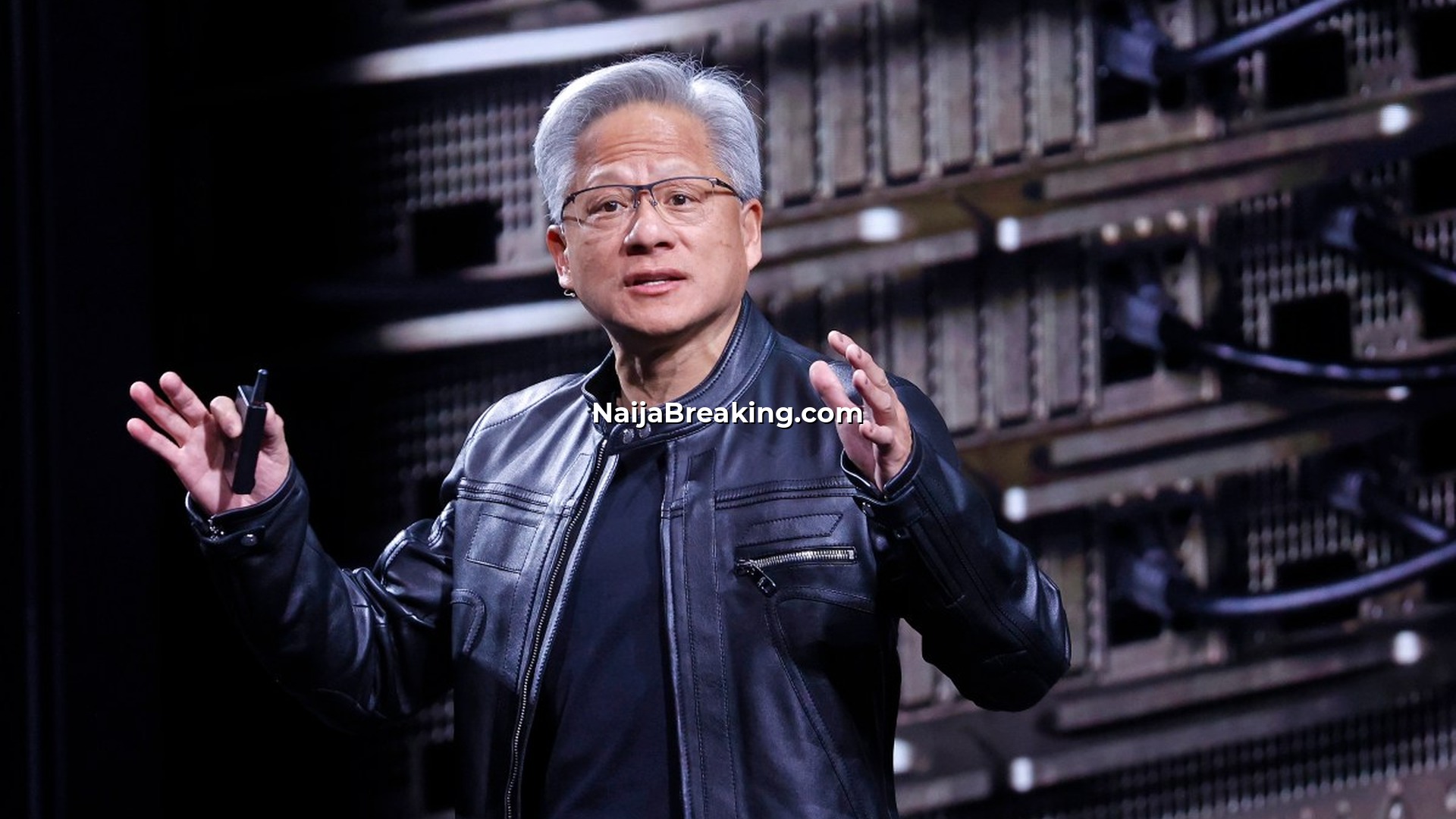
Nvidia CEO Jensen Huang Unveils $200B AI CPU Market for Vera Processors
Nvidia founder and Chief Executive Officer Jensen Huang has announced the discovery of a brand new $200 billion market opportunity centred on the company’s innovative Vera CPU, specifically designed for agentic artificial intelligence applications. This announcement represents a watershed moment in the technology sector, signalling a significant expansion beyond Nvidia’s traditionally dominant GPU business. The Nvidia $200 billion CPU market revelation comes at a time when the global artificial intelligence industry is experiencing unprecedented growth, with major technology corporations racing to establish dominance in this lucrative space. For Nigerian technology enthusiasts, investors, and businesses looking to understand the future trajectory of global tech markets, this development carries substantial implications for how artificial intelligence infrastructure will be deployed worldwide. Jensen Huang’s track record of delivering on ambitious promises has earned him considerable credibility with Wall Street analysts and technology industry observers, making this proclamation worthy of serious attention from emerging markets seeking to understand technological trends that will shape their digital economies.
Background
Nvidia’s historical dominance in the graphics processing unit (GPU) market has been nothing short of remarkable, transforming the company from a gaming-focused chipmaker into the world’s leading artificial intelligence infrastructure provider. However, this success has also created significant anxiety among investors and analysts concerning the company’s long-term growth prospects and whether Nvidia can maintain its market leadership as competitors develop alternative solutions. The central concern revolves around whether Nvidia can successfully expand beyond its fortress-like GPU business into new markets, particularly in the CPU segment where traditional players like Intel and Advanced Micro Devices (AMD) have historically maintained control. Recent competitive threats have intensified this concern, most notably when Amazon Web Services announced a massive contract with Meta to deploy millions of Amazon’s homegrown AI processors, both GPUs and CPUs, directly challenging Nvidia’s monopolistic position. Andy Jassy, Amazon’s Chief Executive Officer, publicly declared that AWS could develop AI chips—both graphics and central processing units—with equivalent or superior performance to Nvidia’s offerings, a statement that sent ripples through the investment community.
The broader context reveals that Nvidia has previously manufactured CPUs, but these efforts never constituted the company’s core business or competitive advantage. The company’s historical expertise centred on parallel processing architectures optimised for graphics rendering and machine learning workloads, domains where GPU technology proved fundamentally superior. Nvidia’s previous CPU ventures existed in the margins of the company’s operations, receiving minimal attention and investment relative to the GPU division. However, the rise of agentic AI—artificial intelligence systems capable of autonomous decision-making and independent action—has fundamentally altered the computational requirements landscape. These agentic systems demand different architectural approaches than traditional supervised learning models, potentially creating opportunities for a fresh player to establish market leadership. The timing of this technological shift coincides with Nvidia’s introduction of the Vera CPU in March, a product explicitly engineered from inception to address the unique computational challenges presented by agentic artificial intelligence systems.
Key Details
According to TechCrunch’s reporting, Jensen Huang made these pivotal announcements during Nvidia’s latest earnings call, following the company’s release of record-breaking financial results showing $81.6 billion in quarterly revenue with forecasts projecting $91 billion for the subsequent quarter. These figures demonstrate that Nvidia’s core GPU business continues operating at extraordinary profitability and growth rates, yet management believes substantial untapped market opportunities remain available. The Vera CPU represents Nvidia’s strategic response to these opportunities, positioned as the world’s first central processing unit purposefully architected for agentic artificial intelligence applications. Huang described Vera as “a major new growth driver” for Nvidia, characterising it as opening “a brand new $200 billion TAM for Nvidia, a market we have never addressed before.”
The strategic importance of this announcement cannot be overstated—Nvidia is essentially claiming it has identified an entirely new market category worth two hundred billion dollars annually that the company had previously not captured. Huang emphasised that “every major hyperscaler and system maker is partnering with us to deploy it,” suggesting that Vera has already attracted commitments from the world’s largest cloud infrastructure operators. The Vera CPU is being sold both as a standalone product and bundled with Nvidia’s Rubin GPU, creating an integrated solution that combines optimised processing for agentic systems with the company’s legendary GPU performance. This bundling strategy represents a deliberate effort to leverage Nvidia’s existing ecosystem dominance while establishing leadership in the emerging CPU market segment. Early sales figures for Vera have reportedly proven promising, though specific revenue numbers remain undisclosed pending their inclusion in future quarterly financial disclosures.
The timing of Vera’s introduction and market reception aligns with accelerating industry-wide recognition that agentic artificial intelligence represents the next evolutionary stage in AI development. Unlike supervised learning systems that operate within strictly defined parameters, agentic AI systems require autonomous reasoning capabilities, dynamic decision-making frameworks, and computational approaches fundamentally different from those optimised for traditional machine learning. Nvidia’s engineering teams apparently recognised this shift early and designed Vera’s architecture to address these specific requirements, potentially creating significant competitive advantages in a market segment that has only recently begun receiving serious investment attention from major technology corporations and venture capital firms globally.
Impact and Analysis
The revelation of this $200 billion market opportunity carries profound implications for Nvidia’s future financial performance, competitive positioning, and strategic direction. If Vera successfully captures even a fraction of this purported market, the product could generate tens of billions of dollars in annual revenue, effectively creating a new revenue stream comparable in size to entire Fortune 500 companies. For Nvidia investors, this announcement suggests that the company’s growth trajectory need not decelerate significantly even if GPU markets experience saturation or increased competitive pressure from companies like Advanced Micro Devices, Intel, or Amazon’s in-house chip development efforts. The announcement fundamentally reshapes market narratives concerning Nvidia’s vulnerability to competition, demonstrating that management maintains confidence in identifying and capturing emerging technology markets worth hundreds of billions of dollars.
However, market analysts remain appropriately cautious about these projections, recognising that the technology industry frequently produces bold predictions that fail to materialise as anticipated. Historical examples abound of companies announcing massive total addressable markets only to discover that actual demand falls far short of optimistic projections. Wall Street’s ongoing anxiety concerning what might dislodge Nvidia from its commanding market position reflects legitimate concerns about complacency and competitive threats. The CPU market differs fundamentally from the GPU market where Nvidia established overwhelming dominance, requiring different expertise, manufacturing relationships, and competitive advantages. Intel and AMD possess decades of accumulated knowledge in CPU architecture, manufacturing processes, and enterprise customer relationships that Nvidia cannot easily replicate despite its extraordinary financial resources and engineering talent.
Nevertheless, the statistical evidence supporting Nvidia’s growth claims remains impressive—the company’s consistent delivery of record quarterly results demonstrates management’s capacity to execute on ambitious strategic initiatives. Whether the Vera CPU achieves the projected $200 billion market addressability remains an open question, but the product’s early adoption by major hyperscalers suggests genuine commercial viability rather than speculative hype.
Expert Perspectives
Technology industry analysts and semiconductor experts have responded with cautious optimism to Nvidia’s Vera CPU announcements, acknowledging both the potential of the product and the legitimate questions surrounding its ultimate market success. Various investment banking firms have incorporated Vera’s potential into updated financial forecasts, adjusting Nvidia’s long-term revenue projections upward based on the assumed success of this new product category. Some analysts specialising in artificial intelligence infrastructure have specifically highlighted the appropriateness of designing specialised CPU architectures for agentic systems, noting that traditional CPU designs optimised for sequential processing may indeed prove suboptimal for autonomous AI applications requiring different computational paradigms.
Industry observers have also noted that the early partnership commitments from major hyperscalers—including firms like Amazon, Google, Microsoft, and Meta—provide meaningful validation of Vera’s commercial viability. When companies of this scale commit to deploying new semiconductor products, they typically base such decisions on extensive internal testing demonstrating genuine performance advantages or cost benefits. The rapid adoption signalling suggests that Vera addresses genuine technical requirements that existing processor designs fail to satisfy adequately. However, some competitive analysts caution that AMD and Intel are simultaneously developing their own agentic AI-optimised processors, meaning Nvidia faces serious competitive challenges even within this newly identified market segment.
What This Means for Nigerians
For Nigerian technology professionals, entrepreneurs, and businesses, Nvidia’s announcement concerning the $200 billion CPU market carries significant implications for understanding the future trajectory of global technology infrastructure. Nigeria’s rapidly expanding technology sector—including major hubs in Lagos, Abuja, and increasingly in cities like Ibadan and Port Harcourt—depends fundamentally on accessing cutting-edge cloud computing and artificial intelligence infrastructure provided by global technology companies. As Nvidia and its competitors introduce next-generation processors optimised for agentic artificial intelligence, Nigerian technology companies will gain access to increasingly sophisticated artificial intelligence capabilities that can be leveraged for local applications addressing Nigerian-specific challenges.
Nigerian fintech companies, for example, could potentially utilise agentic AI systems powered by Vera CPUs to develop more sophisticated fraud detection systems, credit assessment algorithms, and personalised financial services specifically adapted to Nigerian market conditions and customer behaviour patterns. Similarly, Nigerian companies operating in agriculture technology could leverage agentic AI to develop intelligent agricultural systems capable of providing autonomous recommendations for crop selection, irrigation management, and pest control based on regional climate data and soil conditions. The availability of more efficient CPU architectures specifically optimised for AI applications could reduce the computational costs associated with deploying artificial intelligence systems, making such technology more accessible to Nigerian companies with limited infrastructure budgets.
Furthermore, as the global technology infrastructure evolves toward agentic AI systems, Nigerian software engineers and technology professionals who understand these emerging technologies will become increasingly valuable in global job markets. Investment in learning Vera CPU architecture and agentic AI development could position Nigerian technologists for lucrative opportunities in both domestic and international markets. Additionally, as cloud computing becomes increasingly central to Nigerian business operations across sectors like healthcare, education, and finance, understanding the infrastructure enabling these services becomes strategically important for business decision-makers and technology managers.
Conclusion and Outlook
Jensen Huang’s announcement regarding Nvidia’s discovery of a brand new $200 billion market for the Vera CPU represents a significant development in the global technology sector with implications extending far beyond Wall Street financial projections. The product demonstrates Nvidia’s capacity to innovate beyond its traditional GPU business, identifying and addressing entirely new market opportunities as technology landscapes evolve. Whether Vera ultimately achieves the projected market size remains uncertain, but early adoption signals from major hyperscalers provide meaningful validation of the product’s commercial viability and technical merit. For the broader Nigerian technology ecosystem, this development underscores the importance of remaining engaged with emerging global technology trends and positioning local technology talent to participate in the infrastructure evolution accompanying artificial intelligence advancement.
Looking forward, the competition between Nvidia, Intel, AMD, and other technology companies in the CPU market for agentic AI will likely intensify significantly throughout the coming years. This competitive dynamic may ultimately benefit customers through innovation, cost reductions, and improved product offerings. Nigerian businesses and technology professionals should monitor these developments closely, recognising that the technology infrastructure available to local companies will increasingly reflect the outcomes of these global competitive battles. The next generation of Nigerian technology solutions will likely be built upon infrastructure incorporating innovations like Vera, making understanding these developments essential for maintaining competitive relevance in digital transformation initiatives. Share your thoughts in the comments below about how you believe agentic AI and advanced CPU technologies might impact Nigeria’s technology sector and your own professional opportunities.