
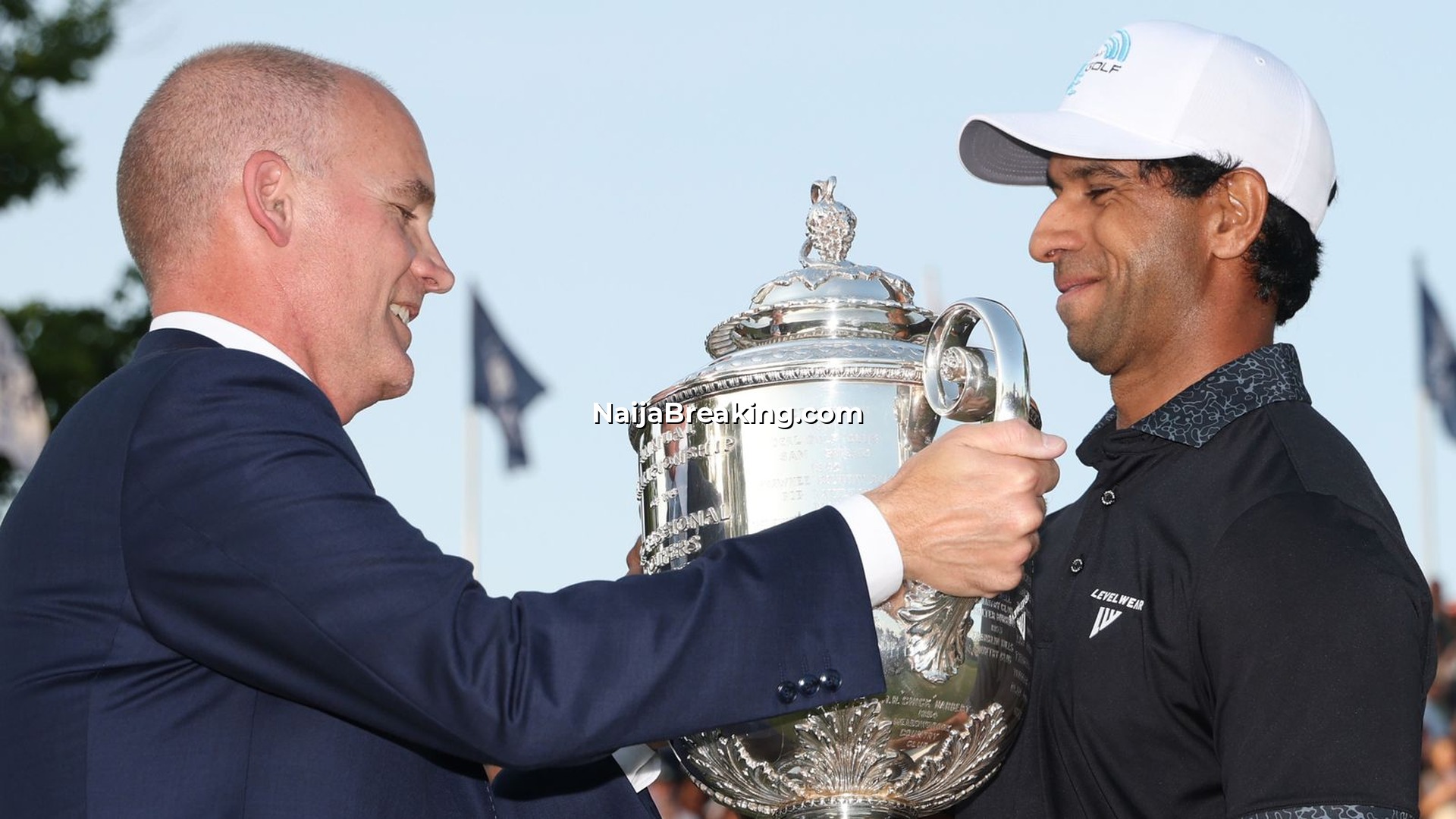
Aaron Rai Wins PGA Championship: England’s Historic First Major Victory in 107 Years
In a stunning display of championship golf at Aronimink Golf Club, England’s Aaron Rai has claimed his maiden major title at the PGA Championship with a commanding three-shot victory that ends a historic drought for English golfers in professional sport’s most prestigious tournaments. The PGA Championship Aaron Rai victory marks a remarkable achievement for the 25-year-old from Essex, who surged through the field with a final-round 65 to capture the Wanamaker Trophy and become the first English champion since the legendary Jim Barnes claimed the title in 1919—a remarkable 107-year gap that highlights the rarity of English dominance in this particular major championship. Rai’s triumph is not merely a personal achievement but represents a watershed moment in international golf, breaking a relentless streak of ten consecutive American winners whilst simultaneously elevating English golf back onto the world’s grandest stages. For Nigerian sports enthusiasts and golf fans across Africa, this victory demonstrates the globalisation of elite-level golf and the increasing competitiveness of international players who are challenging the traditional dominance of American golfers on the professional circuit. Rai’s performance throughout the week showcased exceptional skill, mental fortitude, and the kind of championship temperament that defines major-winning golfers, making his story one of the most compelling narratives in recent sporting history.
Background
The PGA Championship stands as one of golf’s four major tournaments, alongside the Masters Tournament, the United States Open Championship, and the Open Championship (commonly known as the British Open). Dating back to 1916, the PGA Championship has established itself as the second-oldest major in golf and has traditionally served as a stronghold for American players, particularly those competing on the PGA Tour. The championship carries the prestigious Wanamaker Trophy as its prize, named after department store magnate Rodman Wanamaker, who founded the PGA of America in 1916. Over more than a century, the tournament has crowned numerous legends of the sport, including Jack Nicklaus, Tom Watson, Gary Player, and Tiger Woods, cementing its status as one of golf’s most coveted titles that commands respect throughout the sporting world.
The fact that no English player had won the PGA Championship since Jim Barnes in 1919 speaks volumes about the difficulty of the feat and the dominance of American and international players in major championships over the past century. This 107-year drought for English champions represented a significant gap in a nation with a rich golfing heritage and numerous world-class players who had challenged but ultimately fallen short at the PGA Championship. The United States had maintained a stranglehold on the title for a decade heading into the 2024 championship, with ten consecutive American winners demonstrating American golf’s resurgence and the depth of talent available on the PGA Tour. However, this streak was always vulnerable to being broken by a player of sufficient quality and composure, and Aaron Rai proved to be precisely that calibre of golfer when it mattered most.
Rai’s path to major championship success had been marked by steady improvement and increasing appearances in contention at elite-level tournaments. Before his triumph at Aronimink, Rai had established himself as a promising young talent on the international circuit, attracting attention from golf analysts and tournament organisers alike. The young English golfer’s previous ranking of World No. 44 suggested that whilst he possessed considerable talent, a major championship victory would represent a significant breakthrough that would propel him into a new category of global elite golfers. His victory thus represents the fruition of years of dedication, technical refinement, and the kind of mental preparation required to succeed under the intense pressure of a major championship.
Key Details
Aaron Rai’s final round at Aronimink Golf Club demonstrated the kind of controlled aggression and clutch performance that defines major championship winners. According to Sky Sports coverage of the championship, Rai carded an impressive final-round 65 to finish the tournament at nine under par, securing his three-shot victory margin. The turning point in Rai’s round came at the par-five ninth hole, where he struck an extraordinary 40-foot eagle putt that dramatically shifted the momentum in his favour and propelled him into genuine contention for the title. This eagle sparked a remarkable scoring burst that saw Rai post two birdies in a three-hole stretch beginning at the 11th hole, consolidating his position at the top of the leaderboard.
The critical sequence that secured Rai’s victory came on the back nine, particularly from the 16th hole onwards. Rai recorded back-to-back birdies from the 16th hole, with the most spectacular coming at the par-three 17th hole where he rolled in a sensational 70-foot putt that left his competitors with an insurmountable deficit. This putt was a moment of pure championship golf—the kind of stroke that separates major winners from talented players who fall just short. He closed out his round with a composed two-putt par at the 18th hole, sealing a final-round 65 that proved decisive in his three-shot victory. Jon Rahm finished tied for second place alongside overnight leader Alex Smalley, both completing the championship at six under par, while two-time PGA champion Justin Thomas shared fourth position with Ludvig Aberg and Matti Schmid of Germany, demonstrating the quality of the field competing for the Wanamaker Trophy.
Rory McIlroy’s performance represented an intriguing subplot to the championship narrative, as the Northern Irish superstar attempted to capture back-to-back major titles following his recent victory at another major championship. McIlroy ultimately finished tied for seventh place at four under par, five strokes behind Rai’s winning total, sharing that position with American Xander Schauffele and Australian Cameron Smith. Defending champion Scottie Scheffler, who had won the previous year’s championship, concluded the tournament at two under par following a final-round 69, demonstrating that even the world’s best players face extreme difficulty in successfully defending major championship titles. The depth of quality displayed by the leaderboard—with numerous internationally recognised players bunched together—illustrated the competitive depth of modern professional golf and the fine margins that separate victory from defeat at the sport’s highest level.
Impact and Analysis
Aaron Rai’s victory at the PGA Championship carries profound implications for the future of international golf and the dynamics of major championship competition. The breaking of the ten-year streak of consecutive American winners represents a potential inflection point in the competitive landscape, suggesting that elite international players are increasingly capable of competing and winning at the highest level despite the advantages traditionally enjoyed by American PGA Tour professionals. This victory reinforces the notion that major championships have become genuinely open competitions where talent, preparation, and mental fortitude can overcome statistical advantages or tournament seeding. Data from major championship victories over the past two decades demonstrates that whilst American players have maintained strong representation in major championship final leaderboards, international players have been steadily improving their conversion rates when reaching contention, indicating a gradual shift in competitive dynamics.
The significance of an English player breaking through to victory cannot be understated, particularly given England’s distinguished golfing heritage that includes legendary figures like Nick Faldo and countless other world-class competitors who competed at the highest level without capturing the PGA Championship. Rai’s triumph provides inspiration to English golfers of the current generation and demonstrates that major championship success remains achievable through dedication and excellence. The financial implications for Rai are also substantial, as major championship victories typically result in significant prize money, increased sponsorship opportunities, and enhanced appearance fees at prestigious tournaments. Beyond the personal benefits, Rai’s victory likely attracts increased interest in golf within England and potentially inspires younger players to pursue the sport at elite levels, contributing to the development pipeline for future English golfers who might aspire to major championship success.
The tournament’s competitive dynamics also deserve analysis, as the presence of thirty players within five strokes of the lead heading into the final day illustrated the unprecedented competitiveness of modern major championships. This level of congestion on the leaderboard suggests that traditional advantages in terms of experience, seeding, or favouritism count for considerably less than they once did in professional golf. The ability to maintain composure when thirty competitors remain within striking distance represents an extraordinary test of mental resilience, and Rai’s successful navigation of this pressure-filled scenario demonstrates his psychological readiness for sustained success at the highest level.
Expert Perspectives
Golf analysts and industry experts have responded with considerable enthusiasm to Aaron Rai’s breakthrough major championship victory, recognising it as a significant moment in contemporary professional golf. Sports commentators have highlighted Rai’s technical execution under pressure, particularly his exceptional putting performance on the back nine, as evidence of elite-level championship golf. The manner in which he capitalised on the 40-foot eagle at the ninth hole—converting a low-percentage opportunity when others might have been satisfied with par—demonstrated the kind of aggressive decision-making that defines champions. Expert observers have noted that Rai’s relatively modest world ranking of 44 entering the championship underscores how major tournaments remain genuinely open competitions where current form and preparation matter more than historical rankings or seeding considerations.
International golf correspondents have noted that Rai’s victory represents a validation of English golf’s continued competitiveness at the absolute elite level, dispelling any notion that English players have fallen behind in the global golf hierarchy. Analysts have drawn comparisons to previous breakthrough moments in golf history when younger players of different nationalities have emerged to claim major titles that had previously eluded them, each such victory typically initiating a period of renewed competitive intensity from that nation’s players. The consensus among golf experts suggests that Rai’s victory may inspire increased investment in English golf development programmes and potentially attract greater sponsorship attention to promising young English golfers who demonstrate major championship potential. Several prominent golf commentators have specifically praised Rai’s ability to maintain composure whilst in contention with world-class competitors, suggesting that this mental fortitude will serve him well in pursuing additional major championships throughout his career.
What This Means for Nigerians
For Nigerian sports enthusiasts and golf aficionados, Aaron Rai’s PGA Championship victory carries important implications for how we understand the modern sporting landscape and the globalisation of elite-level golf. Nigeria has produced several accomplished golfers who have competed internationally, and Rai’s success demonstrates that players from smaller nations relative to traditional golf superpowers can indeed compete and win at the highest levels of professional sport. The victory reinforces the message that sporting achievement at the elite level requires not merely access to world-class facilities and coaching, though these remain important factors, but also individual talent, relentless dedication, and psychological resilience. For young Nigerian golfers aspiring to international success, Rai’s story provides a blueprint for how persistent effort and excellence can overcome structural disadvantages and competitive barriers.
The broader significance for Nigerian sports culture relates to how we consume and celebrate international sporting achievement across different sports and competitions. Whilst football dominates Nigerian sporting consciousness through the Super Eagles and domestic league competitions, golf represents an increasingly important component of the global sporting landscape with substantial television audiences and commercial investment. The fact that major golf championships are broadcast widely and attract international audiences means that Nigerian viewers have access to world-class sporting spectacle across multiple platforms. Rai’s victory demonstrates that athletic excellence transcends geography and national boundaries, resonating with sports fans across the African continent who appreciate quality athletic performance regardless of the competitor’s nationality. For Nigeria’s sports media landscape, international golf tournaments represent important content opportunities that can expand coverage beyond football and basketball, introducing Nigerian audiences to different sports and international athletes.
Additionally, Rai’s PGA Championship victory carries inspirational value for young Nigerians pursuing careers in professional sports across all disciplines. The victory illustrates that breakthrough moments can arrive unexpectedly when players combine preparation with opportunity, a lesson applicable across all competitive sporting domains. For Nigeria’s sports development initiatives, the success of international players from non-traditional golf nations provides valuable insights into talent identification, coaching methodology, and the importance of international exposure for athletes seeking to compete at elite levels. As Nigeria continues developing its sporting infrastructure and identifying athletic talent, success stories like Rai’s championship victory offer instructive examples of how players can transcend geographical and economic limitations to achieve elite-level success through excellence and dedication.
Conclusion and Outlook
Aaron Rai’s historic victory at the PGA Championship at Aronimink Golf Club represents a significant moment in professional golf, ending a 107-year drought for English champions at this major championship whilst simultaneously breaking the ten-year streak of consecutive American winners. The manner of his victory—featuring spectacular putts under pressure and composed final-round execution—demonstrates that Rai possesses the championship temperament and technical excellence required to succeed at golf’s highest levels. His three-shot victory margin over Jon Rahm and Alex Smalley validates the competitive quality that has been steadily building throughout his professional career, suggesting that this breakthrough may be merely the first of multiple major championships that the 25-year-old English golfer will capture throughout his career. The PGA Championship Aaron Rai victory will undoubtedly resonate throughout international golf for years to come, potentially inspiring future generations of English golfers and reinforcing the message that major championship success remains attainable through dedication, talent, and excellence.
Looking forward, the implications of Rai’s victory extend beyond immediate tournament results to influence how major championships may unfold in future editions. The increasing competitiveness of international players and the demonstrated vulnerability of traditional American dominance suggest that future major championships may feature even greater representation from players outside the traditional American powerbase. For professional golf globally, Rai’s triumph contributes to the sport’s continued evolution as a genuinely international competition where players from diverse backgrounds and nations can rise to claim the sport’s most prestigious titles. The 2025 PGA Championship and subsequent major tournaments will undoubtedly feature Aaron Rai as a credible contender rather than an outlier, fundamentally altering expectations about English and international players’ competitiveness in future major championships. Share your thoughts in the comments below about what Rai’s historic victory means for the future of competitive golf and whether you believe this breakthrough signals a broader shift in major championship dynamics.


