
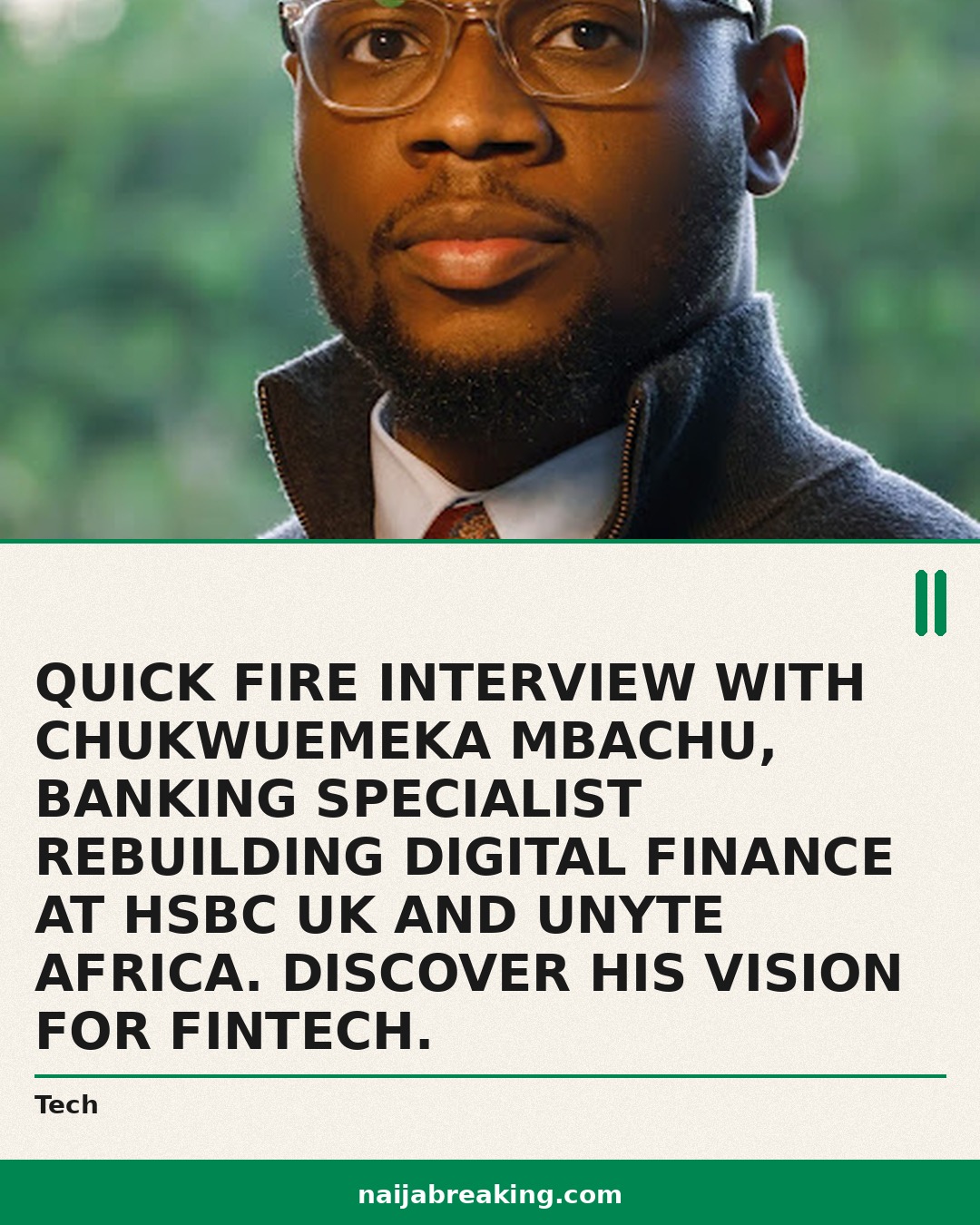
In an era where digital transformation is reshaping every industry, few sectors are experiencing as dramatic a shift as banking and financial services. At the forefront of this revolution stands Chukwuemeka Mbachu, an experienced banking specialist who believes that banking is no longer just evolving—it’s being completely rebuilt from the ground up. Through his dual roles at HSBC UK and Unyte Africa, Mbachu is driving innovation that’s transforming how millions of people across Africa and beyond experience financial services.
This Quick Fire interview with Chukwuemeka Mbachu reveals the insights of a professional who stands at the intersection of traditional banking expertise and cutting-edge financial technology. His unique perspective offers valuable lessons for anyone interested in understanding where the future of finance is heading, particularly in the African context where financial inclusion remains a critical challenge.
The Man Behind the Digital Banking Revolution
Chukwuemeka Mbachu’s career trajectory exemplifies the modern financial services professional—someone who understands both the foundational principles of traditional banking and the innovative potential of fintech solutions. His current role as Director at Unyte Africa places him at the center of one of the continent’s most ambitious insurance technology initiatives, while his position as Digital Expert at HSBC UK gives him firsthand experience with how established financial institutions are adapting to the digital age.
At Unyte Africa, Mbachu is spearheading efforts to revolutionize the insurance landscape across the continent. The platform he’s helping to build, Superpool, represents a fundamental shift in how insurance products are conceived, distributed, and consumed in Africa. By partnering with leading insurers including AXA Mansard, Leadway Assurance, and Heirs Holdings, Superpool is creating an ecosystem that simplifies the traditionally complex process of discovering, comparing, and purchasing insurance products.
This initiative is particularly significant given Africa’s insurance penetration rates, which remain among the lowest globally despite the continent’s growing economy and expanding middle class. According to recent industry reports, insurance penetration in sub-Saharan Africa averages just 2.8% of GDP, compared to the global average of 7.4%. Mbachu’s work at Unyte Africa directly addresses this gap by removing traditional barriers to insurance access.
Bridging Traditional Banking and Fintech Innovation
One of the most compelling aspects of Chukwuemeka Mbachu’s perspective is his balanced view of the relationship between traditional banks and fintech companies. Rather than seeing these as competing forces, he recognizes the complementary strengths each brings to the financial services ecosystem.
“Fintechs have mastered speed, user experience (UX), and access,” Mbachu observes. “But when things go wrong—accounts flagged, payments delayed, compliance checks triggered—customers don’t simply want a fast app. They need a system that can hold the pressure.”
This insight highlights a critical challenge in the fintech space that often gets overlooked amid the excitement about innovation. While fintech companies have excelled at creating user-friendly interfaces and streamlined processes, the robust risk management frameworks, regulatory compliance systems, and accountability mechanisms that traditional banks have spent decades developing remain essential components of a trustworthy financial system.
The Trust Infrastructure Challenge
Mbachu’s analysis goes deeper than surface-level comparisons between fintechs and traditional banks. He identifies what he calls the “backend of trust”—the complex infrastructure of risk management, regulatory alignment, and escalation procedures that ensure financial institutions can protect their customers’ money and interests when things go wrong.
“Fintechs are brilliantly rebuilding the front end of banking,” he explains. “The real challenge is rebuilding the backend of trust.” This observation is particularly relevant in the Nigerian and broader African context, where financial inclusion efforts must balance accessibility with security and reliability.
The challenge of building trust in digital financial services is especially acute in markets where many consumers are experiencing formal financial services for the first time. According to the Financial Inclusion Insights program, trust remains one of the primary barriers to digital financial service adoption across sub-Saharan Africa, alongside factors like affordability and digital literacy.
Transforming User Experience at Scale
At HSBC UK, Chukwuemeka Mbachu’s role as Digital Expert provides him with insights into how large, established financial institutions are navigating digital transformation. His mission is clear: making digital banking feel effortless while driving adoption across mobile and online platforms.
His approach to this challenge is rooted in a deep understanding of user psychology and behavior. Rather than simply digitizing existing processes, Mbachu focuses on fundamentally reimagining how customers interact with financial services. “I make digital journeys easier, so that when people use an app to manage their money, get insurance, or access any financial service, it actually feels like it was built for them,” he explains.
The Power of Simplification
One of the most instructive examples Mbachu shares involves addressing customer feedback about HSBC’s mobile application. Users consistently reported that the app appeared too complicated to navigate, leading to poor user experiences and negative reviews.
The solution, however, wasn’t to add more features or create more sophisticated interfaces. Instead, Mbachu and his team focused on breaking down complex processes into manageable stages that felt like progressive achievements rather than overwhelming obstacles.
“We redesigned the user journey to simplify usage, guiding them through the seemingly complex processes. Breaking the steps into stages that felt like they were unlocking wins kept the bad reviews away,” he explains. “Our customers felt like they were progressing rather than drowning.”
This approach reflects a sophisticated understanding of user experience design principles and behavioral psychology. By creating a sense of progression and achievement, the redesigned system transformed what had been a source of frustration into a more engaging and confidence-building experience.
The Philosophy Behind Financial Product Design
Chukwuemeka Mbachu’s philosophy extends beyond technical solutions to fundamental questions about how financial products should be designed and for whom they should be optimized. His perspective challenges common assumptions about why people struggle with financial management.
“Most people don’t fail with money because they’re irresponsible,” he argues. “They fail because the products built to help them were never really built for them.” This insight drives his work across both of his current roles, whether he’s redesigning digital banking experiences at HSBC or developing insurance platforms at Unyte Africa.
This human-centered approach to financial services design is particularly relevant in the African context, where traditional financial products have often failed to meet the needs of diverse populations with varying income levels, financial literacy levels, and life circumstances. The World Bank’s financial inclusion data shows that while significant progress has been made in expanding access to financial services across Africa, usage and engagement with these services remain challenges that require more thoughtful product design.
Building Financial Confidence, Not Just Access
Perhaps the most forward-thinking aspect of Mbachu’s vision is his focus on financial confidence rather than mere access. While much of the conversation around financial inclusion has centered on getting more people connected to formal financial services, Mbachu argues that the real measure of success should be whether these services give people greater confidence to take control of their financial lives.
“The future of finance will not be defined by access alone, but by the confidence it gives people to take control of their financial lives,” he states. This shift from access to empowerment represents a maturation in thinking about financial inclusion that could have profound implications for how financial products are designed and delivered across Africa.
The Insurance Revolution in Africa
Through his work at Unyte Africa, Chukwuemeka Mbachu is tackling one of the most underserved areas of African financial services: insurance. The Superpool platform represents an ambitious attempt to address the structural barriers that have kept insurance penetration low across the continent.
Traditional insurance distribution in Africa has relied heavily on agent-based models that often struggle with issues of cost, scalability, and customer education. By creating a digital platform that allows customers to discover, compare, and purchase insurance products directly, Superpool is potentially disrupting these traditional models while making insurance more accessible to a broader population.
The partnerships with established insurers like AXA Mansard, Leadway Assurance, and Heirs Holdings suggest a collaborative rather than disruptive approach to market transformation. Rather than trying to replace existing insurers, Superpool appears to be focused on creating better distribution and customer experience infrastructure that benefits the entire ecosystem.
Lessons for Nigeria’s Fintech Ecosystem
Chukwuemeka Mbachu’s insights offer valuable lessons for Nigeria’s rapidly growing fintech ecosystem. His emphasis on building trust infrastructure alongside user experience improvements suggests that sustainable success in financial services requires more than just attractive interfaces and fast processing times.
The Nigerian fintech sector has experienced tremendous growth in recent years, with companies like Flutterwave, Paystack, and Kuda gaining international recognition and significant investment. However, as the sector matures, the challenges Mbachu identifies—particularly around building robust risk management and accountability systems—are becoming increasingly relevant.
His balanced perspective on the relationship between fintechs and traditional banks also offers a roadmap for more collaborative approaches to financial services innovation. Rather than viewing digitization as a zero-sum competition between new and established players, there may be opportunities for partnerships that combine the innovation and agility of fintechs with the risk management expertise and regulatory compliance capabilities of traditional financial institutions.
The Future of African Financial Services
Looking ahead, Chukwuemeka Mbachu’s work at both HSBC UK and Unyte Africa positions him to influence the future direction of financial services across Africa and globally. His focus on building confidence rather than just access suggests a more mature approach to financial inclusion that could help address some of the persistent challenges in African financial markets.
The insurance focus at Unyte Africa is particularly strategic given the continent’s exposure to climate change, economic volatility, and health challenges that make risk mitigation products increasingly important. By making insurance more accessible and understandable, platforms like Superpool could play a crucial role in building economic resilience across African communities.
Meanwhile, his experience with digital transformation at a major international bank like HSBC provides insights that could be valuable for other established financial institutions looking to modernize their operations and improve customer experiences.
Conclusion: A Vision for Inclusive Financial Innovation
This Quick Fire interview with Chukwuemeka Mbachu reveals a thoughtful practitioner who understands both the promise and the challenges of financial services transformation. His dual focus on user experience and trust infrastructure, combined with his commitment to building products that genuinely serve users’ needs, offers a roadmap for more inclusive and sustainable financial innovation.
As Africa’s financial services sector continues to evolve, professionals like Mbachu who can bridge the worlds of traditional banking and fintech innovation will play crucial roles in shaping outcomes. His emphasis on building confidence rather than just access represents an important evolution in thinking about financial inclusion that could have lasting impact across the continent.
The work being done at both HSBC UK and Unyte Africa demonstrates that meaningful financial services innovation requires both technological sophistication and deep understanding of human behavior and needs. As the sector continues to mature, these insights will likely become even more valuable for anyone working to build financial products that truly serve African consumers.
What are your thoughts on the future of digital banking and insurance in Africa? Share your perspectives in the comments below and join the conversation about how technology can better serve financial inclusion across the continent.
Source: TechCabal – Quick Fire 🔥 with Chukwuemeka Mbachu by Opeyemi Kareem